

Members of China's 43rd Antarctic scientific expedition team aboard the icebreaker Xuelong 2 are pictured before their departure from Nanshan Port in Sanya, south China's Hainan Province, Nov. 7, 2026. (Xinhua/Guo Cheng)
SANYA, Nov. 7 (Xinhua) -- China held a departure ceremony in Sanya, south China's Hainan Province, on Saturday to mark the start of its 43rd Antarctic scientific expedition.
Organized by the Ministry of Natural Resources, the mission will upgrade China's polar research stations and logistics network and carry out comprehensive multidisciplinary surveys and monitoring in Antarctica. It will also pursue priority research at the frontiers of polar science, test and apply domestically developed equipment, and deepen bilateral and multilateral cooperation in science and logistics support.
The expedition is supported by the icebreakers Xuelong and Xuelong 2, along with another vessel. More than 600 team members from over 100 domestic institutions are participating, and the team is expected to return to China in April 2027 after completing its tasks. ■
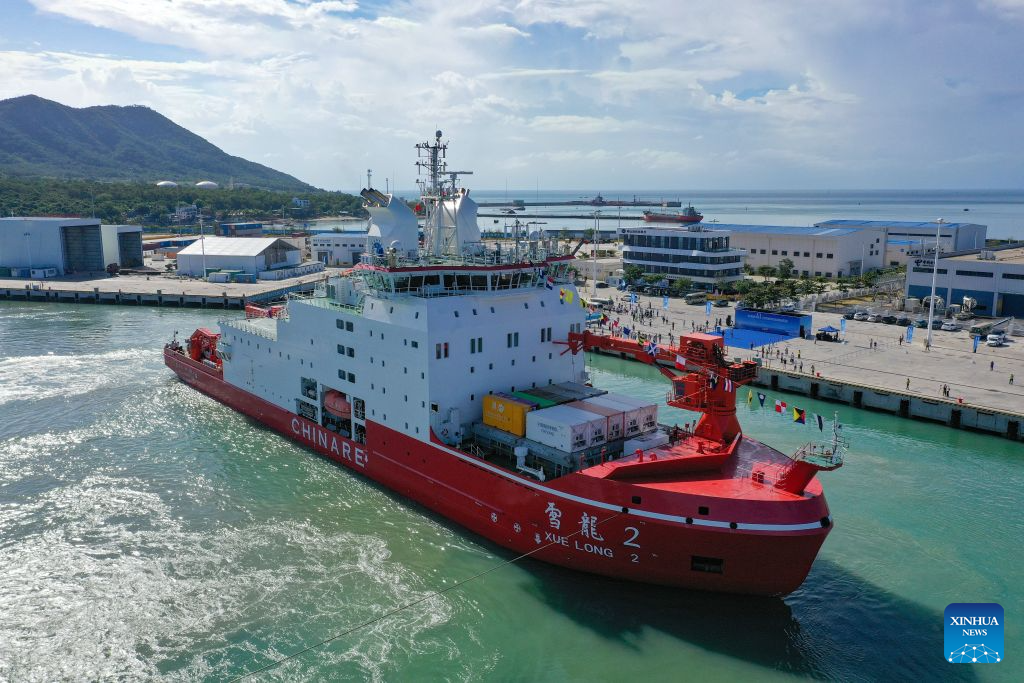
An aerial drone photo shows China's icebreaker Xuelong 2 departing from Nanshan Port in Sanya, south China's Hainan Province, Nov. 7, 2026.
China held a departure ceremony in Sanya on Saturday to mark the start of its 43rd Antarctic scientific expedition.
Organized by the Ministry of Natural Resources, the mission will upgrade China's polar research stations and logistics network and carry out comprehensive multidisciplinary surveys and monitoring in Antarctica. It will also pursue priority research at the frontiers of polar science, test and apply domestically developed equipment, and deepen bilateral and multilateral cooperation in science and logistics support.
The expedition is supported by the icebreakers Xuelong and Xuelong 2, along with another vessel. More than 600 team members from over 100 domestic institutions are participating, and the team is expected to return to China in April 2027 after completing its tasks. (Xinhua/Guo Cheng)

An aerial drone photo shows China's icebreaker Xuelong 2 departing from Nanshan Port in Sanya, south China's Hainan Province, Nov. 7, 2026.
China held a departure ceremony in Sanya on Saturday to mark the start of its 43rd Antarctic scientific expedition.
Organized by the Ministry of Natural Resources, the mission will upgrade China's polar research stations and logistics network and carry out comprehensive multidisciplinary surveys and monitoring in Antarctica. It will also pursue priority research at the frontiers of polar science, test and apply domestically developed equipment, and deepen bilateral and multilateral cooperation in science and logistics support.
The expedition is supported by the icebreakers Xuelong and Xuelong 2, along with another vessel. More than 600 team members from over 100 domestic institutions are participating, and the team is expected to return to China in April 2027 after completing its tasks. (Xinhua/Guo Cheng)

Members of China's 43rd Antarctic scientific expedition team board the icebreaker Xuelong 2 at Nanshan Port in Sanya, south China's Hainan Province, Nov. 7, 2026.
China held a departure ceremony in Sanya on Saturday to mark the start of its 43rd Antarctic scientific expedition.
Organized by the Ministry of Natural Resources, the mission will upgrade China's polar research stations and logistics network and carry out comprehensive multidisciplinary surveys and monitoring in Antarctica. It will also pursue priority research at the frontiers of polar science, test and apply domestically developed equipment, and deepen bilateral and multilateral cooperation in science and logistics support.
The expedition is supported by the icebreakers Xuelong and Xuelong 2, along with another vessel. More than 600 team members from over 100 domestic institutions are participating, and the team is expected to return to China in April 2027 after completing its tasks. (Xinhua/Guo Cheng)

An aerial drone photo shows China's icebreaker Xuelong 2 before departure from Nanshan Port in Sanya, south China's Hainan Province, Nov. 7, 2026.
China held a departure ceremony in Sanya on Saturday to mark the start of its 43rd Antarctic scientific expedition.
Organized by the Ministry of Natural Resources, the mission will upgrade China's polar research stations and logistics network and carry out comprehensive multidisciplinary surveys and monitoring in Antarctica. It will also pursue priority research at the frontiers of polar science, test and apply domestically developed equipment, and deepen bilateral and multilateral cooperation in science and logistics support.
The expedition is supported by the icebreakers Xuelong and Xuelong 2, along with another vessel. More than 600 team members from over 100 domestic institutions are participating, and the team is expected to return to China in April 2027 after completing its tasks. (Xinhua/Guo Cheng)

An aerial drone photo shows China's icebreaker Xuelong 2 departing from Nanshan Port in Sanya, south China's Hainan Province, Nov. 7, 2026.
China held a departure ceremony in Sanya on Saturday to mark the start of its 43rd Antarctic scientific expedition.
Organized by the Ministry of Natural Resources, the mission will upgrade China's polar research stations and logistics network and carry out comprehensive multidisciplinary surveys and monitoring in Antarctica. It will also pursue priority research at the frontiers of polar science, test and apply domestically developed equipment, and deepen bilateral and multilateral cooperation in science and logistics support.
The expedition is supported by the icebreakers Xuelong and Xuelong 2, along with another vessel. More than 600 team members from over 100 domestic institutions are participating, and the team is expected to return to China in April 2027 after completing its tasks. (Xinhua/Guo Cheng)

Members of the Chinese Young Pioneers salute the 43rd Antarctic scientific expedition team during a departure ceremony at Nanshan Port in Sanya, south China's Hainan Province, Nov. 7, 2026.
China held a departure ceremony in Sanya on Saturday to mark the start of its 43rd Antarctic scientific expedition.
Organized by the Ministry of Natural Resources, the mission will upgrade China's polar research stations and logistics network and carry out comprehensive multidisciplinary surveys and monitoring in Antarctica. It will also pursue priority research at the frontiers of polar science, test and apply domestically developed equipment, and deepen bilateral and multilateral cooperation in science and logistics support.
The expedition is supported by the icebreakers Xuelong and Xuelong 2, along with another vessel. More than 600 team members from over 100 domestic institutions are participating, and the team is expected to return to China in April 2027 after completing its tasks. (Xinhua/Guo Cheng)


