
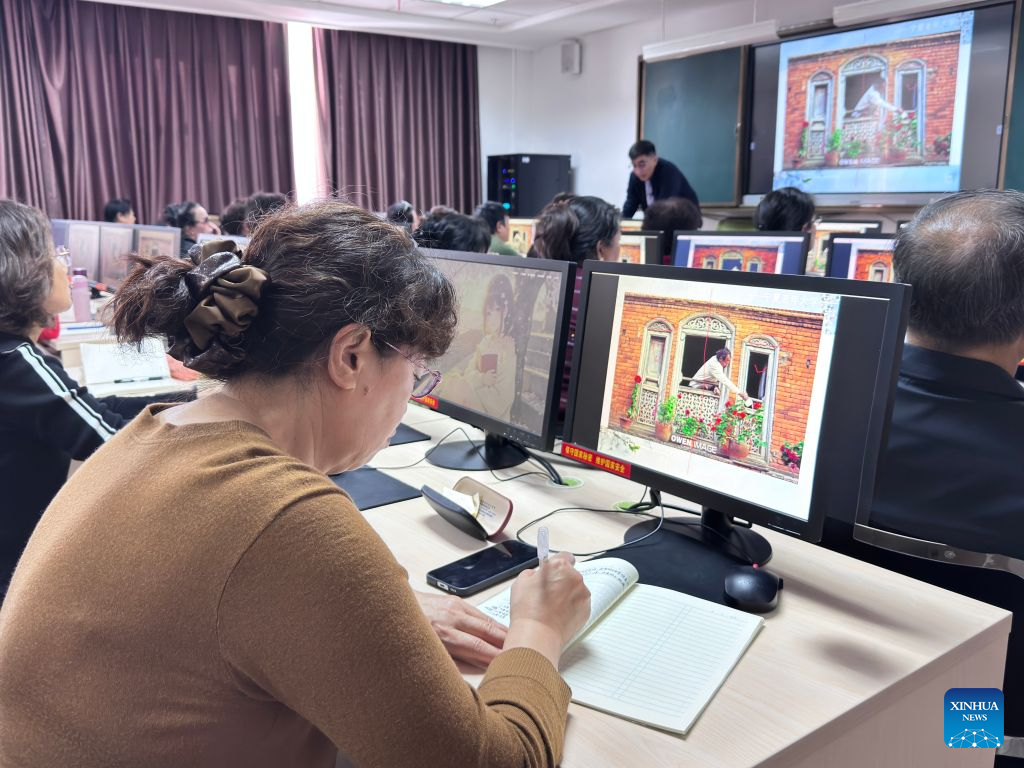
This undated photo shows the elderly taking a short video production class at Ningxia University for the Elderly in Yinchuan, northwest China's Ningxia Hui Autonomous Region. (Xinhua)
BEIJING, Nov. 3 (Xinhua) -- Zhao Minghui, 71, took notes of the tutor's guidance with a pen, listing how to use artificial intelligence (AI) applications on her smartphone.
"We may be getting older, but we still want to keep up with the times," said Zhao after the class at Ningxia University for the Elderly in northwest China.
Zhao used to ask her children for help with her smartphone. After enrolling in the university's classes, she learned to send WeChat messages, make mobile payments, book tickets and medical appointments, and edit short videos, all on her smartphone.
This year, she registered for the AI course.
Instructor Yu Cheng recalled that roughly 60 to 70 percent of his students could not use smartphones back in 2019 when he started teaching there. Today, he rarely encounters such students.
"Type in a sentence, and it can generate text or pictures," said the amazed Zhao, who now uses AI for answering questions and even chatting when she feels bored.
Across China, universities for the elderly are offering AI, video production and drone photography courses, helping retirees handle everyday tasks more easily, keep in touch with family or simply try something new.
China had more than 323 million people aged 60 and above by 2025, accounting for 23 percent of its population. However, only 53.7 percent of that age group were internet users, compared with a national internet penetration rate of 80.1 percent, official figures showed.
Wang Weiyu, 69, is among those applying new skills for creation in eastern China's Shandong Province.
At Qingdao University for the Elderly, instructor Ji Pengcheng mirrored his smartphone screen onto a large display, showing about a dozen students how to edit videos. When someone struggled with an operation, he walked over to help.
Wang enrolled in the class earlier this year. In six months, she has learned to use editing software, camera techniques and video templates.
"Whenever I share a self-made video clip in my family WeChat group, the children always give me a thumbs-up," she said, smiling.
Such enthusiasm among learners has fueled surging demand for tech courses at universities for the elderly nationwide.
In 2025, all 60 places in a DeepSeek AI course at a university for the elderly in Guangzhou were snapped up within tens of seconds upon registration. In Shanghai, the university for the elderly has enrolled students even in their 80s on drone photography courses, which were launched in 2022.
At Ningxia University for the Elderly, more than 3,600 people have registered for technology courses, covering AI applications, video production, smart home technology and e-commerce.
"Many courses fill up within minutes of registration opening," said Liu Rui, deputy director of the university's service center.
China's 15th Five-Year Plan (2026-2030) calls for expanding educational opportunities for older people and developing more universities for the elderly to meet their cultural and intellectual needs.
For many participants, the appeal goes beyond learning new practical skills, with classes also providing opportunities for personal growth and social interaction.
"Learning these new skills has made my retirement more fulfilling," said Xu Zonggang, a 70-year-old in Qingdao, who is planning his next trip with classmates. ■
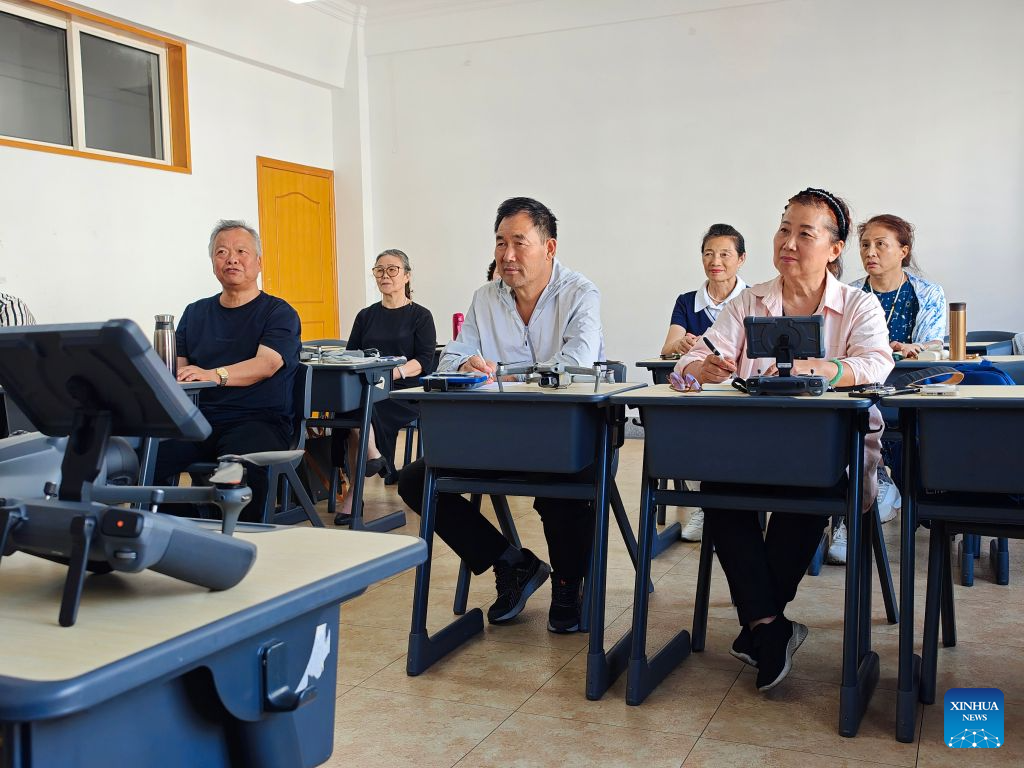
The elderly learn the use of drones at a university for the elderly in Qingdao, east China's Shandong Province, Sept. 23, 2026. (Xinhua/Li Aoqiu)


