
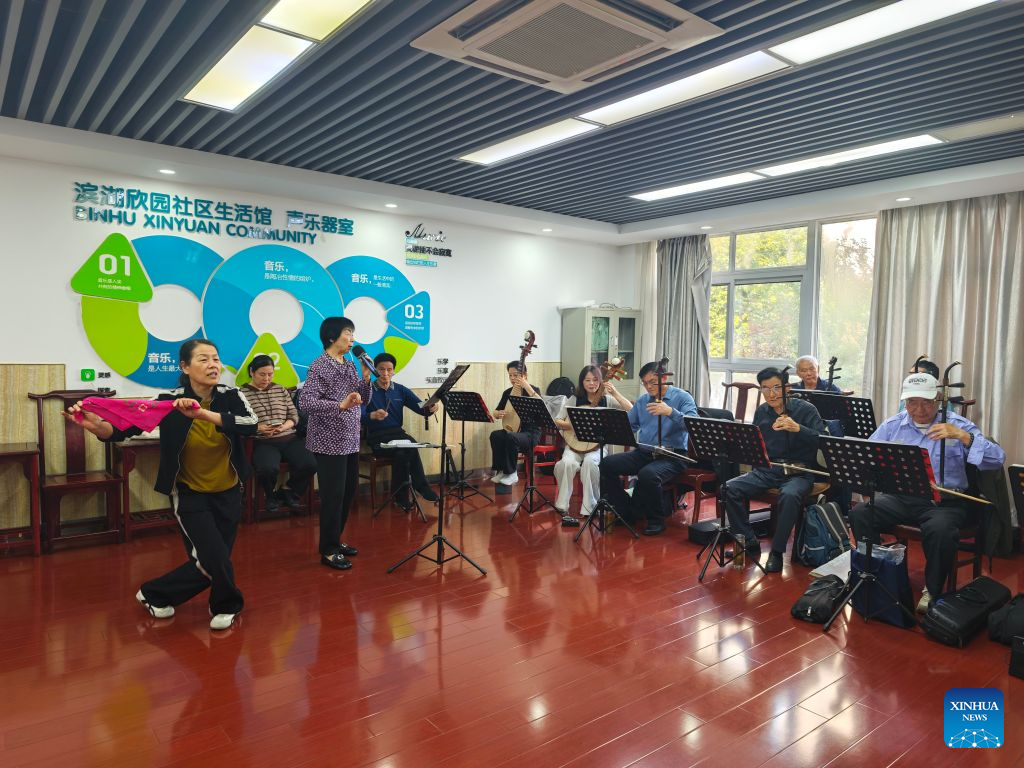
The elderly learn opera at a community in Baohe District of Hefei, east China's Anhui Province, Oct. 9, 2026. (Xinhua/Guo Chen)
HEFEI, Oct. 24 (Xinhua) -- While his family set out for holiday adventures earlier this month, Wang Libing, 74, chose to stay behind as a persistent leg ailment made walking tough. But he was determined not to spend the holiday alone at home.
He checked into a care center, where he was looked after by caregivers and could socialize with other older residents in Xinyuan community in Hefei, capital of eastern Anhui Province.
"I fear loneliness more than anything else," Wang said. His children are busy with work and his wife sometimes goes back to her hometown to care for her mother.
Wang has used the center for short stays each year since 2017, enjoying the companionship and meals planned by professional dietitians.
Families can bring their elders to the center for a short-term stay when they are away for work or travel, said Feng Jinjin, Party chief of Xinyuan community.
Each eligible elderly resident is entitled to 15 days of free care per quarter and unused days can be accumulated for a stay of up to two months at a time, Feng said.
Xinyuan, a residential area of high-rise apartment buildings, has about 26,000 permanent residents. People aged 60 and over account for 30 percent of the population, including 352 aged 80 and above.
Wang's experience reflects efforts across China to meet the needs of an aging population through short-term community elderly care, health services and volunteer support.
Community service centers in Hefei provide a range of activities and basic health services. In the mornings, teachers from seniors' universities offer free classes, and medical workers conduct basic checks such as blood pressure and blood glucose measurements.
Community canteens serve nutritionally tailored meals at noon, with home delivery for those with limited mobility. Afternoons feature performances and sports activities.
"Our goal is to ensure that the elderly are looked after properly, have access to medical care, and can enjoy their later years," Feng said.
Two floors of the four-story Xinyuan community service center are dedicated to elderly care, and the center also offers 27 courses for elders, including dance, fine arts, table tennis and choir.
Communities in Hefei are also adopting simple ways to check on elderly people living alone.
At Binhu Shiji community, seniors switch on red balcony light bulbs between 7 p.m. and 9 p.m. and turn them off before bed. If a light is not switched on or off as scheduled, volunteers will come to check on their situation, said Lang Ping, a community official.
Similar arrangements in Taiyuan, capital of Shanxi Province, and Qinhuangdao in Hebei Province, both in northern China, use balcony lights or curtains as signals to help confirm residents are safe.
Volunteers also help elderly residents with daily chores. Ma Menglan, 86, lives alone in Xinyuan community, where Ye Qinghua, a 64-year-old community social worker, and other volunteers regularly visit to clean Ma's home and wash clothes.
"I retired not long ago and am in good health, so I wanted to do some volunteer work to help other much older people," Ye said.
Two years ago, Ye joined a community initiative pairing younger seniors with older residents who live alone.
The program helps ease pressure on community services. Xinyuan's service center has only about a dozen staff members and social workers, making it hard to meet growing demand, Feng said.
The community now has more than 10 small teams of social workers pairing with younger seniors to support community elderly care. Feng said the community hopes to attract more young people and students in the future.
Elsewhere in China, other cities are developing services tailored to local needs. In Ningbo, Zhejiang Province, in China's eastern coastal region, programs offer free help with medical appointments, medicine collection, health follow-ups, and household tasks. In Xi'an, capital of northwestern Shaanxi Province, retired residents with specialized skills volunteer as teachers for the elderly.
Researchers are also exploring ways to make residential areas safer for aging residents.
Li Lianjun, a research associate professor at the School of Public Policy and Management at the University of Science and Technology of China, is leading a study on fall-risk perception and prevention behavior among older adults. She hopes the findings will help improve age-friendly renovations.
"China has a huge elderly population with diverse care needs. This poses new challenges for grassroots public services while also testing the sophistication of grassroots governance," Li said.
Official data shows that China's population aged 60 and above exceeded 323 million by the end of 2025, accounting for about 23 percent of the country's total population.
Meeting those needs requires government support, professional services, and help from residents, volunteers, and researchers, which can make community-based care more targeted, diverse, and sustainable, Li said. ■
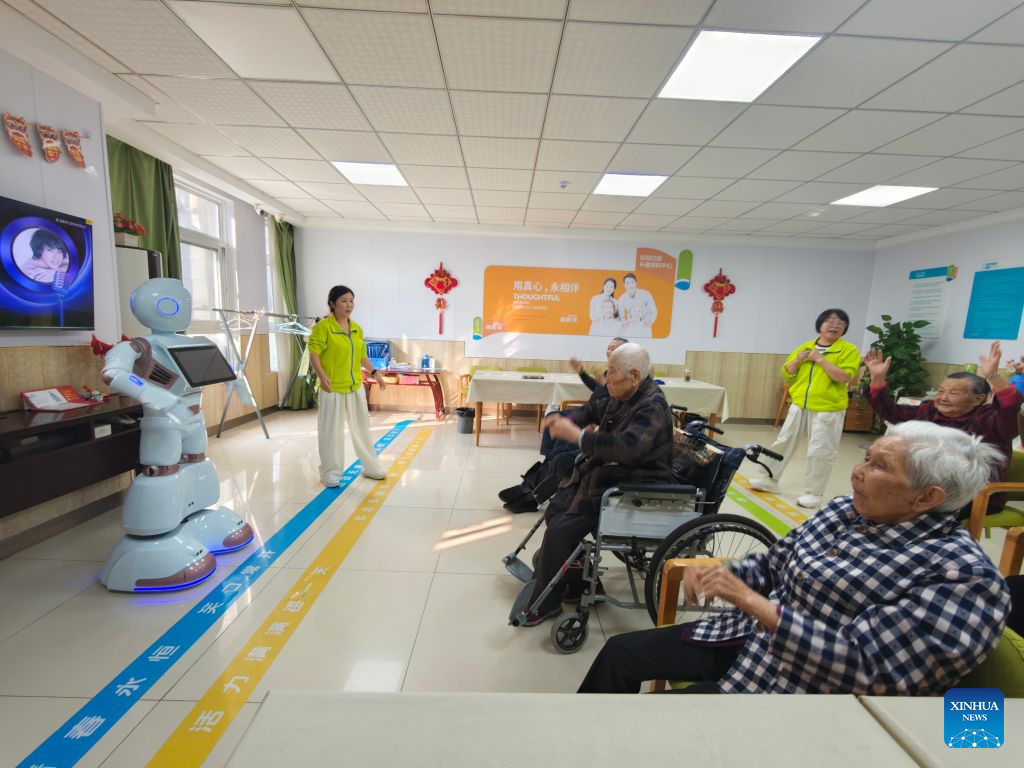
The elderly interact with an elderly care robot at a community in Baohe District of Hefei, east China's Anhui Province, Oct. 9, 2026. (Xinhua/Guo Chen)


