
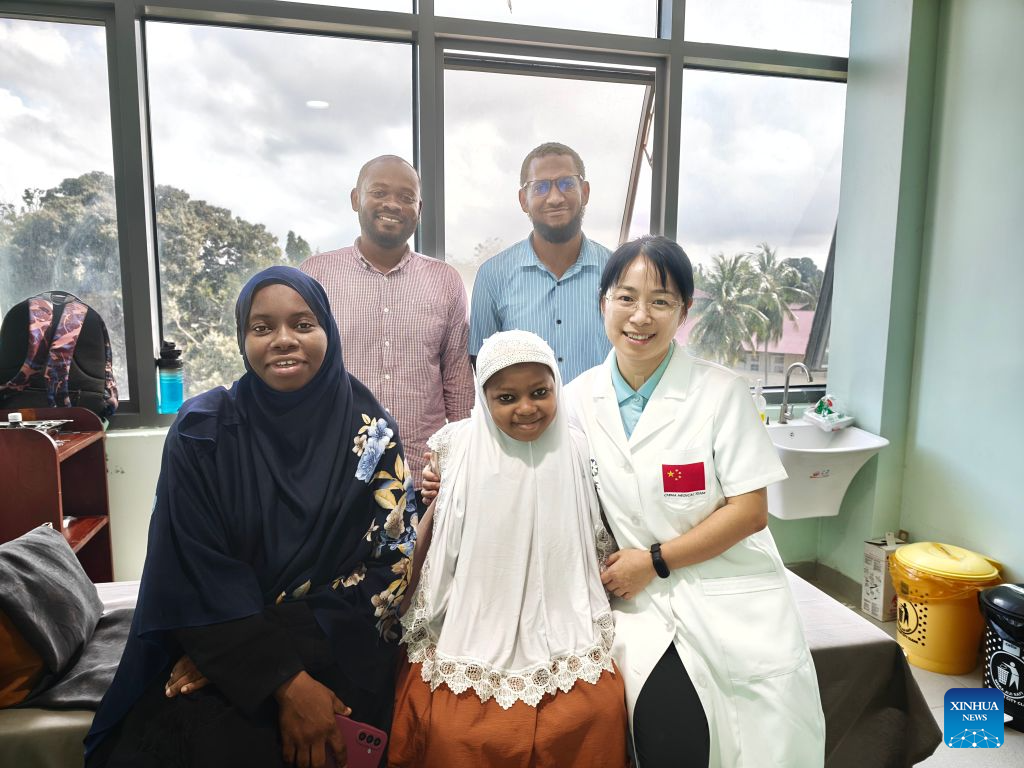
This photo taken with a mobile phone shows Ashfaina Omari Ali (C, front) posing for photos with Li Li (1st R, front), a doctor from the 35th Chinese medical team in Zanzibar, during a follow-up visit before returning to school in Zanzibar, Tanzania, on Sept. 7, 2026. (The 35th Chinese Medical Team in Zanzibar/Handout via Xinhua)
ZANZIBAR, Tanzania, Sept. 16 (Xinhua) -- On Tuesday morning, nine-and-half-year-old Ashfaina Omari Ali walked into Sebleni Primary School on Zanzibar's Unguja Island with renewed confidence.
For Ashfaina, returning to school was more than the start of another school day. It was a sign that life was finally returning to normal after a severe ear disease had threatened her health and disrupted her education.
Her father, Omari Ali Omari, a mason living in Sebleni, told Xinhua that he once feared his daughter might never again enjoy the ordinary life of a child her age.
Now, Omari's fear has vanished.
Ashfaina's recovery followed a complex operation at Lumumba Regional Hospital in Zanzibar, performed by a Chinese medical team led by Li Li, a doctor from the 35th Chinese medical team in Zanzibar.
The nine-year-old had suffered recurrent fever and seizures for several days. She initially received conservative anti-inflammatory treatment at a local medical facility, but her condition worsened.
When she was referred to Lumumba Regional Hospital, Li and her team conducted imaging examinations and diagnosed congenital middle ear cholesteatoma, a serious condition involving abnormal skin growth in the middle ear.
"The disease had caused extensive damage; the combination of intracranial and extracranial complications made the case particularly dangerous," Li explained.
Ashfaina continued to suffer from a high fever. If left unchecked, it could be life-threatening.
After a series of preoperative preparations and detailed discussions with Ashfaina's family, the team carefully assessed the risk and formulated a tailored treatment plan before proceeding with the surgery.
The operation lasted four hours. It eliminated the sources of infection and ultimately reduced the risk of the disease spreading into the skull and bloodstream.
The surgery was a success. Ashfaina made a full recovery and was eventually discharged from the hospital.
For her father, however, the most important measure of success was not found in a medical report or operating theatre. It was seeing his daughter prepare for school again after taking some time off at home to rest.
The journey from a seriously ill child facing a potentially life-threatening condition to a schoolgirl walking confidently into her classroom illustrates the human impact of specialized medical care.
According to the Chinese medical team, the successful treatment of Ashfaina's condition filled an important local gap in the diagnosis and treatment of complex severe ear diseases.
But the team's mission extends far beyond treating individual patients. Ashfaina's case was also an important learning experience for local healthcare professionals.
Bao Zengtao, the leader of the 35th Chinese medical team in Zanzibar, said that since arriving in Zanzibar, the team has emphasized transferring medical knowledge, skills and technology to local health workers to strengthen Zanzibar's long-term healthcare capacity.
For families such as Ashfaina's, such cooperation is ultimately measured in deeply personal moments: a child recovering from serious illness, a parent regaining hope.
"I don't have the words to thank the Chinese doctors," Omari said. "They have rekindled the life of my daughter." ■
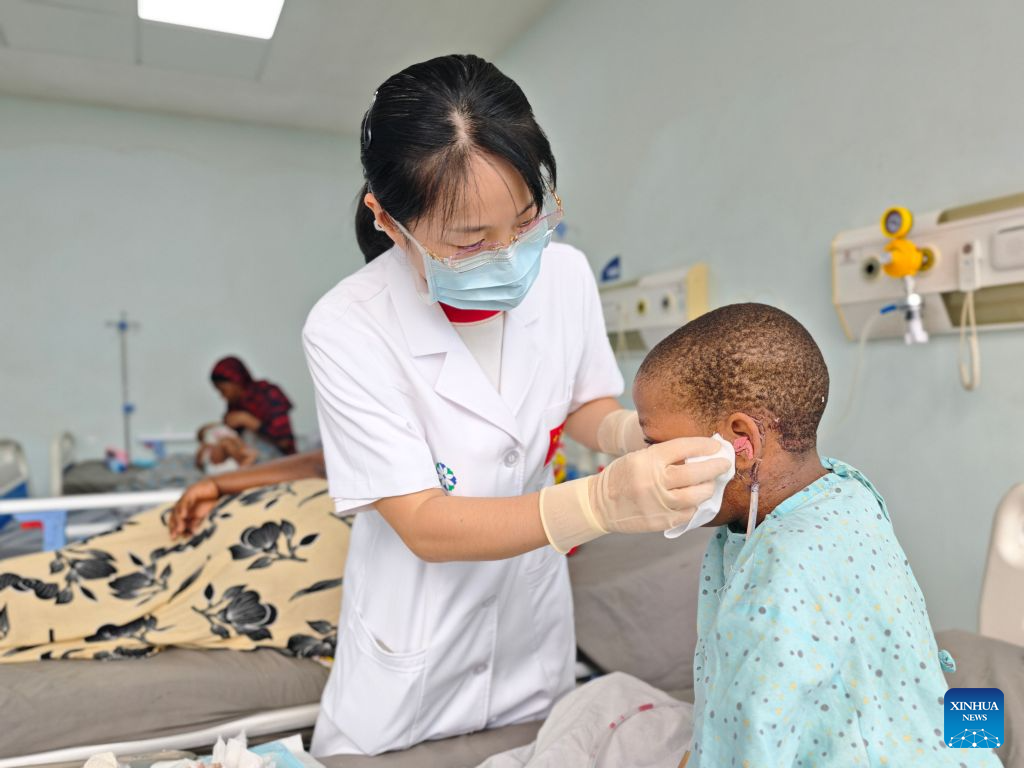
This photo taken with a mobile phone shows Li Li, a doctor from the 35th Chinese medical team in Zanzibar, changing dressings for Ashfaina Omari Ali in a ward in Zanzibar, Tanzania, on Aug. 4, 2026. (The 35th Chinese Medical Team in Zanzibar/Handout via Xinhua)


