
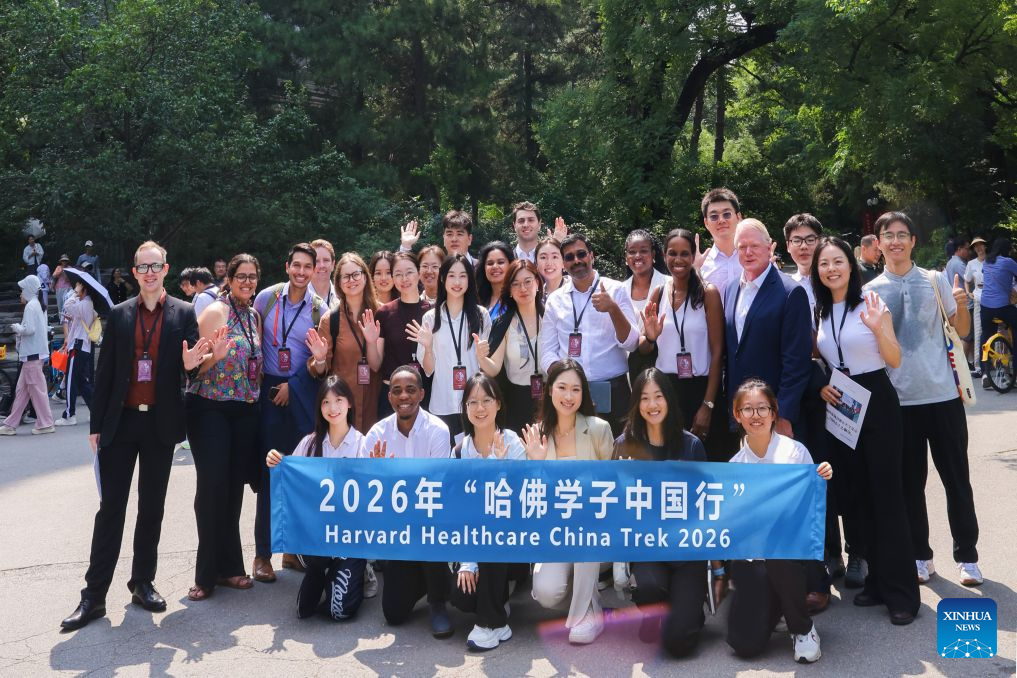
Members of the exchange program "Harvard Healthcare China Trek 2026" pose for photos while visiting Peking University in Beijing, capital of China, Aug. 19, 2026. (Xinhua)
BEIJING, Aug. 26 (Xinhua) -- China can set an example for the world in confronting demographic change, a U.S. public health scholar said, as a 25-member American delegation tours the country to learn from its healthcare reform, biotech innovation and artificial intelligence application.
David Crumpacker, assistant professor at Texas A&M University and a master of public health graduate from Harvard T.H. Chan School of Public Health, stressed the importance of learning from Chinese experience, such as primary care infrastructure, and efforts to manage the intersection of economic development with population health.
"These are insights that are not fully reflected in global health literature. We want to understand those insights from the people who generate them," he said.
The delegation, comprising scholars, medical professionals and students from Harvard University and other leading U.S. institutions, has been in China since Aug. 16.
They have visited the National Healthcare Security Administration and a national artificial intelligence medical pilot base in Beijing, as well as hospitals in Shanghai. They are also scheduled to tour health companies in Shenzhen, a global tech hub in southern Guangdong Province, and the Boao Lecheng International Medical Tourism Pilot Zone -- the country's sole medical special zone -- in Hainan Province.
China is racing to upgrade its healthcare system to meet the needs of an aging society. With more than 300 million people aged 60 and above, it has the largest elderly population of any country in the world.
By the end of 2025, the national basic medical insurance program covered 1.331 billion people, with the participation rate remaining stable at over 95 percent.
"Over one billion people means over one billion patients," said Jennifer Miles-Thomas, vice chair of integration and innovation at Northwestern Medicine in Chicago.
She said China and the United States are "very aligned" in the goal of delivering the highest quality care, but the U.S. faces challenges with expensive healthcare and incomplete insurance coverage. "I'm here to observe and to receive information and ideas about what we can do better," she said.
The exchange program, "Harvard Healthcare China Trek 2026," is hosted by the China Center for International People-to-People Exchange under the Ministry of Education, with support from Peking University Health Science Center and Fudan University Shanghai Medical College. It is part of a broader initiative to invite 50,000 young Americans to China over five years for study, research and dialogue.
During a visit to the BioPark in Beijing, Khaoula Belahsen, a 28-year-old master's student at Harvard T.H. Chan School of Public Health and an AI researcher at Harvard Medical School, was impressed by the scale and speed of the pharmaceutical and biotechnology hub. First announced in October 2025, the BioPark has drawn nearly 5,000 medical and healthcare companies, including global leaders Eli Lilly, Pfizer, Bayer, AstraZeneca and Medtronic.
"I've always dreamed of coming to China. The country has so much history, but also so much progress economically and scientifically," Belahsen said.
Morgan Moncada, 35, a Harvard graduate and founder of an AI digital health company, said strong incentives exist for medical companies to engage with the Chinese market, citing lower costs and vast reach. "China is open to collaboration, and that is really exciting," he said.
China is pushing artificial intelligence deeper into healthcare, with a roadmap to bring AI-assisted diagnosis to all primary-care clinics by 2030. Major hospitals are already using AI for imaging analysis and treatment planning.
Noting that his company uses AI agents to help people manage chronic diseases such as sleep apnea and diabetes, Moncada expressed his hope to introduce the technology they're building in the U.S. to China and adapt it for the Chinese population.
"I think something that we're really interested in is how we can contribute to China's healthcare system and how we can learn from China's healthcare system to improve healthcare in the United States and other countries around the globe," Moncada added.
In the Boao Lecheng pilot zone, patients can access innovative drugs and medical devices not yet approved on the mainland -- a policy that has benefited nearly 280,000 people and spared many costly overseas medical trips. The zone also uses real-world patient data to accelerate regulatory approvals, helping more products reach the wider Chinese market faster.
"We're very interested in seeing how this special zone actually helps, and how all those incredible medical technologies take effect," said Ze'ev Drukker, a 26-year-old bioengineering graduate from Tufts University who is applying for a master's program at Tsinghua University in Beijing.
As the delegation explores China's healthcare landscape, they are also building bridges of understanding between the younger generation of U.S. and Chinese health professionals, paving the way for joint efforts to advance global public health.
"What I like about healthcare is that it's something shared between all people, and across all countries. We all face the same challenges, and all want to integrate innovation to save people's lives and reduce burdens," Belahsen said. "It's really inspiring to come to China and see what innovation looks like here." ■


