
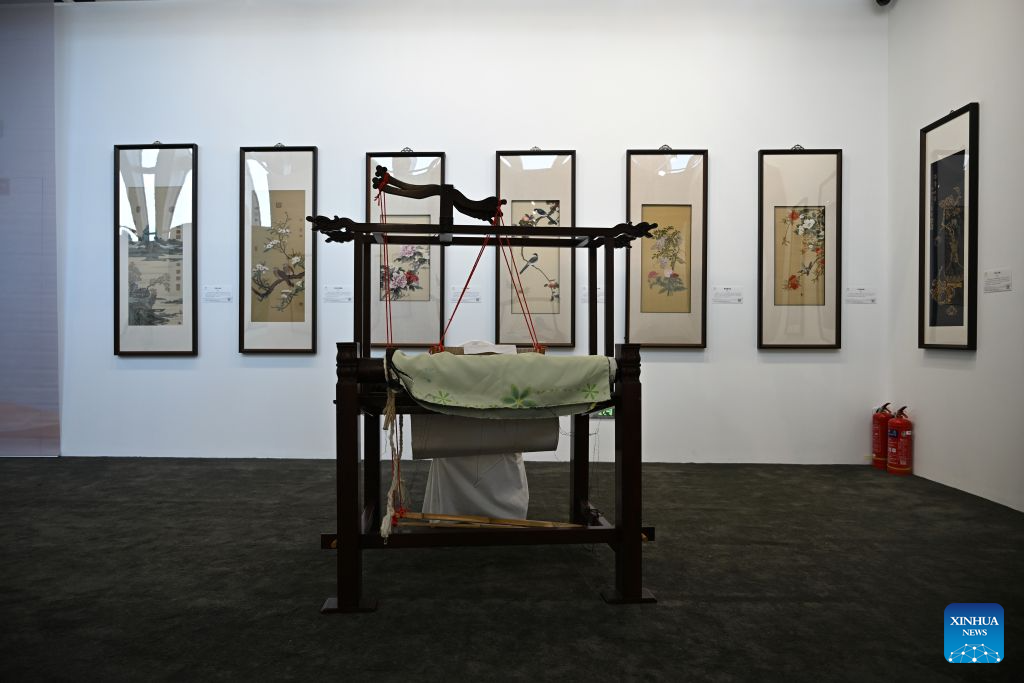
An exhibition of the Innovative and Inherited Works of Chinese Brocade Craftsmanship in the New Century is held at the Xinhua News Agency Art Museum in Beijing, capital of China, Aug. 19, 2026. The exhibition runs from Aug. 19 to Sept. 17. (Xinhua)
BEIJING, Aug. 25 (Xinhua) -- Vincent van Gogh's iconic painting "Irises" has found an unexpected new canvas -- a traditional Chinese Qipao dress woven in brocade.
The fabric's intricate weave renders the painting's brushstrokes. Deep blue petals sweep upward from the hem, interlaced with lush green leaves, while green trim and knotted buttons at the collar echo the flowers' hues.
The dress is among more than 130 works on display at the Touring Exhibition of the Innovative and Inherited Works of Chinese Brocade Craftsmanship in the New Century. The Beijing leg of the exhibition, held at the Xinhua News Agency Art Museum, runs from Aug. 19 to Sept. 17.
The exhibition showcases the expanding scope of artistic expression and innovation in contemporary Chinese brocade through a wide range of works, including a brocade painting that uses modern weaving techniques to recreate the texture of oil painting, a piece featuring a giant panda, and a wall hanging rich in ethnic Zhuang character.
Brocade originated in China and is regarded as one of the most sophisticated forms of silk craftsmanship. Over more than 2,000 years, different regions of China have developed distinctive brocade traditions, including Shujin, Songjin, Yunjin and Zhuangjin. In 2009, the Craftsmanship of Nanjing Yunjin brocade was inscribed on the UNESCO Intangible Cultural Heritage List.
"Brocade reflects the artistic creativity and wisdom of our ancestors," said Li Jialin, curator of the exhibition and director of the research center for silk and fashion culture at Zhejiang Sci-Tech University.
For Li, keeping the ancient craft alive means more than preserving tradition. It also means drawing on the past to "create something new" -- a message he hopes the exhibition will convey.
At the heart of this transformation are ongoing breakthroughs in interweaving warp and weft threads.
In the past, brocade patterns were woven with colored warp and weft threads, but limitations in the weaving process restricted the palette to no more than a dozen colors.
Today, with advanced digital technology, more than 4,500 colors can be reproduced in brocade, allowing silk threads to capture subtler variations in hue, light and shadow and opening up new possibilities for artistic expression.
According to Li, brocade can now reach a warp density of 113 threads per centimeter and a weft density of 205 threads per centimeter, with more than 300 warp and weft threads intersecting within each square centimeter of fabric.
Meanwhile, digital platforms are helping preserve, document and share traditional patterns and techniques more systematically. Generative artificial intelligence is also giving designers greater freedom to explore new themes and forms of expression.
One abstract piece caught the attention of visitor Tao Xiaodong. It uses weaving structures of varying densities and thread types to create a naturally textured, three-dimensional surface.
"It could be a rock, bubbles or anything you imagine," Tao said while discussing the piece with a friend. For him, that openness to interpretation is part of its appeal, showing how brocade can move beyond traditional motifs and take on a freer, more contemporary form.
Li said the evolution of brocade craftsmanship has always gone hand in hand with advances in tools, technology and materials, much like a relay carried forward through the generations.
"The history of brocade offers a glimpse into the development of human civilization," he said. "What we are doing today is taking our turn in that relay." ■
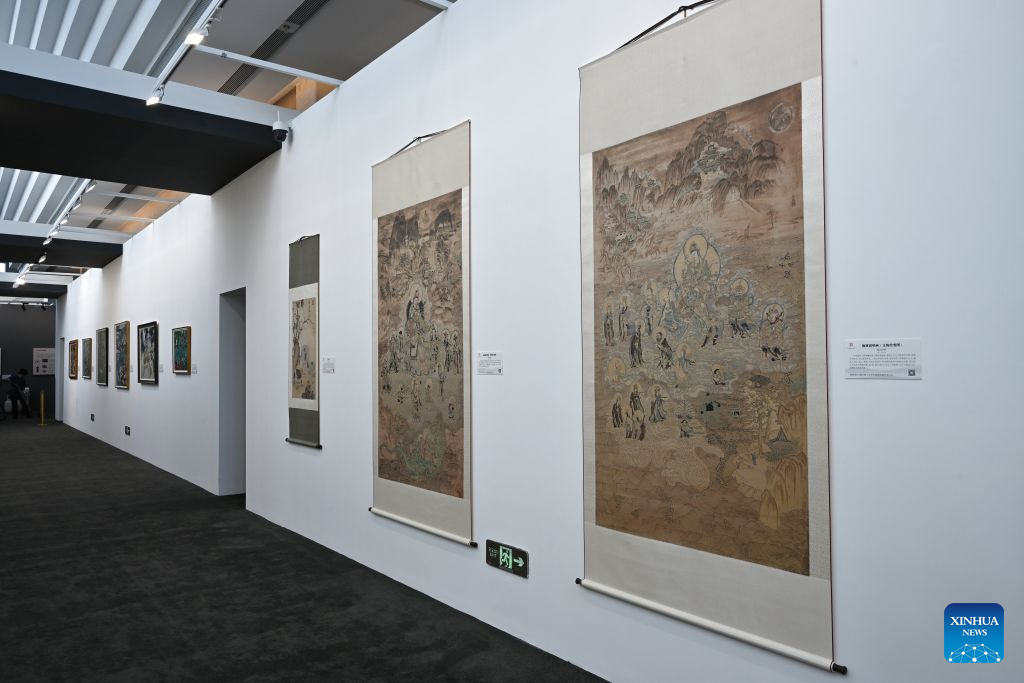
An exhibition of the Innovative and Inherited Works of Chinese Brocade Craftsmanship in the New Century is held at the Xinhua News Agency Art Museum in Beijing, capital of China, Aug. 19, 2026. The exhibition runs from Aug. 19 to Sept. 17. (Xinhua)


