
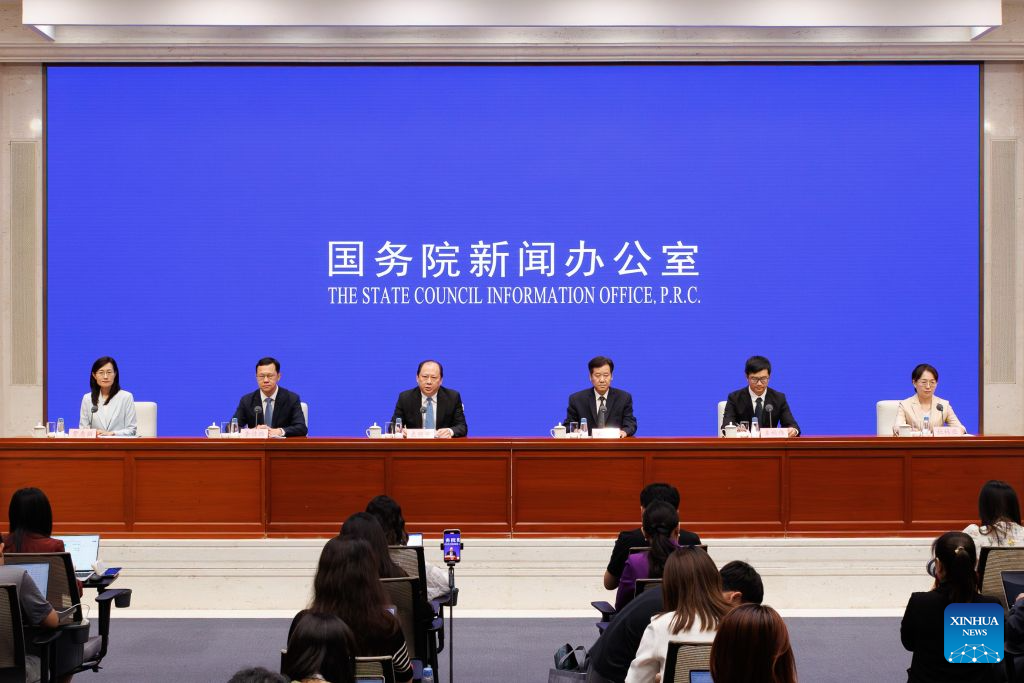
The State Council Information Office (SCIO) holds a press conference on energizing lower-tier markets and boosting county-level consumption in Beijing, capital of China, Aug. 18, 2026. (Xinhua/Chen Yichen)
BEIJING, Aug. 18 (Xinhua) -- By early morning, Lutai Fair in north China's Tianjin Municipality is already alive with activity. Stalls overflow with fresh produce, local specialties, and daily necessities, while folk performances and local foods add fresh appeal to this centuries-old rural market.
Since 2025, the fair has drawn more than 5.5 million visits and provided over 1,000 jobs, as new cultural, dining and leisure offerings turn traditional market-going into a broader consumption experience -- a shift echoed across China's county-level markets as they seek to unlock new spending potential.
China on Tuesday unveiled a set of measures to unlock the consumption potential of counties and smaller cities, tapping into the vast lower-tier markets as a new source of domestic demand and economic growth.
The government calls for upgrading consumption channels in counties, including renovating township commercial centers, rural markets and local fairs, encouraging domestic and international brands to open regional debut stores, and promoting the revitalization of existing land resources to improve services, according to a guideline jointly issued by the Ministry of Commerce and other authorities.
The guideline urges better services that cater to the elderly and children, more efficient urban-rural distribution networks, and stronger county-level employment, as well as more channels for residents to increase their incomes.
In Chaisang District of Jiujiang, east China's Jiangxi Province, a morning market allows local farmers to sell produce free of charge from 6 a.m. to 8 a.m. on a riverside road, which is then cleared for normal traffic during the morning rush hour.
This time-sharing arrangement transforms the same public space into a bustling market at dawn and a regular road during peak hours, striking a balance between vendors' livelihoods, residents' convenience and traffic flow.
The guideline comes as China seeks to give consumption a bigger role in driving economic growth.
The lower-tier markets, generally referring to third-tier and smaller cities, counties, townships and rural areas, account for about 70 percent of China's population and 60 percent of total retail sales of consumer goods.
The lower-tier markets have diverse needs across different levels, said Shen Bing, a researcher at an institute under the National Development and Reform Commission (NDRC), noting that this diversity can provide broad room for businesses to develop new service models while creating new momentum for consumption.
Yuan Xiaoming, assistant minister of commerce, told a press conference on Tuesday that China has continued to improve its county-level commercial system since 2021, with commercial outlets now basically covering counties, townships and villages nationwide.
More than 3,600 county- and township-level logistics distribution outlets have been upgraded, with over 100 million parcels moving in and out of rural areas every day.
Official data showed that retail sales of consumer goods in rural areas rose 2.4 percent year on year in the first seven months of 2026, 1.3 percentage points faster than in urban areas. County- and township-level retail sales were estimated to account for nearly 40 percent of the country's total.
China's 2,800-plus county-level administrative divisions form a vast and diverse domestic market, said Chen Xi, a researcher with the NDRC, noting that consumption upgrade is gradually extending from major cities to county-level markets, providing an endogenous source of consumption growth.
Li Jialu, an official with the Ministry of Commerce, said more chain brands will be encouraged to expand into county-level markets, but their business models should be tailored to local demand rather than simply copied from cities.
Support will also be given to local shops, time-honored brands and workshop-style businesses rooted in local culture, Li said.
"We are introducing more debut stores, experiential consumption and smart retail, and upgrading traditional markets such as Lutai Fair to make county-level consumption more diverse and appealing," said Dou Shiwen, deputy head of the commerce bureau of Tianjin's Ninghe District.
For businesses, China's county-level markets are becoming a strategic growth area as consumers seek a wider range of products and services closer to home.
Jiajiayue, a supermarket chain that originated in east China's Shandong Province, has spent years expanding its presence in county-level markets. Of the group's nearly 18 billion yuan (about 2.65 billion U.S. dollars) in revenue in 2025, about half came from county-level markets.
"We have more than 1,000 stores across the country, about 60 percent of which are rooted in county-level markets," said Wang Peihuan, chairman of Jiajiayue Group. Given the broad and diverse nature of county-level markets, the company has expanded beyond supermarkets in recent years, developing a range of formats, including snack stores and bakeries, to cater to local consumers, Wang said.
Lower-tier markets have become fertile ground for fast-growing consumer brands. In 2025, MIXUE Group, a beverage chain operator, had 32,000 stores in third-tier and smaller cities, accounting for about 58 percent of its total stores on the Chinese mainland.
Even international brands are moving deeper into these markets, with Sam's Club and Starbucks making county-level markets an increasingly important part of their growth strategies.
"Compared with cities, county-level markets generally have lower costs for rent and labor, which can translate into higher returns on investment," said Chen Liping, a professor at the Capital University of Economics and Business, adding that residents in county-level areas, facing lower costs for housing and transportation, also show stronger consumption willingness and resilience.
The trend is expected to strengthen. Consulting firm McKinsey estimates that by 2030, about 66 percent of China's incremental personal consumption will come from lower-tier markets, including third-tier and smaller cities as well as county and township areas.
As chain supermarkets expand into rural areas, popular brands open more stores in counties, and local specialty industries attract more visitors and consumers, experts believe China's vast lower-tier markets will play a greater role in shaping the country's consumption landscape and injecting fresh momentum into domestic demand. ■


