
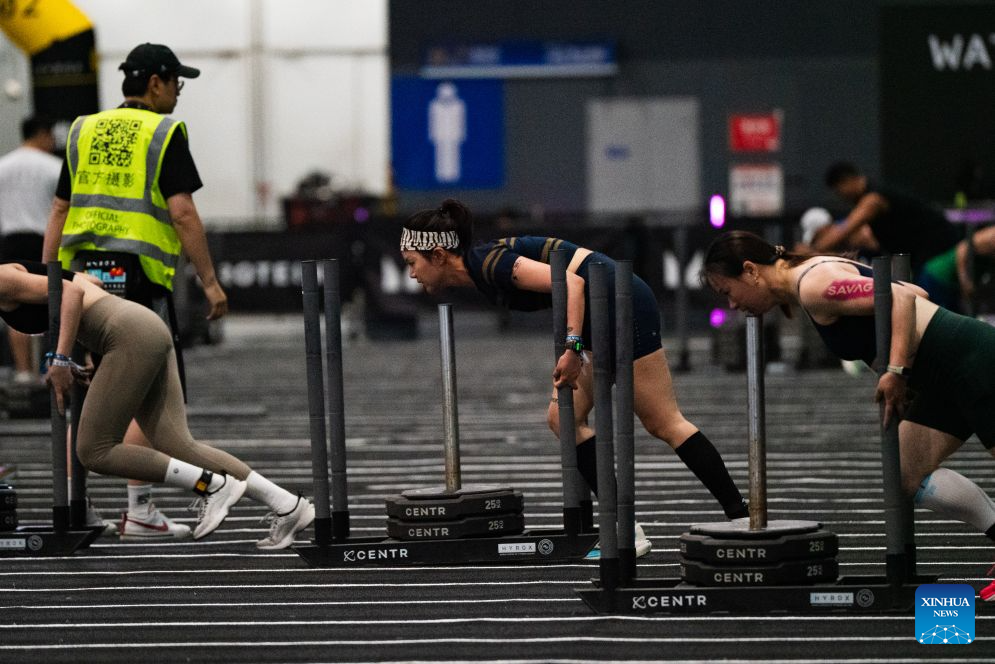
Li Baihui (C) participates in a Hyrox event in Shanghai, east China, May 17, 2026. (Xinhua)
BEIJING, Aug. 6 (Xinhua) -- This summer, a new sport blending competition, social buzz and fresh experiences, is spreading fast among young Chinese, boosting China's sports consumption and national fitness development.
From Ski Erg drills to sled pushes and burpee jumps to wall balls, after-work preparation for Hyrox, a global fitness race, is becoming a daily ritual for many in China.
"I wasn't really into fitness until I took a trial Hyrox course at the gym," said Li Baihui, a 28-year-old office worker in east China's Shanghai. "Unlike traditional workouts, it's so much fun. I'm completely hooked."
The Hyrox event is a circuit-style race consisting of eight functional movement stations, with one kilometer of running before each.
For Li, the blend of cardio and strength training the race emphasizes has helped her build muscle and boost endurance, effectively improving her overall health.
Over the past few months, she has poured tens of thousands of yuan into this new hobby, covering regular training, race entry fees, pairs of Hyrox-specialized shoes, and a whole new race-day wardrobe.
For others, the tab can run even higher when travel and accommodation for cross-city races are factored in.
However, such high expenses haven't stopped young Chinese from embracing this new sports experience. Hyrox, which originated in Germany in 2017 and entered the Chinese market just two years ago, has already taken China's sports community by storm.
This May, Hyrox's Shanghai stop drew more than 10,000 participants, a nearly six-fold jump from its inaugural Beijing stop in 2024. Despite ticket prices of 600 yuan (about 88 U.S. dollars) or more, race slots for popular divisions were sold out within minutes.
From 2024 to 2026, Hyrox has forged long-term partnerships with over 600 gyms across major Chinese cities, offering specialized group training classes for race preparation at a monthly cost of 800 to 1,000 yuan per person.
Its participants are a clearly defined group: predominantly aged 25 to 40, they come from industries such as finance, internet and artificial intelligence. Why are these young people willing to pay for Hyrox?
Yuan Fang, head of Hyrox China, believes that the key reason lies in the product itself. "Traditional fitness lacks a standardized competitive format. Hyrox fills that gap with a clear, universal set of rules, and that gives people a tangible way to track their progress and push their own limits."
Social appeal matters too. Wang Zhe, a lecturer at Beijing Sport University, said Hyrox resonates with young people's aesthetic sensibilities and self-expression.
"There's music, food and interactive activities on-site," Wang said. "The sense of ritual at the finish line, the cheers from the crowd, and the photos that capture their physical beauty -- all of it is built to be shared across social media."
On Chinese lifestyle platform Rednote, the Hyrox hashtag has racked up more than 130 million views. Many young participants post their perfect "finisher photos" and swap training tips and outfit ideas online. Such user-generated content, in turn, attracts even more young participants.
Also, behind the trend lies China's overall health landscape and a favorable development environment for the sports industry.
Official data shows that by the end of 2025, the proportion of Chinese residents who exercise regularly had exceeded 38 percent. By 2030, China aims to raise that figure to around 40 percent and boost the share of the population with a good level of physical fitness to over 31 percent, according to a plan issued by China's General Administration of Sport.
As fitness awareness grows, so does spending on sports. The plan said that China will work to expand the total value of its sports industry to more than seven trillion yuan in five years. Young consumers are set to play a pivotal role in reaching this goal.
From buying a pair of running shoes to embracing a sweat-filled lifestyle, young people are now more willing to pay for the experience, and not just the gear.
"Energetic and trend-savvy, they are the ones creating new sports scenes, spotting emerging trends, and setting the pace for sports consumption," said Wang Xueli, a sports industry expert and professor in the School of Economics and Management at Tsinghua University in Beijing.
"Their diverse and sophisticated demand pushes producers to step up their game, forging a virtuous cycle for the entire industry," she added. ■


