
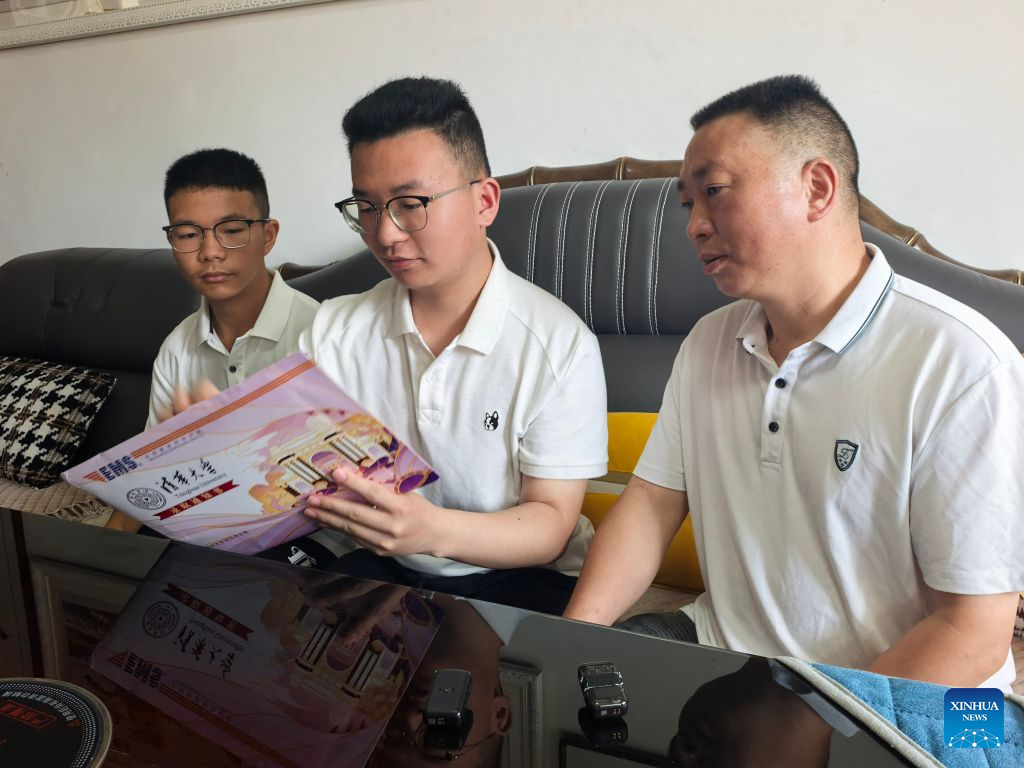
Hu Haoran (C) opens the envelope of the admission letter from Tsinghua University at home in Bijie City, southwest China's Guizhou Province, July 27, 2026. (Xinhua)
GUIYANG, July 30 (Xinhua) -- A postal courier knocked on the door of Hu Haoran's home, holding a much-anticipated envelope. "Congratulations, this is your university admission letter," the courier said with a smile, handing over the package to the 18-year-old.
Tearing open the seal, Hu held the admission letter from Tsinghua University, one of China's top universities, up to his father Hu Maoheng and younger brother Hu Chang, their faces lighting up with shared joy.
Hu Haoran scored 683 out of 750 in this year's national college entrance exam, a result he attributes largely to the stability brought by the poverty alleviation relocation policy his family has benefited from.
Hu Haoran's parents used to live in the remote Gaochao Village of Bijie, Guizhou Province in southwest China, but the brothers were born and raised in a shanty town in Kunming, capital of Yunnan Province, also in the southwest, where their parents worked as migrant workers.
In 2018, the whole family moved into a 100-square-meter apartment in the Baiyanglin resettlement community in Qixingguan District of Bijie, as part of Guizhou's massive relocation program for people living in inhospitable, poverty-stricken mountainous areas.
"After we moved here, my wife and I found stable jobs nearby, we no longer have to travel far for work, and our sons finally have a stable home to focus on their studies," said Hu Maoheng.
Hu Haoran said without the relocation, he would never have achieved such a high score.
One day before Hu received his university offer, 18-year-old Sun Xun, a resident of Hezhang County's Jinyinshan Subdistrict in Guizhou, received her admission letter. She scored 610 points in this year's exam, following in the footsteps of her three elder sisters, all of whom have been admitted to universities.
Sun's family moved to the resettlement community in 2019 from the remote Axue Village, where her elder sisters used to walk more than an hour to school, setting off before dawn with flashlights in winter.
"After relocation, the school is just a short walk away, and the teaching quality is much better. We barely have to worry about our children's schooling now," said their father Sun Chengliang.
Stories like the Hu and Sun families are playing out across resettlement communities in Guizhou, the province with the largest number of relocated people in China, with a total of 1.92 million people moved out of deep mountains since the launch of the poverty alleviation relocation program.
Official data showed that over the past five years, 51,955 children from relocated families have been admitted to colleges across the province, and the total figure is expected to exceed 60,000 this year. Many resettlement sites have seen multiple students admitted to China's top institutions of higher education.
To guarantee access to quality education for relocated children, Guizhou has invested more than 18.1 billion yuan (about 2.66 billion U.S. dollars) to expand and renovate 669 supporting schools near resettlement sites, realizing full coverage of education supporting facilities for all resettlement sites.
Supporting facilities, including children's homes and libraries, as well as services such as after-school tutoring classes and child welfare parks, have been set up to broaden children's horizons and improve their education and relaxation options.
"The relocation policy has not only changed the living environment of these children, but also reshaped their growth trajectory," said Wang Dingfang, director of the education bureau of Bouyei-Miao Autonomous Prefecture of Qianxinan.
"Moving out of the mountains where they used to trek for hours to school, they now have access to quality education close to home, which opens up more possibilities for their future," Wang added.
Such changes in the living environment have expanded the horizons of relocated children. With a wider world unfolding before them, the students can aim for a bigger stage in the future, noted Ren Shenghong, dean of the basic education research institute of Guizhou Normal University. ■
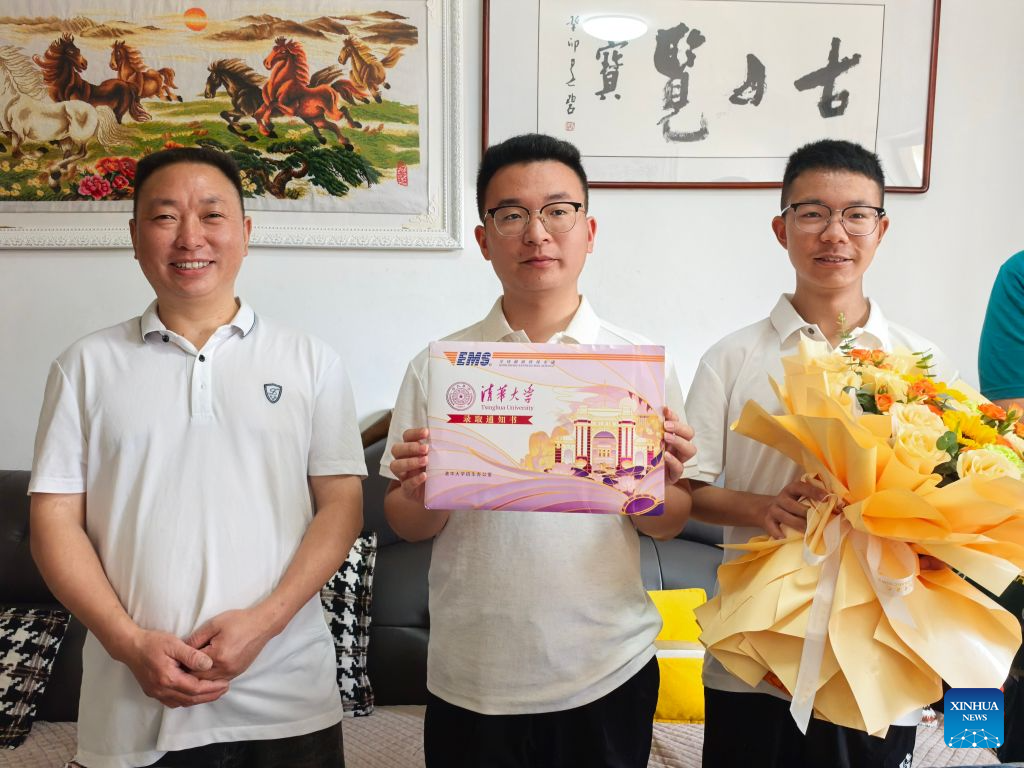
Hu Haoran (C), his father Hu Maoheng (L) and his younger brother Hu Chang pose for a photo at home in Bijie City, southwest China's Guizhou Province, July 27, 2026. (Xinhua)


