
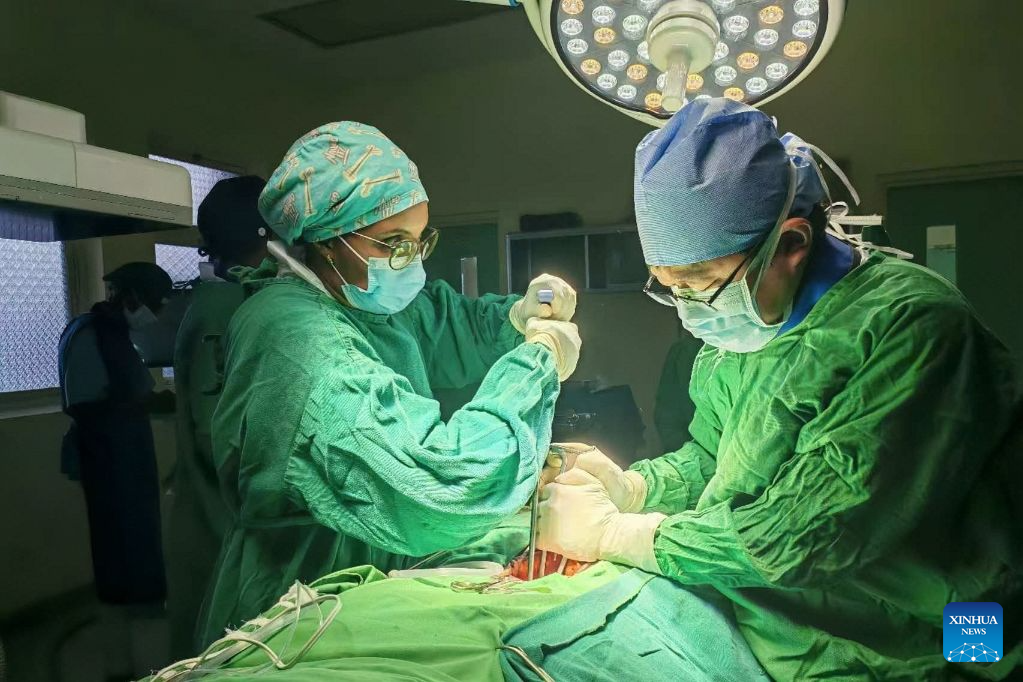
This photo taken with a mobile phone shows Chinese spine surgeon Zhou Chao (R) and a local doctor performing a surgery for a Tanzanian patient at Mbeya Zonal Referral Hospital in Mbeya, Tanzania, June 15, 2026. (The 28th Chinese medical team in Tanzania/Handout via Xinhua)
DAR ES SALAAM, July 18 (Xinhua) -- For years, Matilda Chisuguru, a 46-year-old entrepreneur and mother of two from Mbeya in southwestern Tanzania, lived with pain that gradually eroded her independence, disrupted her work, and eventually made even the simplest movements unbearable.
Chisuguru's ordeal began more than a year ago, when she underwent lumbar decompression and internal fixation surgery at a medical facility in Dar es Salaam. Initially hopeful, she expected relief. Instead, six months later, her condition deteriorated dramatically.
Severe lower back pain returned, accompanied by numbness in both legs and persistent radiating discomfort. "I could not walk on my own. The pain in my back and legs was constant," she recalled.
Today, she is beginning to reclaim her life, thanks to a complex surgery performed by members of the 28th Chinese medical team in Tanzania at Mbeya Zonal Referral Hospital.
Her recovery follows a medical milestone: the hospital's first-ever lumbar revision surgery, successfully carried out on June 15 by Chinese spine surgeon Zhou Chao and his team.
When Zhou first examined Chisuguru, he immediately recognized the complexity of her case. The previous surgery had left behind scar tissue and severe adhesions around critical nerves. Signs of vertebral damage raised concerns about possible chronic infection. Additionally, weakened bone structure and loosened screw tracks suggested that any new fixation would be technically challenging.
Revision spine surgery is among the most difficult procedures in orthopedics. In Chisuguru's case, the risks were amplified by limited hospital infrastructure.
The available C-arm X-ray imaging system, critical for guiding screw placement, produced low-quality images. Surgical instruments, including electrosurgical units, had been used repeatedly over many years, resulting in wear and inconsistent performance.
Working within these constraints, Zhou designed a tailored surgical plan that balanced safety with practicality.
On the day of the operation, he and colleagues carefully removed the previously implanted screws, which had become unstable. They then performed bone grafting to strengthen the damaged vertebrae and prepared new pathways for fixation.
The most delicate part involved separating scar tissue from nerve structures without causing further injury, a painstaking process requiring patience and precision. With limited imaging support and occasionally unreliable instruments, the team relied heavily on experience and anatomical knowledge.
Step by step, the team performed neural decompression, restored spinal stability, and secured new pedicle screws. Despite the daunting challenges, the operation was completed successfully.
In the days that followed, Chisuguru began to notice changes. Under medical guidance, she has started light physical exercises, a crucial step toward regaining mobility.
"I can feel that my body is improving," she said. "What they have done is not just treatment; it is something that gives hope."
The successful surgery marked more than a turning point for Chisuguru. It also filled a critical gap in the capabilities of Mbeya Zonal Referral Hospital, where lumbar revision surgeries of this complexity had not previously been performed.
As Chisuguru continues her recovery, her story stands as a testament to resilience, both her own and that of the medical team that treated her.
"I believe I will walk again," she said, a hint of determination in her voice.
For Zhou and his colleagues, the journey does not end with one successful surgery.
"We are here to serve, to share, and to learn," he said. "Every patient teaches us something, and every success encourages us to do more." ■
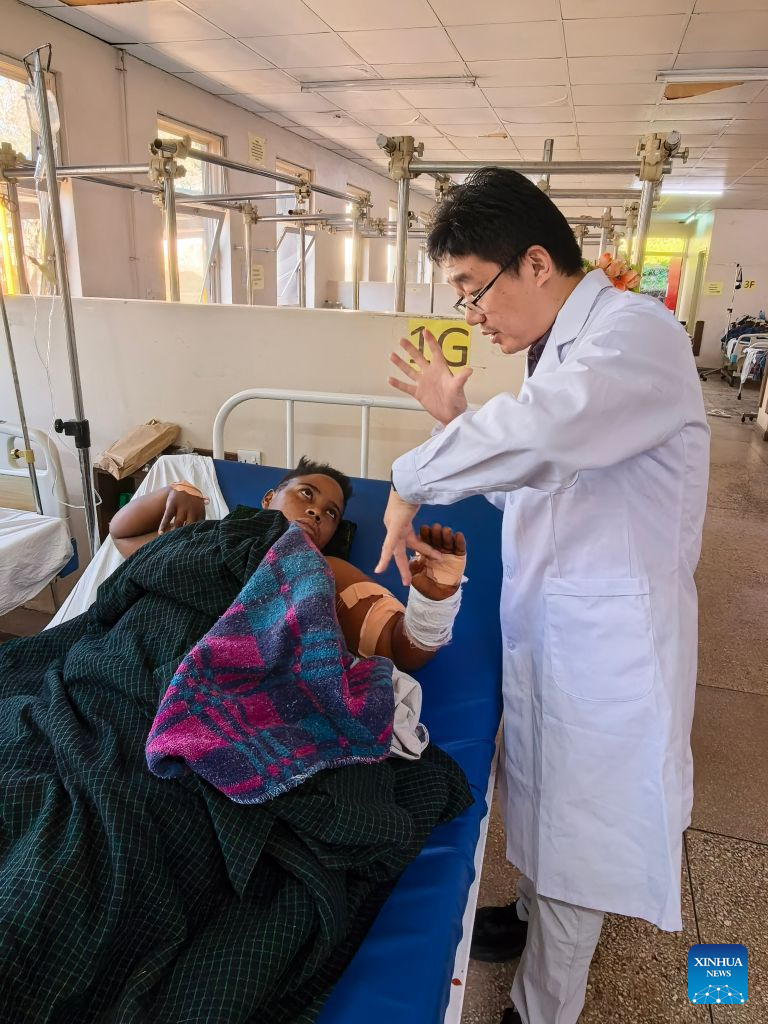
This photo taken with a mobile phone shows Chinese spine surgeon Zhou Chao (R) checking a patient at Mbeya Zonal Referral Hospital in Mbeya, Tanzania, May 4, 2026. (The 28th Chinese medical team in Tanzania/Handout via Xinhua)


