
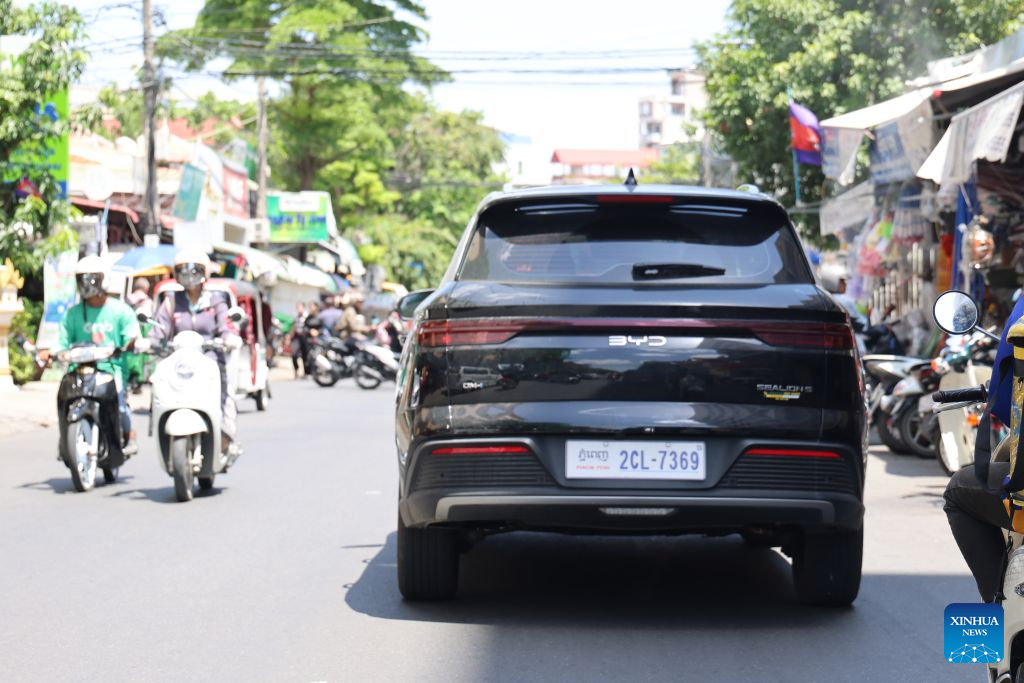
A BYD electric car is pictured on a road in Phnom Penh, Cambodia on July 10, 2026.(Photo by Sin Sareth/Xinhua)
PHNOM PENH, July 10 (Xinhua) -- Chou Sivly, a 30-year-old Cambodian merchant, recently switched to a Chinese-branded electric vehicle (EV) following rising fuel prices caused by the Middle East conflict, noting that the EV saves her money and protects the environment.
Driven by economic and environmental factors, Sivly transitioned to a fully EV, a Dongfeng Forthing S7.
"Because my daily commute to work requires consistent driving, my fuel costs under a gasoline vehicle had climbed to between 150 and 200 U.S. dollars per month," she told Xinhua on Friday.
"Since making the switch, my monthly charging expenditure has plummeted to just 50 to 75 dollars, representing a massive reduction in my recurring transport overhead," she added.
Sivly said the vehicle has an estimated range of 555 kilometers on a full charge.
"In practice, I top up the battery every four to six days, typically maintaining the battery health window by charging from 20 to 85 percent, with each session costing approximately 12.50 dollars," she said.
Soy Mealea, a 24-year-old private company employee, switched to a Chinese EV after gasoline prices spiked, noting it has saved her significant money.
"When comparing the operating costs of gasoline vehicles to EVs, the EV saves me a significant amount of money," she told Xinhua, adding that a 10-dollar full charge powers her EV for over 400 kilometers.
"EVs also help the environment because it does not emit pollutant smoke," Mealea said.
Chhoeun Phanit, a sales consultant at the Mingyang Guoji Co., Ltd., which is the sole agent of the Hongqi brand in Cambodia, said the company offers the E-QM5 and EHS5 EV models in the Cambodian market.
"These vehicles are Chinese high-end luxury EVs and provide significant cost savings," he told Xinhua.
Phanit said that as fuel costs have risen, more consumers have become interested in EVs because their operating costs are much lower than those of gasoline or diesel-powered cars, and they do not pollute the environment.
"For the Hongqi brand, we have sold many cars each month, from 20 to 30 units," he said. "For the EV, a full charge can run from 400 to 500 kilometers."
Cambodian Ministry of Public Works and Transport spokesperson Phan Rim said the Southeast Asian country had registered 14,056 EVs between 2021 and May 2026.
He said that BYD and GAC are among the most popular EV brands in Cambodia.
"We have seen a significant increase in EV registrations since March, following the Middle East conflict that drove up fuel prices," he said, adding that approximately 3,693 EVs were registered between March and May of this year.
"EVs reduce fuel costs and eliminate tailpipe emissions," he said.
Thong Mengdavid, deputy director at the China-ASEAN Studies Center of the Cambodia University of Technology and Science, said widespread EV adoption immediately benefits Cambodia's urban micro-environments by drastically lowering localized air pollution and improving air quality in dense areas.
"Furthermore, as Cambodian consumers shift toward electric mobility at scale, it creates a powerful demand signal," he told Xinhua.
"This market shift incentivizes both the government and private investors to aggressively scale up domestic investments in renewable energy infrastructure," Mengdavid said. "This will expand our grid capacity through clean sources like hydro, solar, and wind power in the near future." ■
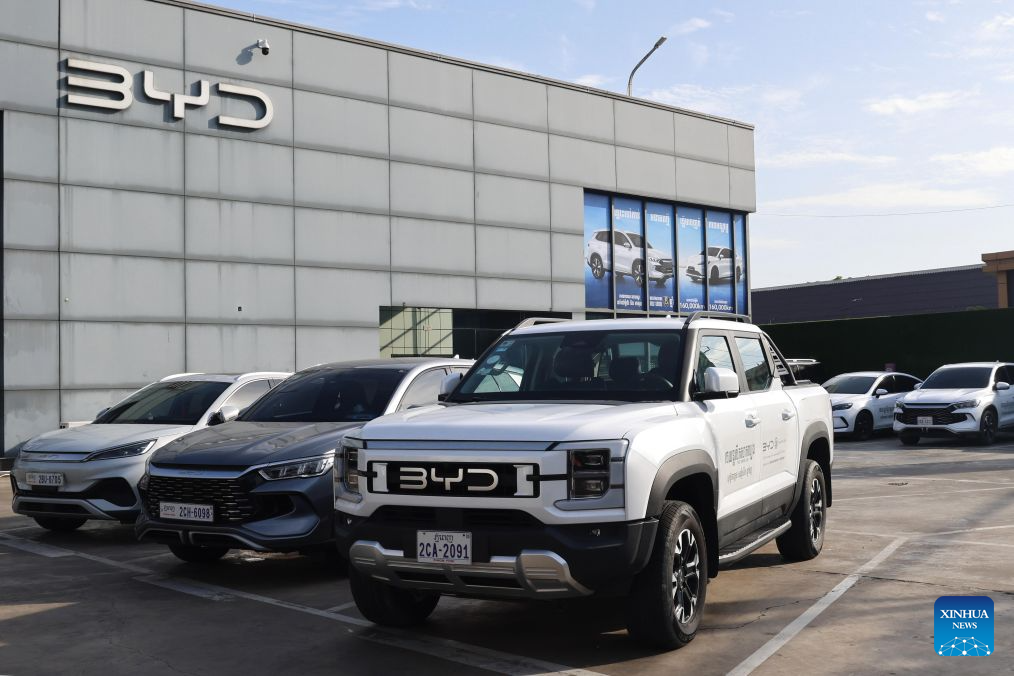
This photo taken on July 9, 2026 shows a BYD sales center in Phnom Penh, Cambodia.
TO GO WITH "Feature: Cambodians shift to EVs after Mideast conflict drives up fuel prices" (Photo by Sin Sareth/Xinhua)


