
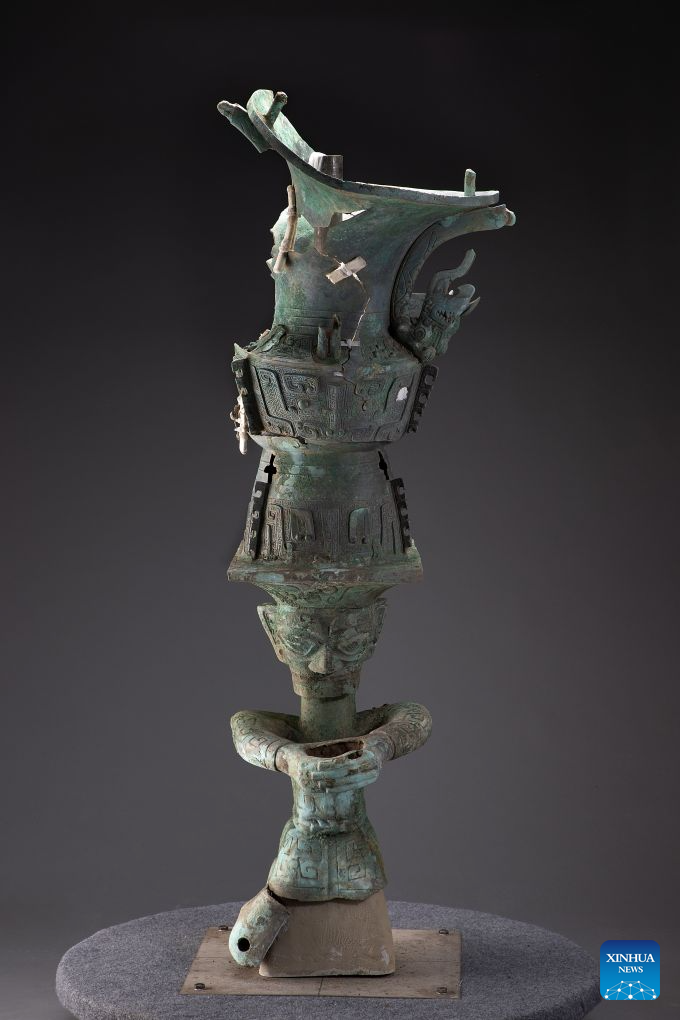
This undated file photo shows a bronze kneeling figurine with a Zun vessel unearthed from the No. 3 pit at the Sanxingdui Ruins in southwest China's Sichuan Province. (Sichuan Provincial Cultural Relics and Archaeology Research Institute/Handout via Xinhua)
CHENGDU, July 10 (Xinhua) -- New research on a bronze artifact from China's renowned Sanxingdui Ruins shows that the ancient Shu civilization was deeply connected with other regional cultures in ancient China, the latest evidence proving the unity in diversity of Chinese culture.
The Sichuan Provincial Cultural Relics and Archaeology Research Institute released its research findings on Friday, focusing on a bronze kneeling figurine with a Zun vessel unearthed from the No. 3 pit at the ruins in southwest China's Sichuan Province.
The monumental bronze artifact, composed of multiple separately cast components, features a complex and unique design that showcases the Sanxingdui people's superb casting skills.
Metal composition analysis indicates that the components of the artifact were made of mineral materials sourced from different regions of China.
The bronze Zun vessel was likely produced in the Central Plains region, while the figurine and decorative parts were locally cast in Sanxingdui, said Guo Jianbo, an associate researcher at the institute.
These components were crafted separately by different artisans at different times and places, before being assembled at Sanxingdui, he noted.
The process of modification and combination, Guo explained, endowed the artifact with new cultural connotations, demonstrating how different regional cultures converged and contributed to the unity in diversity of Chinese civilization.
Located in the city of Guanghan in Sichuan, the Sanxingdui Ruins, believed to be remnants of the Shu Kingdom dating back some 3,000 to 4,500 years, have been called one of the world's greatest archaeological finds of the 20th century. Two sacrificial pits were discovered in 1986, while another six were found in 2021. The core area of this site covers 3.6 square kilometers.
The ruins are renowned for their large and medium-sized bronze artifacts, many of which feature striking and elaborate designs.
The latest findings challenge the earlier assumption that these artifacts were purely mythical, conjured by the imaginations of the ancient Shu people.
The figurine being studied holds a sacred object and bows with clasped hands. Despite carrying the heavy vessel filled with cowrie shells and other valuables on its head, it maintains a solemn and devout facial expression.
"The delicately designed artifact is not an abstract myth but a vivid representation of real sacrificial rituals, reflecting the ancient Shu ancestors' worship of deities," Guo said.
The recurring image of a figurine bearing a vessel on its head reflects both the uniqueness of the ancient Shu civilization and the profound influences of the Central Plains culture.
As new discoveries emerge, research on the Sanxingdui Ruins is progressing steadily. This year alone, findings on a meteoritic iron artifact and carnelian beads have been released. ■
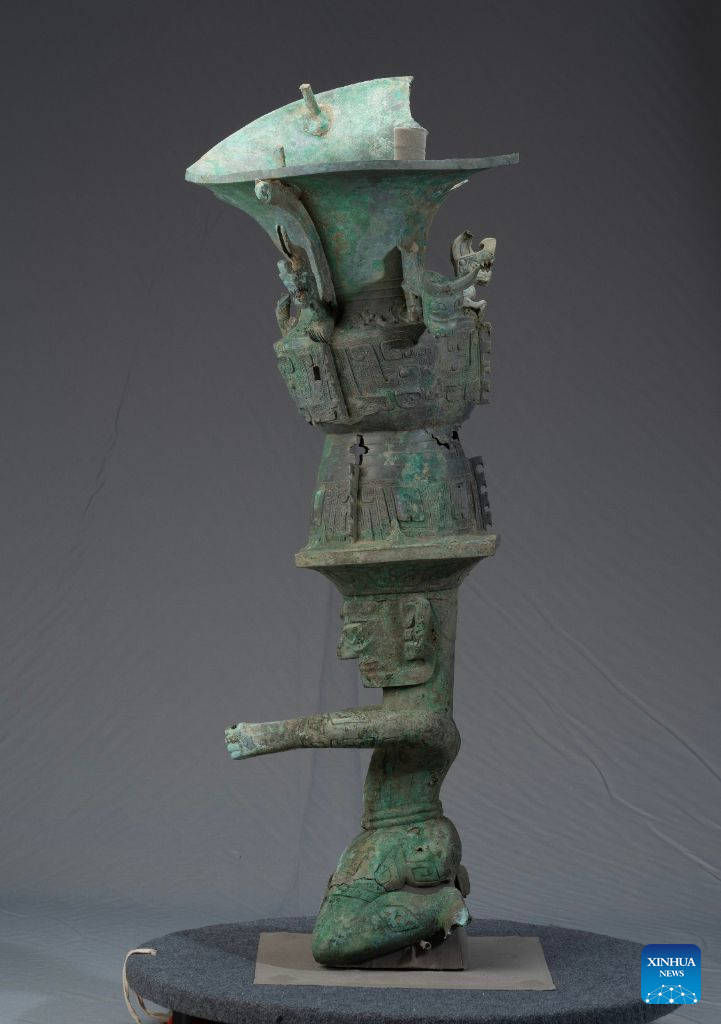
This undated file photo shows the side view of a bronze kneeling figurine with a Zun vessel unearthed from the No. 3 pit at the Sanxingdui Ruins in southwest China's Sichuan Province. (Sichuan Provincial Cultural Relics and Archaeology Research Institute/Handout via Xinhua)


