
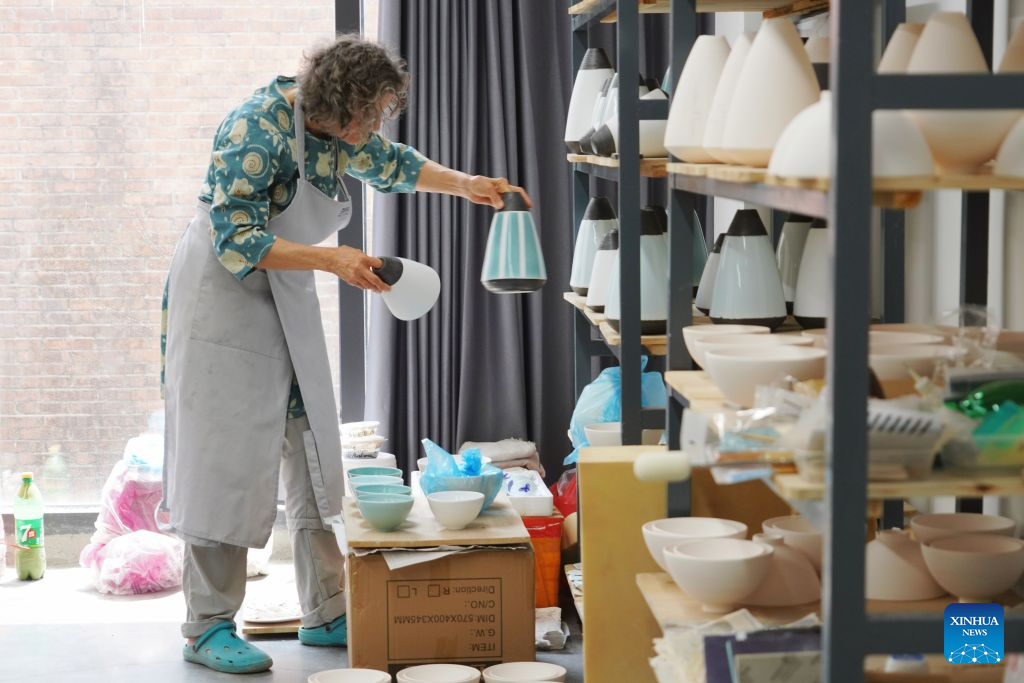
German ceramic artist Karin Flurer-Bruenger works at her studio in Jingdezhen, east China's Jiangxi Province, April 8, 2025. (Xinhua/Du Juanjuan)
NANCHANG, July 1 (Xinhua) -- For many creators, Jingdezhen, China's porcelain capital, serves as a massive and living workshop, with numerous local artisans dedicating themselves to a specific niche within the craft in the eastern Chinese city.
Such intricate division of labor is a centuries-old tradition, in which young apprentices spend years perfecting a single step in the porcelain-making process. Today, this comprehensive industry chain in the city sustains over 100,000 workers.
Jingdezhen, home to more than 60,000 ceramic studios, is hosting the 2026 Congress of the International Academy of Ceramics (IAC). The event has brought together ceramic artists and experts from around the globe to discuss the inheritance and innovation of ceramic culture.
Since the Song Dynasty (960-1279), ceramics crafted in Jingdezhen have been exported to Central Asia, West Asia, Europe and Africa. Today, the city still retains its global appeal, drawing over 5,000 ceramic enthusiasts from around the world at peak times.
For international artists, the city's most magnetic appeal lies in its vast, collaborative network of master craftsmen, each playing a distinct and indispensable role.
French visual artist Karima Duchamp is among those captivated by this dynamic. After a three-month residency in Jingdezhen last year, she has returned as an IAC member.
During her previous stay, she painted on clay bodies but struggled with the firing process. In a local alley, she watched a craftsman seamlessly slide a multi-meter-long clay body into a kiln without a single flaw. This refined skill, honed over decades, instantly won her trust.
"I didn't just 'borrow hands.' I borrowed Jingdezhen's fire," Duchamp told Xinhua, adding that the expertise of local kiln masters was crucial in realizing her creation.
"Jingdezhen always helps me bring my creative ideas to life," said Croatian visual artist Sandra Ban, echoing Duchamp's view. Returning to the city half a year after a three-month residency, she added that the city's synergistic craftsmanship is particularly liberating for artists tackling irregular or oversized designs.
"Ceramics is a universal language, and craftsmanship is the bond connecting humanity and nature," said Ban. "Handmade porcelain in Jingdezhen stands in contrast to mass-produced goods. Every single piece carries the warmth of human touch."
The city's dedication to craftsmanship is etched into its landscape. Along the Zhushan Bridge, 72 bronze statues line both sides, capturing the entire traditional porcelain-making process, from throwing to firing.
"Hands serve as a bridge between the heart and the clay," said 87-year-old Liu Yuanchang, a master of Chinese arts and crafts. "For over a millennium, it has been a division of labor, yet also a symphony."
Liu added that while artisans exist elsewhere, few places have organized these "hands" into an ecosystem like Jingdezhen. "Foreign artists bring ideas and creativity, and the hands of Jingdezhen help realize them."
Experts believe that this is the irreplaceable secret of Jingdezhen: it does not require outsiders to be all-round craftsmen. Instead, it offers highly specialized hands, allowing creativity to materialize with maximum efficiency.
Australian artist Fleur Schell told Xinhua that Jingdezhen's scale and comprehensive ceramic industrial chain have attracted many of her friends and colleagues from Australia to work in the city. "It feels like anything is possible," she said. "You could make anything in ceramics here." ■
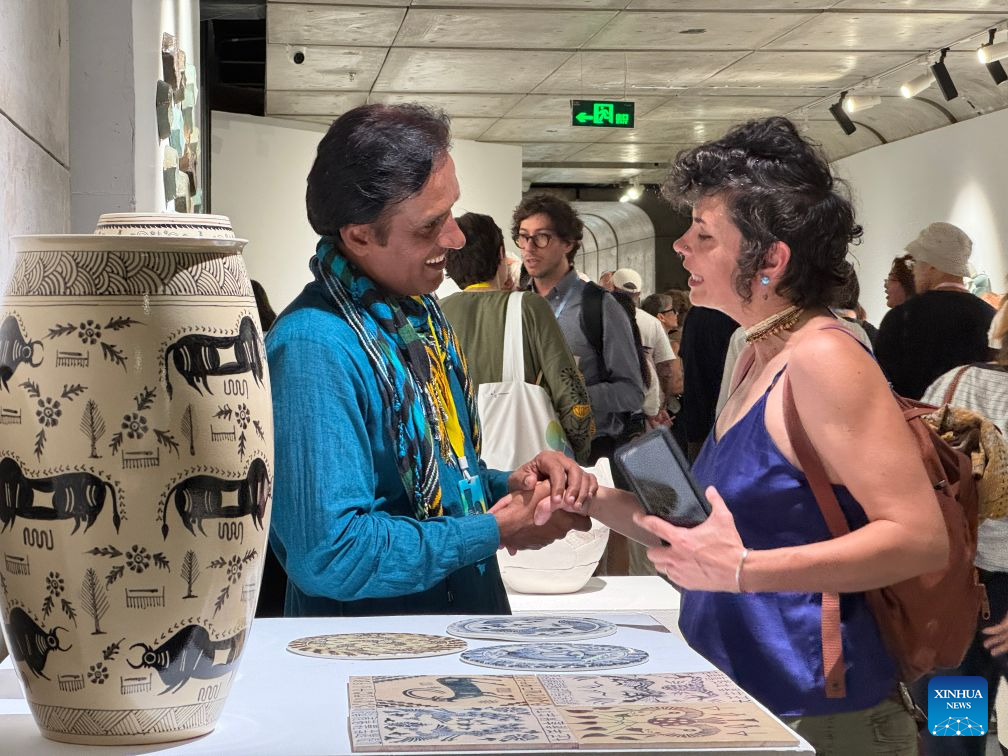
Foreign artists are seen during the 2026 Congress of the International Academy of Ceramics in Jingdezhen, east China's Jiangxi Province. (Photo by Liu Bin/Xinhua)


