
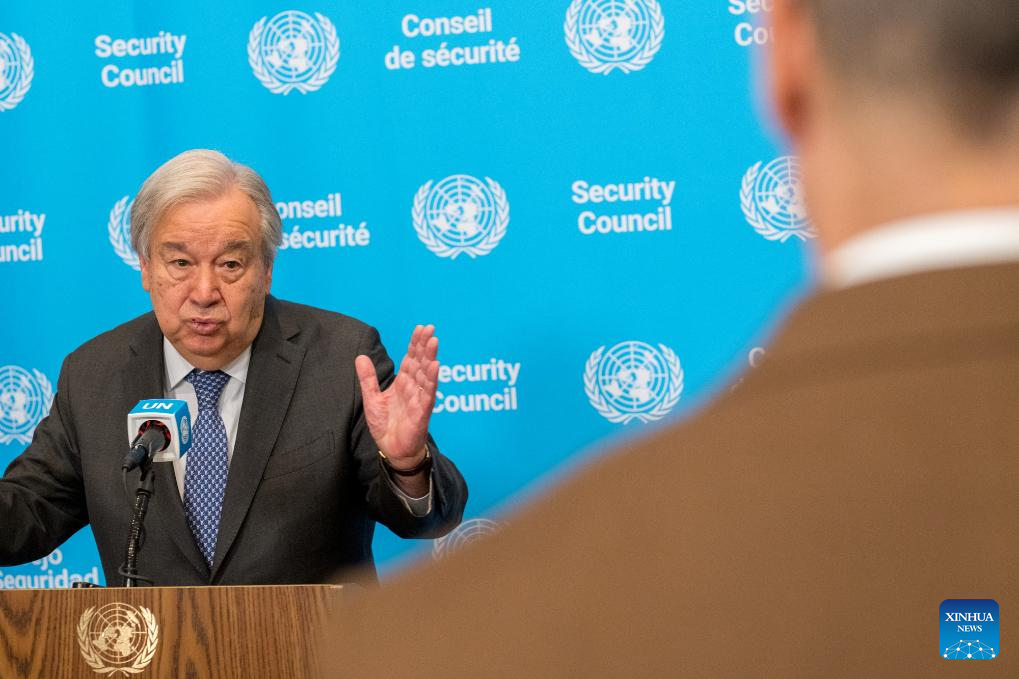
UN Secretary-General Antonio Guterres speaks at a press encounter at the UN headquarters in New York, April 30, 2026. Guterres on Thursday warned of devastating consequences of prolonged disruptions in the Strait of Hormuz. (Mark Garten/UN Photo/Handout via Xinhua)
UNITED NATIONS, April 30 (Xinhua) -- UN Secretary-General Antonio Guterres on Thursday warned of devastating consequences of prolonged disruptions in the Strait of Hormuz.
In a press encounter, Guterres offered three scenarios. In the worst-case scenario where the strait remained closed until the end of the year, global inflation would skyrocket past 6 percent, and growth would plummet to 2 percent.
"Immense suffering takes hold, especially among the world's most vulnerable populations. And we confront the specter of a global recession, with dramatic impacts on people, on the economy, and on political and social stability," he warned.
Guterres said these consequences are not cumulative but exponential. The longer this vital artery is choked, the harder it will be to reverse the damage and the higher the cost to humanity.
Even in the best-case scenario, "where restrictions are lifted today," supply chains will take months to recover, prolonging lower economic output and higher prices, he warned.
According to the UN chief, in that scenario, this year's global economic growth would still drop from 3.4 to 3.1 percent. Global inflation, which had been declining, would climb from 3.8 to 4.4 percent. Global merchandise trade growth would shrink from 4.7 percent last year to roughly 2 percent, with some meaningful supply chain interruptions.
In a second scenario, where disruption drags on through midyear, global economic growth would fall to 2.5 percent. Inflation would rise to 5.4 percent. Some 32 million more people would be pushed into poverty and 45 million more people would face extreme hunger, he said.
As the Middle East crisis is lumbering into its third month, the consequences grow dramatically worse with each passing hour despite a fragile ceasefire between the United States and Iran, he said.
Guterres called for the reopening of the Strait of Hormuz.
"My message to all parties is clear: Navigational rights and freedoms must be restored immediately, in line with the Security Council Resolution 2817. Open the Strait. Let all ships pass. Let the global economy breathe again," he said.
"That requires more than physical reopening," Guterres said. "It requires shipping to be safe, predictable and insurable."
At the same time, the UN chief urged all parties to refrain from actions that could undermine the current ceasefire.
"Now is the time for dialogue, for solutions that pull us back from the brink, and for measures that can open a pathway to peace," Guterres said. "The world is waiting." ■
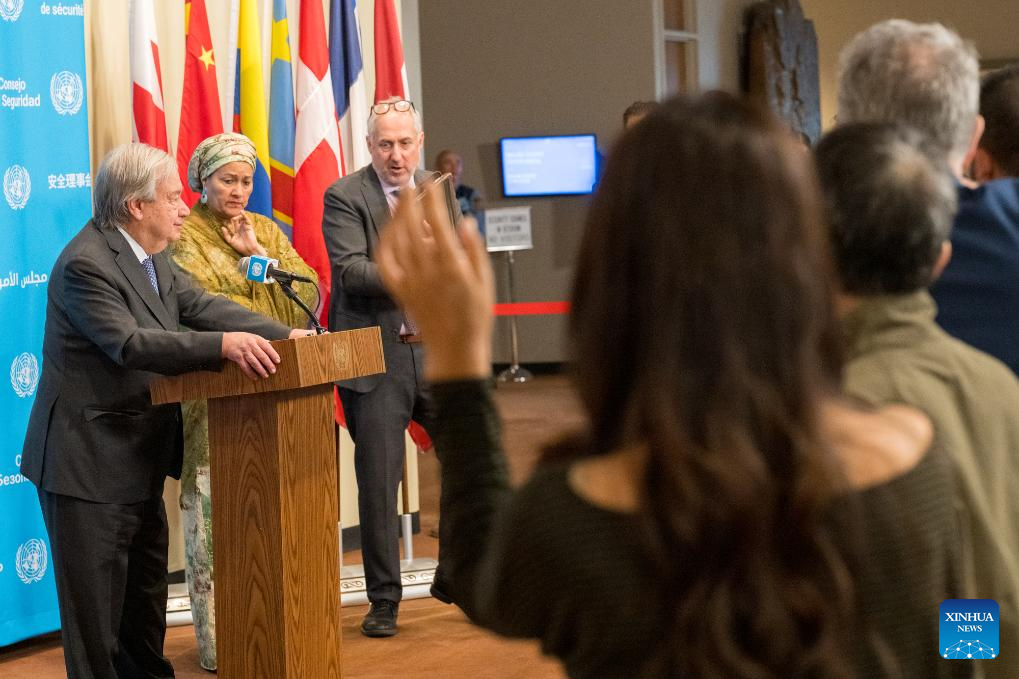
UN Secretary-General Antonio Guterres (1st L) speaks at a press encounter at the UN headquarters in New York, April 30, 2026. Guterres on Thursday warned of devastating consequences of prolonged disruptions in the Strait of Hormuz. (Mark Garten/UN Photo/Handout via Xinhua)


