
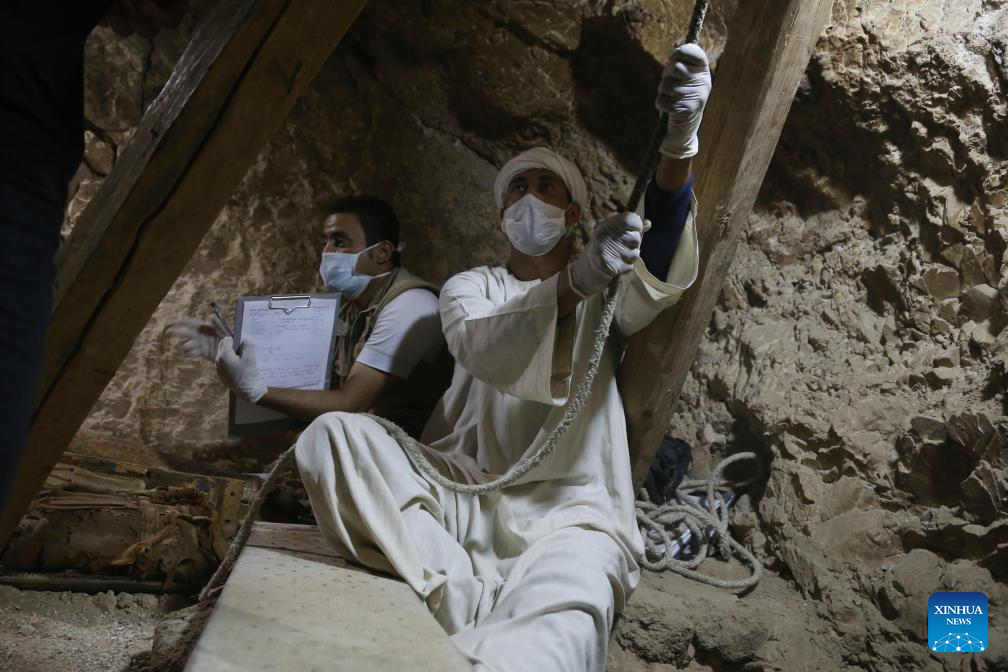
Egyptian workers work in archaeological site on the West Bank of Luxor, Egypt on April 28, 2026. (Radwan Abu Al-Majd/Handout via Xinhua)
LUXOR, Egypt, April 29 (Xinhua) -- At the ancient Temple of Montu in Luxor, Egyptian workers brush sand from stone faces buried for thousands of years and move massive stone blocks back into place using traditional tools and techniques passed down through generations.
While foreign archaeologists often attract attention, the daily preservation of Luxor's temples depends largely on local specialists whose skills have helped protect some of Egypt's most important historical sites.
Dressed in traditional Jalabiyas, workers kneel in the dust, using small brushes to clear sand from stone carvings buried for nearly 3,000 years. Nearby, others use simple tools, similar to those used in ancient times, to lift heavy blocks back into position.
Among them is Ali Farouk, 56, head of archaeological excavation workers in Upper Egypt. Known locally as a fixture of the temples, Farouk has spent 45 years working at nearly every major site in the region, from Karnak Temple to smaller hidden shrines.
Farouk, who also works with Egypt's Ministry of Tourism and Antiquities, does not hold a university degree in Egyptology. Still, he has become a key reference for archaeological missions, taking part in the discovery of hundreds of rare pharaonic tombs alongside Egyptian and foreign researchers.
"A book can tell a student where a wall might be, but it cannot tell you how that stone feels," Farouk told Xinhua. "After 45 years, I can hear the stone. I know if it is fragile or strong just by touching it."
He said more than 300 foreign archaeological missions and 50 Egyptian missions are carrying out excavation and restoration work across Egypt, employing thousands of local workers.
"These skilled workers, mainly from Upper Egypt, are the backbone of the industry, and their expertise is needed everywhere," Farouk said. "We do not just work here in Luxor. Our teams travel across Egypt, from the pyramids in the north to the deepest sites in the south, wherever the earth hides a secret."
Farouk said the exact number of such workers is unclear because most are hired on a daily basis and there is no formal union representing them. Despite the informal nature of the work, he said the income provides a decent living for those who master the trade.
For Farouk, who is from nearby Qena province, the work is also a family legacy. He started in archaeological excavations as a teenager, and six of his brothers work in the same field. He said the profession was passed down from his grandfather, who worked with early European missions clearing sand from Luxor Temple.
To preserve those skills, Farouk opened a training school in his home village of Quft, about 40 kilometers (25 miles) from Luxor, where he teaches relatives and younger workers excavation techniques.
That expertise now supports the Egyptian-Chinese joint mission at the Temple of Montu, a project linking two of the world's oldest civilizations.
Gao Wei, a Chinese archaeologist with the mission, said the team relies on about 50 to 60 Egyptian workers each year, including specialists from Quft who are widely known for their field skills.
"The Qufti workmen are key technical personnel for any foreign archaeological mission in Egypt," Gao told Xinhua. "They have rich experience and know the local soil and stratigraphy inside out. We need their expertise to identify the outlines of mud-brick structures, which are not easily recognizable in the soil. Without their hard work, the archaeological work here would come to a standstill."
The partnership has grown beyond work, with Chinese experts and Egyptian workers often sharing breakfast at the site and building what Gao described as genuine friendship.
For Mahmoud Aly, 38, the job offers both stability and pride. He learned the trade from his father and has spent the past three years working with the Chinese team at the Temple of Montu, clearing sand, moving bricks and helping with restoration.
"Working with the Chinese experts taught me new things, such as using digital tools to document every tiny find," Aly told Xinhua while cleaning a piece of pottery.
In return, he said, Egyptian workers teach the Chinese team how to move heavy limestone without causing damage.
"When the team discovers something, I feel proud to be part of the hands that brought it back to light," Aly said with a smile. ■
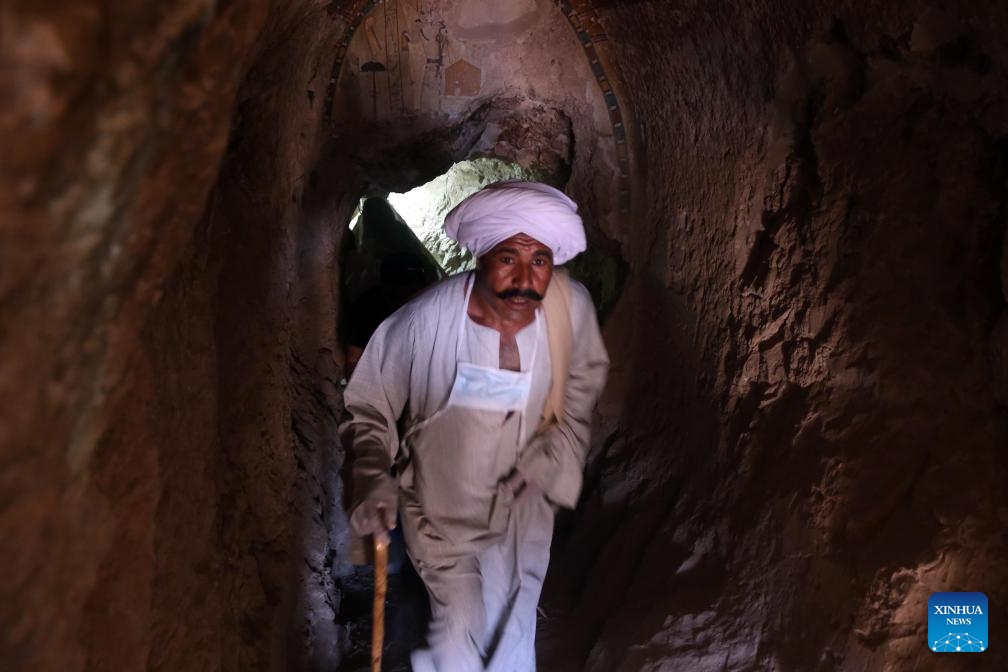
Ali Farouk, 56, head of archaeological excavation workers in Upper Egypt, works in archaeological site on the West Bank of Luxor, Egypt on April 28, 2026. (Radwan Abu Al-Majd/Handout via Xinhua)
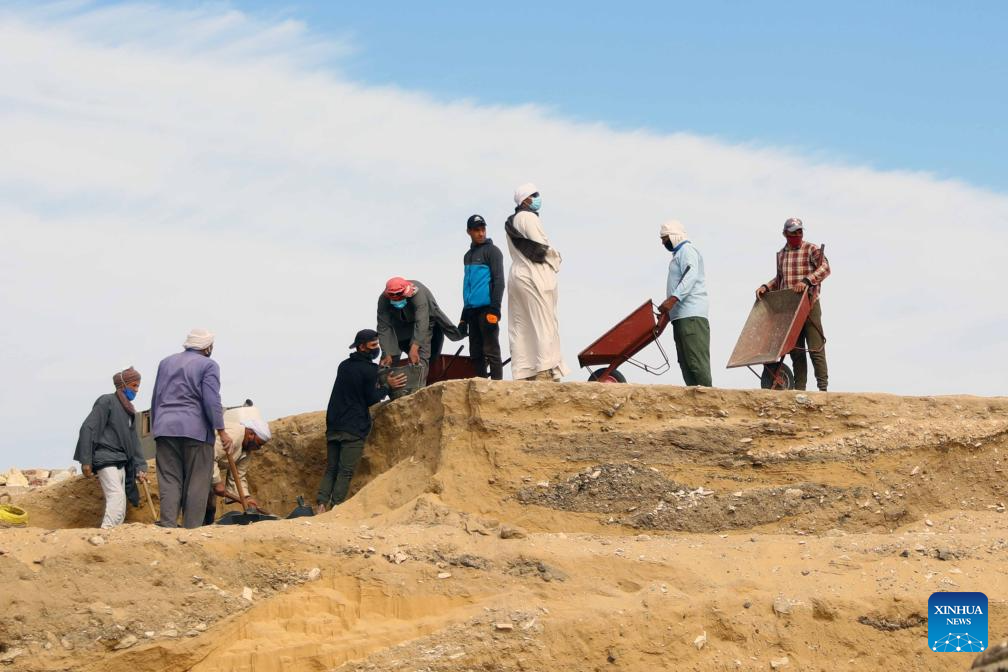
Egyptian workers work in archaeological site on the West Bank of Luxor, Egypt on April 28, 2026. (Radwan Abu Al-Majd/Handout via Xinhua)


