
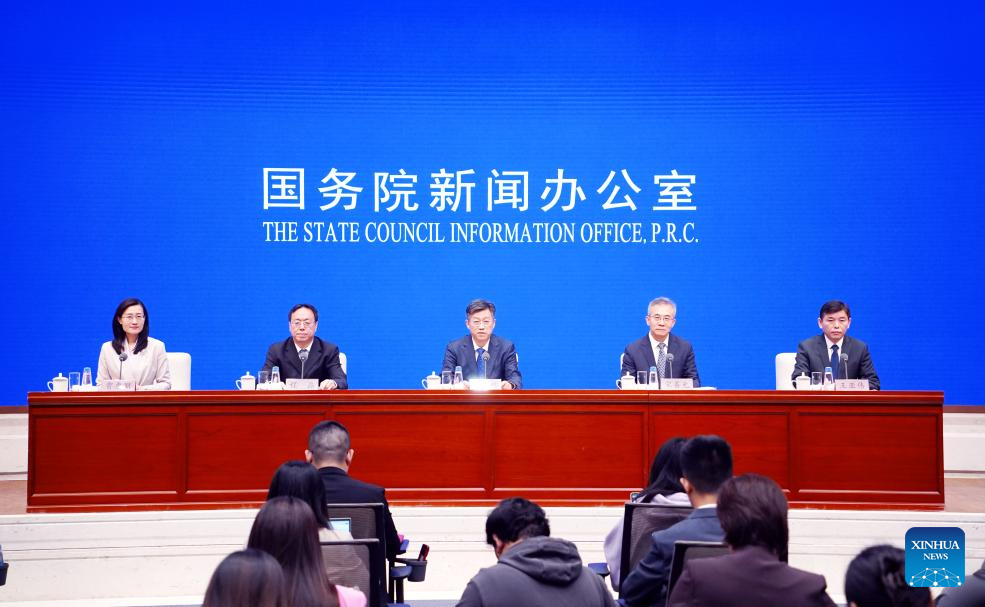
The State Council Information Office (SCIO) holds a press conference on advancing meteorological services to support economic and social development and enhance people's well-being, in Beijing, capital of China, April 28, 2026. (Xinhua/Pan Xu)
BEIJING, April 28 (Xinhua) -- As the world braces for a potential El Nino event later this year, China has unveiled a significant upgrade to the "MAZU" early warning system, a cloud-based meteorological platform designed to help countries, particularly developing ones, better anticipate and respond to extreme weather.
This marks one of the latest milestones in China's participation in global cooperation to tackle climate change.
"MAZU," which literally means "Sea Goddess" in the Minnan culture of China, is the world's first national-level action plan in response to the United Nations' Early Warnings for All initiative, said Chen Zhenlin, head of the China Meteorological Administration (CMA), at a press conference on Tuesday.
Since 2024, meteorological agencies in more than 40 countries have accessed MAZU through the cloud, with customized versions deployed in nations including Pakistan and Ethiopia, Chen added.
Sohail Babar Cheema, an expert from the Pakistan Meteorological Department, noted that with the cloud-based system, information can be accessed anytime, from any city or region across the country.
Last week, the CMA unveiled an updated MAZU system and delivered its customized versions to Jordan and Sri Lanka. The upgraded system features additional overseas cloud service nodes, boosting platform loading speeds by sixfold and reducing data response times sevenfold, thereby improving access stability and efficiency for users in Africa and South Asia.
Supported by multiple AI forecasting models, the system outperforms current internationally advanced counterparts in areas such as heavy precipitation forecasting, according to the CMA.
Raed Rafid, general director of the Jordan Meteorological Department, said the system utilizes multiple meteorological models to tackle floods, droughts, heatwaves and cold spells common to his country.
Athula Karunanayake, director general of Sri Lanka's Department of Meteorology, called the customized MAZU system a transformative advancement, noting that the training on local meteorological data effectively enhances forecast accuracy and disaster response capacity.
China is set to deepen collaboration with United Nations bodies in fields ranging from disaster relief and climate action to food security and humanitarian aid, while continually upgrading the MAZU solution to cater to the diverse needs of nations worldwide, Chen said.
Celeste Saulo, secretary general of the World Meteorological Organization (WMO), expressed hopes that MAZU will be further promoted globally, particularly in the Global South, to boost early warning capabilities and global disaster mitigation.
The WMO forecast reported that an El Nino event is expected to develop as early as May-July 2026. ■


