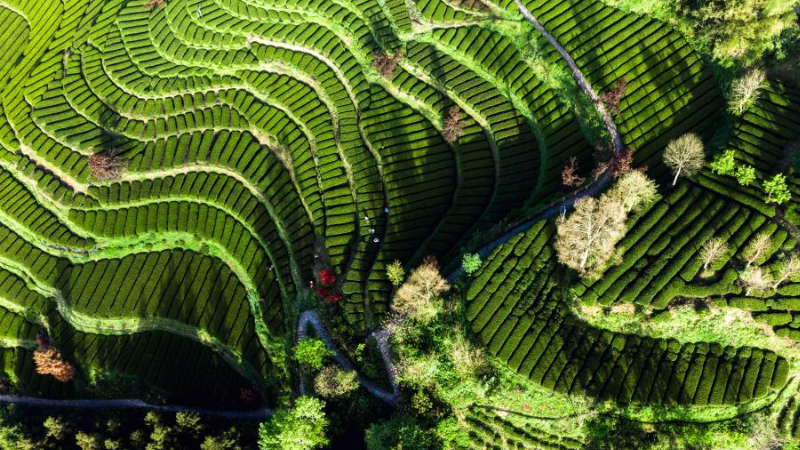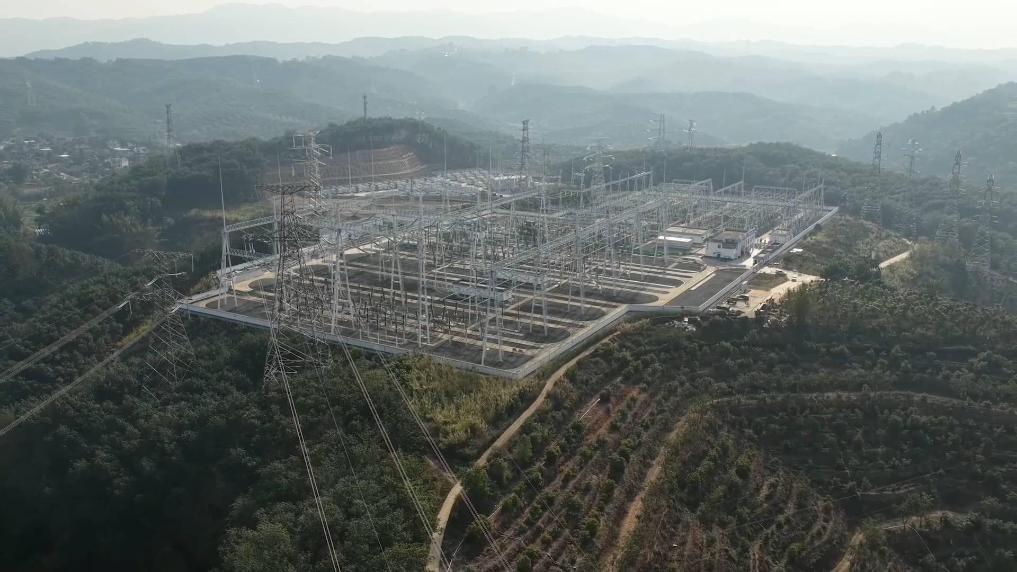
* China, as one of the countries most severely affected by desertification, has brought 53 percent of its treatable degraded land under effective management, and has contributed roughly 25 percent of the world's new green coverage.
* China has been sharing its desertification control concepts, technologies and expertise worldwide, training nearly 100 specialists from developing countries each year.
* China has also turned its fight against desertification into a driver of economic development and improved livelihoods.
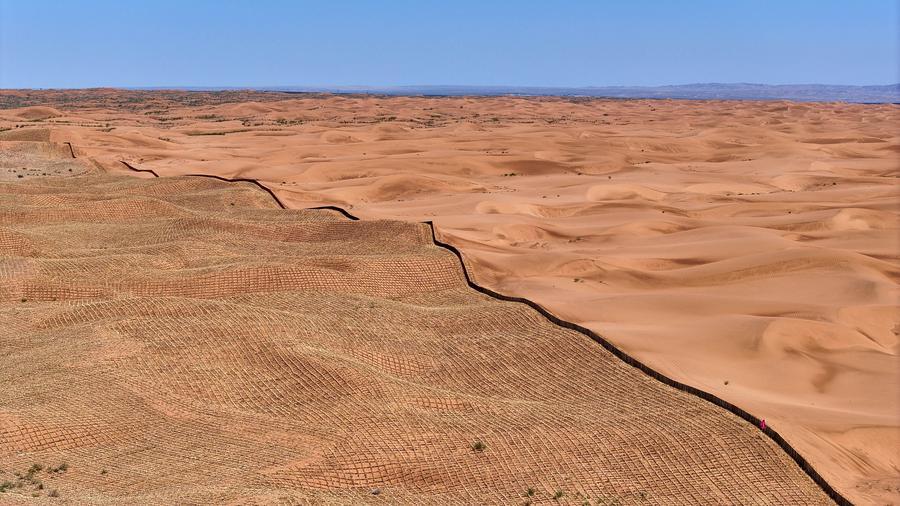
BEIJING, April 22 (Xinhua) -- Along the southeastern edge of China's Tengger Desert, workers were pressing bundles of straw rope into the sand in a grid pattern, like a giant checkerboard holding the dunes in place.
"We are reinforcing the windbreak and sand-blocking belt with a newly developed grass grid barrier. It is less labor-intensive than the traditional version, faster to install, and lasts longer -- five to six years," said Tang Ximing, a forestry engineer in Zhongwei, a city in Ningxia Hui Autonomous Region.
Ningxia lies deep in northwestern China, hemmed in by deserts on three sides, with Zhongwei guarding the corridor where the Tengger Desert historically pushed southeast.
In the 1950s, the city pioneered the straw checkerboard technique to protect the Baotou-Lanzhou Railway -- China's first rail line through a desert -- from being buried by dunes. Decades of continuous efforts followed, and Ningxia eventually became the first provincial-level region in China to reverse desertification.
China's battle against desertification has unfolded on an even larger scale across the country.
As one of the countries most severely affected by desertification globally, China has its desertified areas mainly concentrated in the northwest, north and northeast, which are dubbed the "three-north."
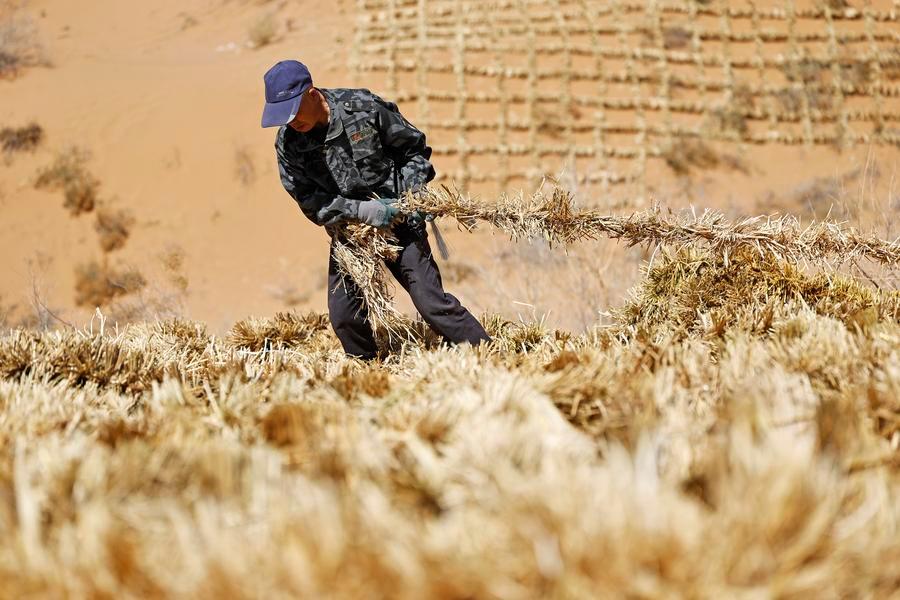
In 1978, China launched its landmark ecological project, the Three-North Shelterbelt Forest Program, which has become the world's largest afforestation endeavor.
After decades of sustained efforts, China has brought 53 percent of its treatable degraded land under effective management, and has contributed roughly 25 percent of the world's new green coverage in recent years.
China has also turned its fight against desertification into a driver of economic development and improved livelihoods.
At a factory in north China's Inner Mongolia Autonomous Region, woody waste from pruning windbreak trees was being sorted, shredded and compressed into biomass pellets, which could match coal in calorific value, cost less to produce and emit far less carbon.
"We process more than 36 tonnes of raw material a day into over 30 tonnes of biomass pellets," said the workshop production manager, adding that the products sell well across multiple regions and new jobs have been created for nearby farmers and herders.
Similar success stories are emerging across China. In Ningxia, desert tourism and solar energy have turned barren dunes into sources of income. In northwest China's Gansu Province, farmers along the desert fringe grow Cistanche and desert onions, with more than 100 sand industry enterprises and production bases.
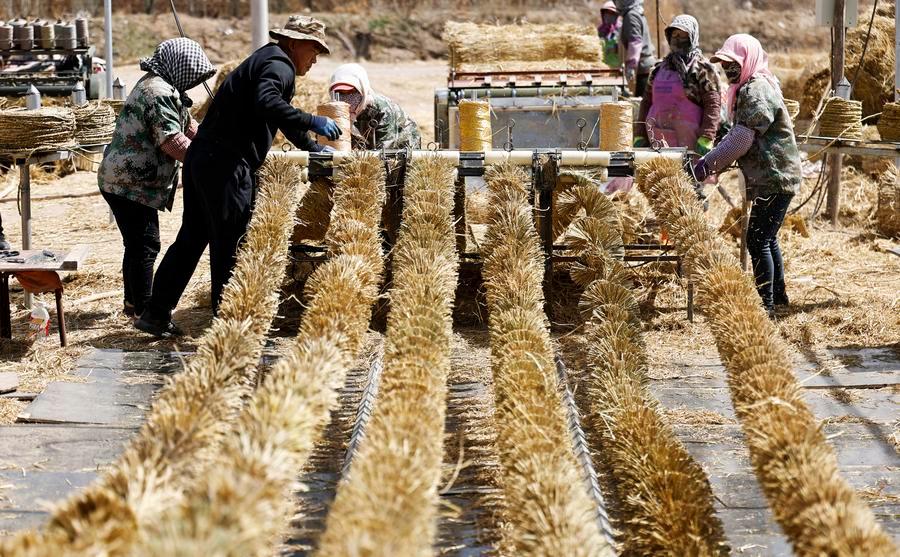
Beyond its borders, China is increasingly sharing its desertification control experience with the world. As one of the earliest signatories to the United Nations Convention to Combat Desertification (UNCCD), it has been exporting its concepts, technologies and expertise worldwide.
In just over a month, Kazakhstan's Almaty will enter its planting season, and quinoa varieties developed by a Ningxia agri-tech company will be sown across large stretches of saline-alkali land there.
Wu Xiarui, the company's chairwoman, said trials started in 2018 and through years of practice, the project has steadily increased land utilization rates and soil fertility, while cutting water use by more than 30 percent and fertilizer consumption by 15 to 30 percent.
"We are actively expanding cooperation with Belt and Road countries such as Uzbekistan and Egypt, building an international model that combines technology export, ecological restoration and shared industrial gains," Wu said.
Earlier this month, a week-long international training program on desertification control, commissioned by the UNCCD secretariat, was held in Yinchuan, Ningxia, with 34 participants from 18 countries, including Mongolia, the Republic of Korea and India.
Each year, China trains nearly 100 desertification control specialists from developing countries in Asia, Africa and Latin America through such programs.
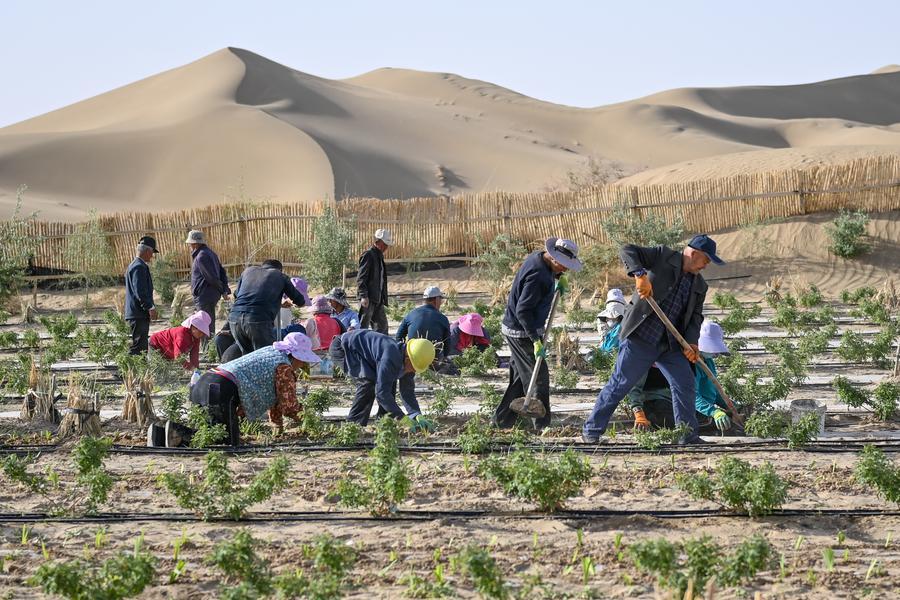
China's experience has reshaped global desertification control efforts. In Mongolia, Chinese experts have contributed to the One Billion Trees initiative, which aims to plant 1 billion trees by 2030, and helped build ecological restoration demonstration zones.
In Saudi Arabia, China's model of using photovoltaic installations to stabilize desert land has been successfully introduced, offering a new approach to both desertification control and energy transition. And along the southern edge of the Sahara, the lessons of China's Three-North program have been applied to the Great Green Wall Initiative.
"We have only one Earth. The technologies China has developed for fighting desertification belong not just to China, but to all of humanity," said Feng Zhanwen, head of the China-Central Asia desertification control cooperation center.
This year, the center will build three physical projects in Central Asian countries and send experts to conduct two technical training sessions on desertification control, Feng said.
(Video reporters: Zhang Sheng, Xie Jianwen, Yang Zhisen, Wang Peng, Cheng Nan, Liu Keying, He Jin, and En Hao; Video editors: Zhang Yichi, Zhang Mocheng, and Yu Jiaming)■