
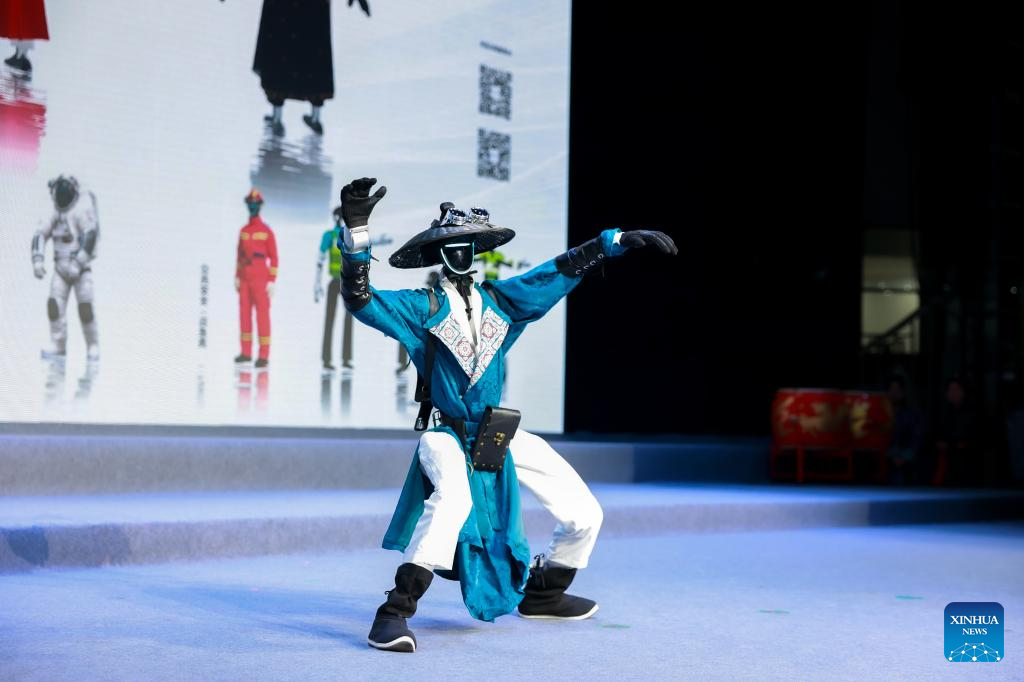
A humanoid robot in Hanfu performs martial arts during a brand show in Caoxian County, east China's Shandong Province, April 11, 2026. (Xinhua)
by Xinhua writers Ji Hang, Ma Yunfei and Shao Kun
JINAN, April 17 (Xinhua) -- Forget a conventional Hanfu launch. At a brand show in Caoxian County, east China's Shandong Province, models took the stage holding pint-sized dolls dressed in matching traditional attire, while humanoid robots also appeared in Hanfu, catching much of the audience's attention.
Amid China's growing enthusiasm for traditional culture, the event offered a vivid glimpse of how one of the country's top Hanfu production hubs is evolving.
In Caoxian, local Hanfu companies that once depended heavily on large-scale manufacturing are now moving further into niche markets and original design, extending their craftsmanship to robots, dolls and furry friends, while also developing products that fit modern lifestyles better.
FROM HUMANS TO HUMANOIDS AND DOLLS
"We used to make Hanfu only for people, but last winter we started exploring clothes for robots," said Hu Chunqing, general manager of Caoxian Chenfei Clothing.
With China's robotics industry expanding and its uses becoming more varied, Hu said, combining Hanfu with robots is both a way to promote traditional culture and a new direction for cross-industry innovation.
In just over a month, his team created more than 20 sets of Hanfu tailored to different robot models, ranging from martial arts styles to those based on clothes from different dynasties.
"Making Hanfu for robots is very different from making it for humans," Hu said.
"First, you have to consider the robot's structure," he said, noting that his company worked with an academic institution to design outfits that fit the robots' body proportions and mechanical joints. "Material choice also matters. The clothes need to be easy to put on and take off, and suitable for heat dissipation."
Looking ahead, Hu sees robotic Hanfu becoming a type of "cultural accessory" for machines.
"Beyond stage performances, service robots in fields like healthcare and public safety could also wear Hanfu to add a cultural touch," Hu told Xinhua.
This move into niche categories also includes the miniature world. Yao Chixing, founder of local designer brand Luoruyan, made the doll-sized Hanfu displayed at the event. Though small, the outfits are far from cheap.
"Every single step of the production process is still required, and it's even harder," she added.
Her company already makes a range of Hanfu for adults and children, and now sees doll Hanfu as a promising new direction.
"Young people today love collectible toys and enjoy customizing outfits for their dolls," Yao said. "Doll Hanfu combines trendy toys with traditional culture. It also shows a sense of identity and cultural confidence."
Her brand has also tried other new ideas. In 2024, it launched a scented Hanfu series, where fabrics were infused with the fragrances of flowers like peonies, roses and lotus. It has also introduced lighter-colored horse-face skirts designed for everyday wear, including at work.
"We want to find ways to bring modern fashion into traditional Hanfu," Yao said.
FURRY FRIENDS IN FASHION
The trend does not end with robots and dolls. In Caoxian, Hanfu is also being adapted for pets.
Walking through a local pet industry showroom, visitors can find pet clothes inspired by Hanfu's cutting techniques and decorated with auspicious motifs, with some designs drawing on traditional craftsmanship like Su embroidery. Special styles have even been made for pets, including Tang-style short jackets.
Local company TAORAE specializes in pet apparel for animals of all sizes, with pet Hanfu making up about 20 percent of its product line.
"We noticed that more people were keeping pets, and there was also a greater demand for emotional value," said Cheng Zhanying, founder of TAORAE. "Caoxian's Hanfu design base also encouraged us to enter this niche market."
"Pet clothing ultimately reflects human aesthetics," Cheng said. "In that way, designing Hanfu for people and for pets follows a similar logic."
At the same time, practicality comes first, Cheng added. Because pets are active, the clothes must be comfortable and allow them to move normally. Based on customer feedback, the company has added adjustable details to help the outfits fit pets better.
Lan Shouku, general manager of Chong Taotao (Shandong) Pet Supply Chain Co., Ltd., is another entrepreneur betting on the sector.
With support from the local government, he returned from Shanghai in early 2025 and set up a company focusing on pet apparel, home products, food and grooming items.
"Some low-end and similar products from the past no longer meet the needs of today's young consumers," he said. "We focus on helping local factories with innovation and product development. Pet Hanfu is one of our directions."
Lan and his team designed a line of red pet outfits that became a hit during the 2026 Spring Festival.
During the holiday, when many people wore festive Hanfu to visit relatives and friends, even their pets were dressed in celebratory outfits. This year, Lan's team has already developed more than 30 new pet Hanfu designs.
FROM SCALE TO SPECIALIZATION
Caoxian's story with Hanfu began nearly two decades ago, when a small number of villagers started making Hanfu costumes for photo studios and live performances. As e-commerce developed in China, local manufacturers acted quickly to open online stores and found strong market demand.
Today, the county, with a population of over 1.7 million, is home to more than 2,800 Hanfu businesses, directly employing nearly 100,000 people. In 2025, its total annual online and offline Hanfu sales exceeded 13 billion yuan (about 1.9 billion U.S. dollars). Within a 5-kilometer radius, the county has a complete industrial chain covering design, cutting, pattern making, embroidery and printing.
Caoxian now produces nearly half of China's Hanfu dresses.
However, the boom has also brought new pressures. As the market becomes more crowded, local companies are increasingly turning to original design, stronger branding and more specialized products to stay competitive.
At the launch event, Luoruyan unveiled six Hanfu dresses created in collaboration with China's latest historical epic TV series "Swords into Plowshares," marking the first time a Caoxian Hanfu brand had launched a collection tied to a hit TV series.
At the same event, an industrial base for intelligent robot apparel was also officially launched. Companies from Caoxian and other areas joined hands to explore deeper integration between traditional Hanfu and modern intelligent technology.
Xie Fangming, full-time vice chairman of the China Fashion Association, said Caoxian has grown from a processor of performance costumes into China's leading production base for original Hanfu. It now has the country's top industrialization level and production capacity in the sector.
Xie added that the association will provide support in areas such as design talent, original copyright protection and brand standards, helping it move from a large production base to a creative hub.
Hanfu, the traditional clothing of China embellished with intricate embroidery, dates back to the Han Dynasty (202 BC-220 AD). It has developed over history, resulting in a diverse array of designs.
"Hanfu is a carrier of culture. By designing Hanfu for robots, dolls and pets, we hope to promote traditional culture across different industries through crossover innovation," said Hu. Enditem
(Xinhua reporter Wang Hongshuo in Jinan also contributed to the story.)
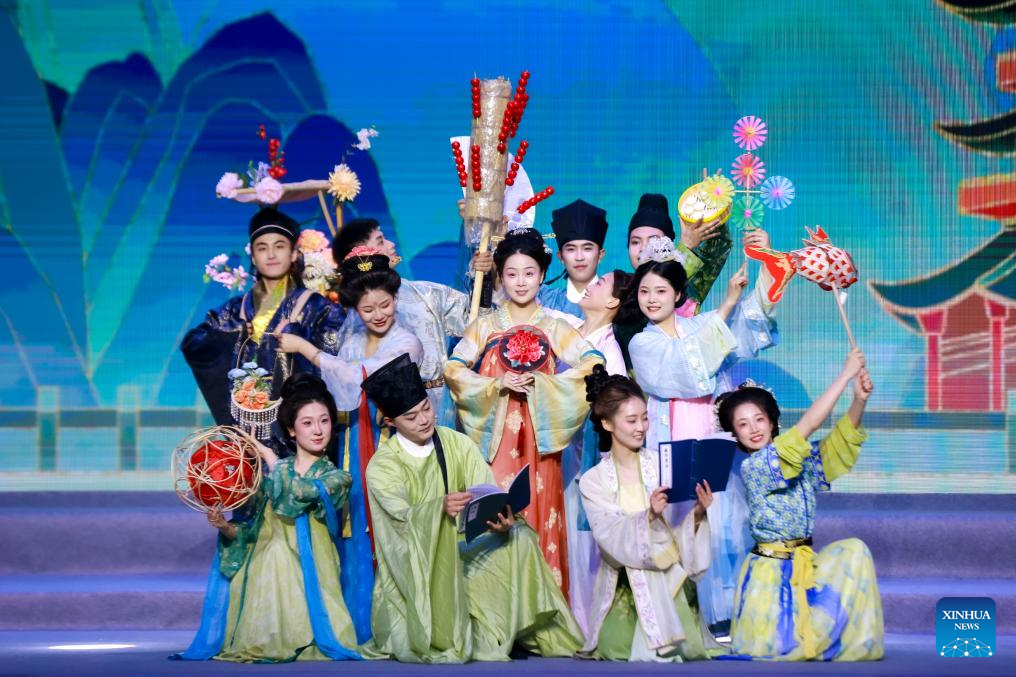
This photo taken on April 11, 2026 shows models in Hanfu performing during a brand show in Caoxian County, east China's Shandong Province. (Xinhua)


