
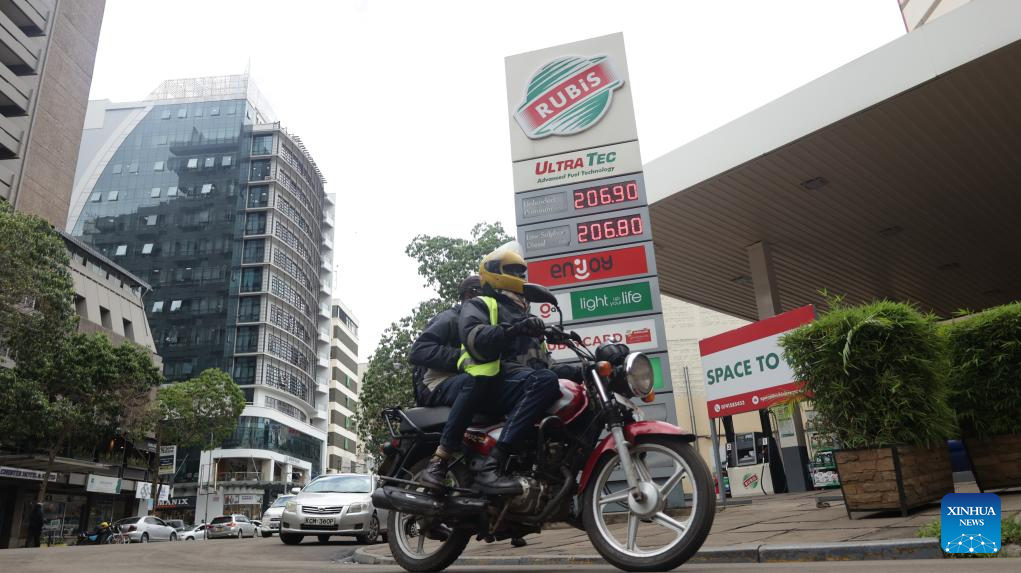
A motorcyclist passes by a petrol station at the central business district of Nairobi, capital of Kenya, April 15, 2026. (Photo by John Okoyo/Xinhua)
NAIROBI, April 15 (Xinhua) -- At a busy bus stop on the outskirts of Nairobi, the capital of Kenya, commuters wait in long queues as transport fares rise in response to surging fuel prices.
"I paid 0.61 dollars this morning instead of the usual 0.38," said Moses Kalondu, an office worker commuting from Mlolongo to the city center. "This hurts, and it has made commuting more expensive."
Kalondu's experience reflects a broader reality. Across Kenya, millions are grappling with a record surge in fuel prices, widely seen as a direct consequence of the Middle East conflict that has disrupted global supply chains and unsettled international markets.
On Tuesday, the country's energy regulator raised the prices of super petrol and diesel by record margins of 28.69 shillings (about 0.22 U.S. dollar) per liter and 40.3 shillings per liter, respectively.
The effects were immediate. In the public transport sector, operators, commonly known as matatus, raised fares by about 25 percent overnight.
"We are simply adjusting to the current fuel situation," said Albert Karakacha, chairman of the Matatu Owners Association. "The cost of fuel has risen beyond what operators can absorb while maintaining current fares."
The impact extends beyond daily commuters. Long-distance travelers are also feeling the pinch, with bus operators increasing fares by between 1.54 dollars and 3.86 dollars. Tickets from Nairobi to Kisii now cost 13.15 dollars, while fares to the coastal city of Mombasa have climbed to 23.21 dollars.
Beyond transport, the ripple effects are expected to spread across the broader economy, as rising fuel costs drive up the price of goods and services in a country heavily dependent on imported petroleum.
Freight operators are already adjusting. Newton Wangoo, chairman of the Kenya Transporters Association, said members would review their cost structures to reflect the new realities.
In response, the government has moved to cushion consumers. Opiyo Wandayi, cabinet secretary for energy and petroleum, said authorities would deploy 48 million dollars in subsidies to ease the burden.
Despite these interventions, analysts warn of sustained economic pressure. Macharia Munene, a professor of international relations, said the Middle East conflict could have lasting consequences for Kenya's economy, noting that "the global nature of this crisis means its effects will not disappear quickly."
Faced with rising costs, some workers are exploring alternatives, including shifting to remote work to reduce commuting expenses.
Meanwhile, concerns are growing that higher fuel prices could fuel inflation. Kenya's inflation rate stood at 4.4 percent in March, slightly up from 4.3 percent in February, with price pressures continuing to build.
Although the World Bank and the National Treasury have projected Kenya's economic growth of at least 5 percent this year, supported by recovering economic activity, rising fuel costs now pose an increasing risk to that outlook. ■

A motorcyclist fuels her motorbike at a petrol station in Nakuru County, Kenya, April 15, 2026. (Photo by Sheikh Maina/Xinhua)


