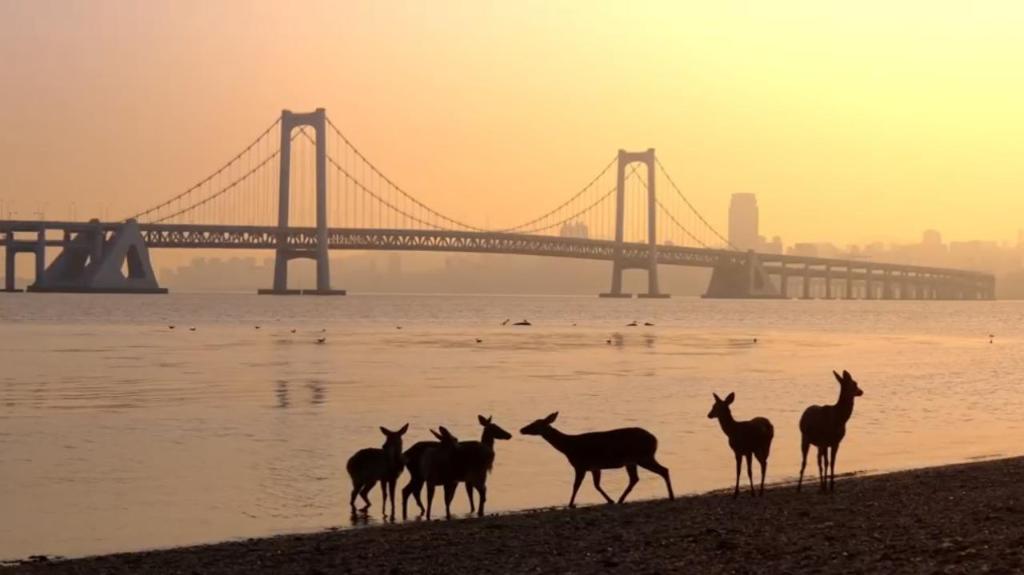
* With growing public awareness of ecological conservation, people and authorities across China are stepping up wildlife protection, and more people are embracing new ways to live in harmony with wild animals.
* According to the National Forestry and Grassland Administration, China now protects 988 species of key wildlife and 1,924 species of terrestrial wildlife with important ecological, scientific and social value, and the scope of protection continues to expand.
* In addition to rescuing and protecting rare animals, China has continuously strengthened ecological and environmental protection, as well as scientific research and monitoring of wildlife, to provide them with more sustainable habitats.
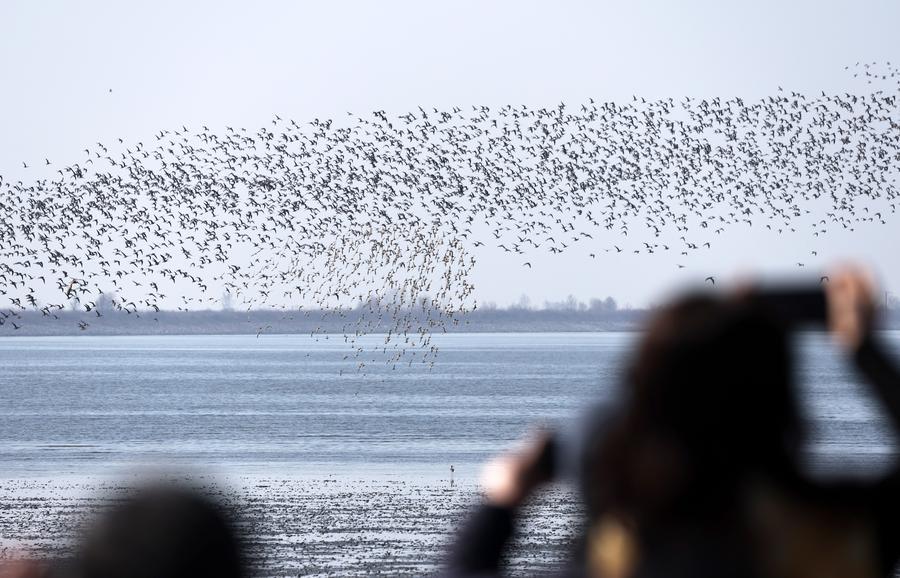
SHENYANG, April 10 (Xinhua) -- As spring arrives, tens of thousands of migratory shorebirds traveling all the way from Australia and New Zealand converge on the coastal mudflats of the Yalu River estuary in Dandong, northeast China's Liaoning Province, while rising tides reshape the landscape.
There, dense flocks ripple like waves as they surge and dive across the sky, while birdsong mingles with the rapid clicking of camera shutters, ushering the wetland -- a paradise for bird lovers and photographers -- into its most vibrant season of the year.
With growing public awareness of ecological conservation, people and authorities across China are stepping up wildlife protection, and more people are embracing new ways to live in harmony with wild animals.
CLOSER ENCOUNTERS
Each year from March to May, hundreds of thousands of migratory shorebirds arrive at the Yalu River estuary, where they rest and refuel for roughly five weeks before continuing their northward migration.
The estuary is part of the Migratory Bird Sanctuaries along the Coast of the Yellow Sea-Bohai Gulf of China (Phase II), which was inscribed on UNESCO's World Heritage List in 2024.
"The golden hours for photographing bird flocks are at sunrise and sunset," said Jiang Xinhe, a local photography enthusiast.
For years, he and his wife have trekked through the wetlands of the Yalu River estuary, patiently following migratory birds with their cameras to capture scenes of harmonious and magnificent natural beauty.
In Dalian, a city in southern Liaoning Province, people enjoy surprisingly close interactions with wildlife, even amid towering skyscrapers and bustling traffic. Wild sika deer roam leisurely through parks and woodlands, sometimes venturing into residential neighborhoods and onto roads.
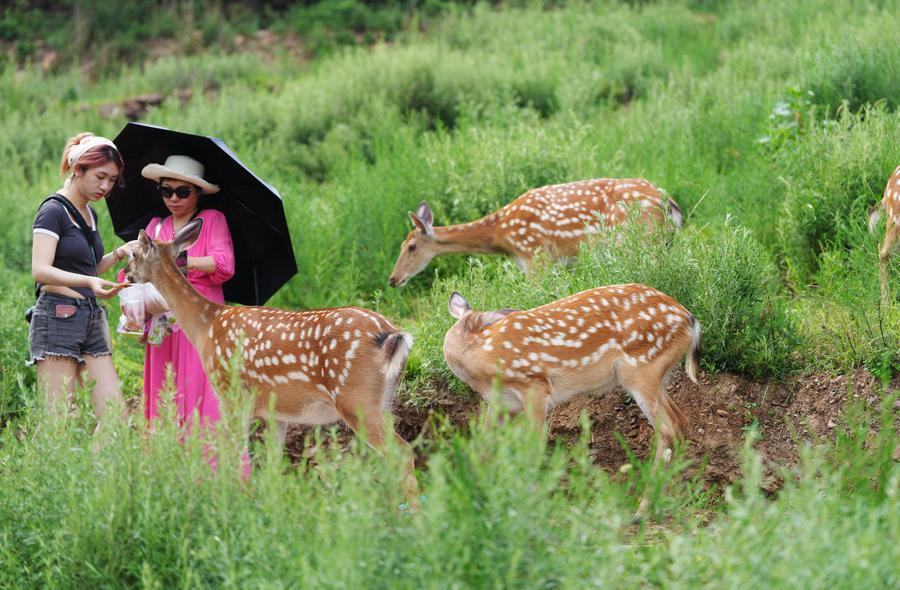
"This group of wild sika deer originally came from a sika deer farm," said Gu Guoqiang, executive vice president of the Dalian wildlife and plant conservation association. "After a fence collapsed, some deer escaped. Over more than 20 years, they have bred in the wild for over three generations and can now be regarded as a truly wild population," Gu added.
Sika deer were listed as a national first-class protected species in 2021. In Dalian, wild sika deer are coming into increasingly frequent contact with humans, and their wariness toward people has gradually faded, allowing them to coexist at close range.
The deer have become a local cultural and tourism attraction, drawing visitors from across the country to photograph and interact with them. A dedicated volunteer team of more than 500 people also works quietly to protect them.
Early each morning, volunteers Zhang Yuan and her companions walk along the misty mountain paths of Lianhua Mountain in Dalian, carrying bags of soybean residue. "I can't sleep without hearing the deer each day," Zhang said. At around 5:30 a.m., she and her team visited three tofu shops to buy 10 bags of soybean residue, each weighing 40 kg, to provide scientific supplementary feeding for over 200 sika deer in the forest.
Knowing that sika deer prefer to forage on vines and herbaceous plants, the volunteers sow alfalfa seeds on the mountain slopes every spring to ensure the deer have enough food in summer and autumn. They have also installed water tanks exclusively for the wild sika deer to supply fresh water and meet their drinking needs.
RESCUE TO RELEASE
According to the National Forestry and Grassland Administration, China now protects 988 species of key wildlife and 1,924 species of terrestrial wildlife with important ecological, scientific and social value, and the scope of protection continues to expand. This expansion is reflected not only in longer protected species lists, but also in timely rescue of every injured or disoriented animal.
In the summer of 2024, a young spotted seal only a few months old appeared in waters near the Beibu Gulf in south China's Guangxi Zhuang Autonomous Region. Its cute appearance drew many local residents and tourists to gather around and take photos, and people gave it a lovely name -- Nana.
As a national first-class protected species, spotted seals migrate to the Liaodong Bay in the Bohai Sea between October and December each year. They give birth and nurse pups on sea ice from January to February, stay in the area to molt from March to April, and gradually swim out of the Bohai Sea to embark on their return journey starting in mid-to-late April.
"When Nana was found, it had five visible wounds, likely from collisions or scrapes against sharp objects or rocks," said Tian Jiashen, director of the marine rare animal protection research office at the Liaoning academy of marine fisheries science. He added that Nana probably became lost while chasing fish, encountering unusual weather, or experiencing a disruption to its natural navigation.
After living for a long time in overly warm, unsuitable seawater, Nana grew increasingly weak. In October 2024, the marine bureau of Beihai City in Guangxi launched an emergency rescue plan, moved Nana to a professional facility for treatment, and designed a tailored care plan to address its infected wounds and unstable body temperature.
After more than a year of care and rehabilitation, Nana's weight rose from 35 kg to 50 kg, and its wounds gradually healed. On Nov. 25, 2025, Nana was flown back to Dalian. The young seal lay quietly in its transport crate, a timid look in its eyes.
"Nana didn't eat for a whole week after arriving because it was unfamiliar with the environment, but now it eats more than a dozen fish a day," Tian said. "Its weight has reached 76.8 kg."
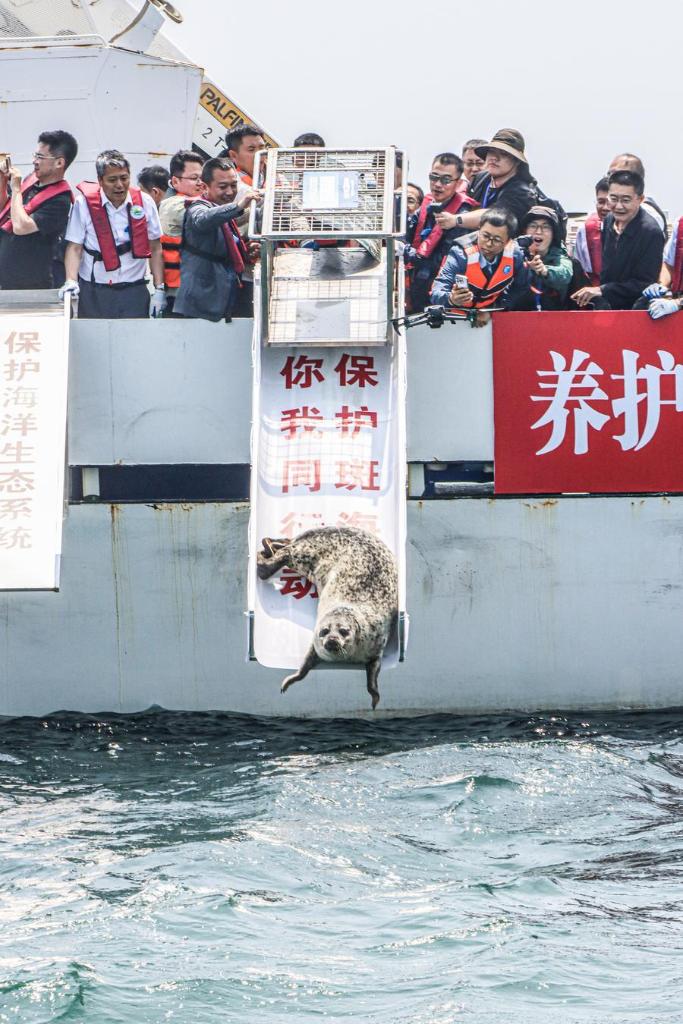
At the rescue pool of the marine fisheries academy, Nana is now lively, playful and at ease in the presence of people. Having completed recovery and rewilding training, staff have assessed it against release criteria, including the ability to hunt live prey, maintain steady weight gain, and show blood test results matching healthy wild seals. Nana is expected to return to its natural habitat on April 16.
Wang Zhen, a rescue specialist who has worked at the academy since 2018, has looked after and released many spotted seals. "I always feel sad to see them leave, but I know the ocean is where they truly belong," Wang said.
Since 2005, the academy has rescued a total of 241 spotted seals and successfully released 220 back into the wild. The released seals were fitted with tracking beacons. Data shows most quickly rejoined and integrated into wild seal groups.

HABITAT RESTORATION
In addition to rescuing and protecting rare animals, China has continuously strengthened ecological and environmental protection, as well as scientific research and monitoring of wildlife, to provide them with more sustainable habitats.
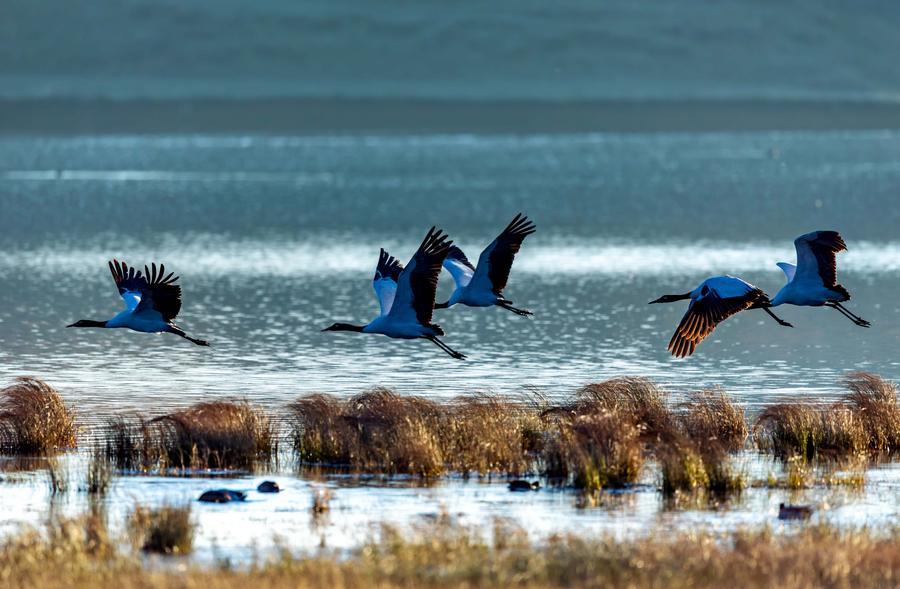
Over the years, the black-necked crane provincial nature reserve in the Hui and Yi Autonomous County of Xundian, southwest China's Yunnan Province, has stepped up ecological protection and restoration, greatly improving habitat quality and supporting a steady recovery of the black-necked crane population. According to the reserve authority, a synchronized survey in 2026 recorded 74 cranes in the reserve, 12 more than the same period last year.
On Dec. 30, 2025, a notable behavioral change was observed for the first time among black-necked cranes, which have long used shrubs and grasslands on hillsides as their main night roosts.
Monitors recorded a family of four black-necked cranes roosting alongside two black storks, also a national first-class protected species, in shallow water until their northward migration in mid-March this year. This return to shallow wetland roosting indicates steady improvement in the reserve's wetland ecological functions.
Elsewhere, Dalian has established a national nature reserve for spotted seals covering an area of over 5,600 square kilometers. By employing drones, maritime scientific surveys and other methods, authorities have built an all-weather ecological monitoring network to track population movements and habitat changes in real time. They have also worked with multiple departments on special operations, strengthening protection through maritime patrols and community outreach.
Thanks to strengthened conservation over recent decades, the spotted seal population in the Liaodong Bay has remained stable at around 2,000 individuals and shown an increasing trend.
In January, the reserve administration captured rare footage of spotted seals leaving the sea ice to give birth on land on an island near Dalian. "This monitoring has brought many unexpected discoveries, especially our use of infrared technology to precisely document intense mating competition among male spotted seals at night, which is a truly rare sight," said Bi Hengtao, deputy director of the bureau.
Meanwhile, a campaign to remove fencing and restore wildlife migration corridors has achieved phased results in Bayannur City, north China's Inner Mongolia Autonomous Region, within a national nature reserve dedicated to protecting the Mongolian wild ass, a national first-class protected species, and its habitat.
Previously, the border wire fencing and numerous self-built nets erected by herders inside the reserve fragmented wildlife habitats, blocked migration, foraging, drinking and breeding routes, severely limiting animal movement and disrupting population exchange.
So far, 31,000 meters of abandoned net fencing have been cleared from the reserve's core area, resulting in a significant reduction in wildlife hoof injuries and deaths from entanglement, as well as a gradual restoration of habitat connectivity.
(Reporting by Cui Enhui, Wang Bingkun, Zhang Boqun, Yu Yetong and Wu Jiangmin; Video reporters: Jiang Zhaochen, Zhao Yong and Yang Qing; Video editors: Zhang Nan, Roger Lott, Luo Hui, Li Qin and Zheng Qingbin) ■