
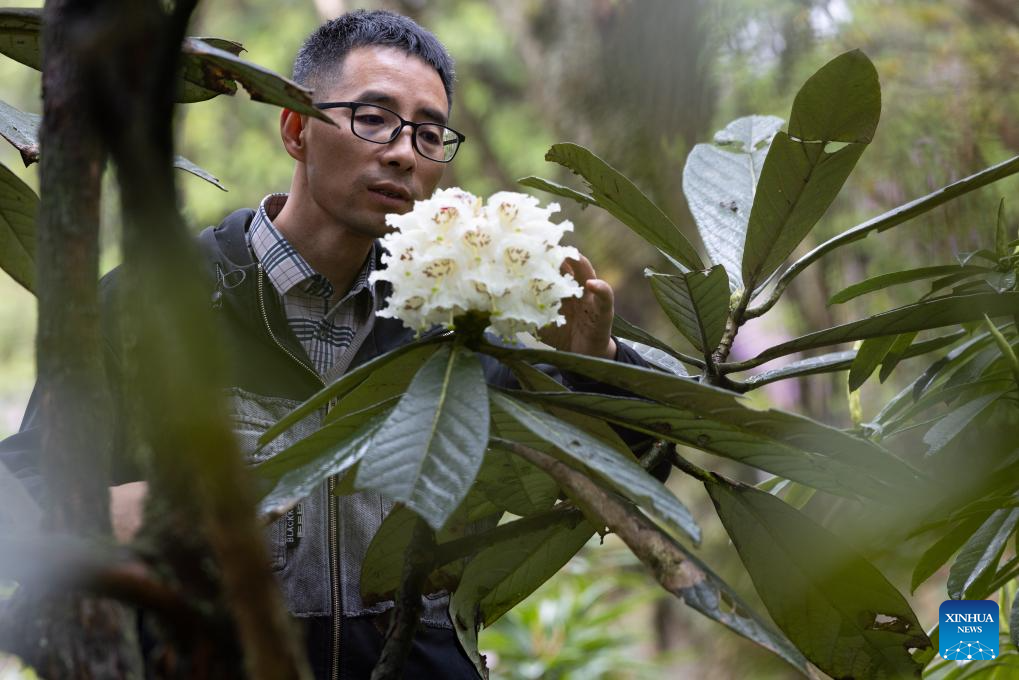
Researcher Wang Fei checks blooming Rhododendron sinogrande at the West China Subalpine Botanical Garden in Chengdu, southwest China's Sichuan Province, April 8, 2026. A batch of Rhododendron sinogrande, an alpine rhododendron species, recently bloomed for the first time here after 29 years of artificial cultivation.
According to researchers at the West China Subalpine Botanical Garden, Rhododendron sinogrande is naturally distributed in high-altitude primeval forests in southwest China's Yunnan and Xizang, while its artificial propagation is characterized by a long cycle and high difficulty.
This achievement fills the gap in the flowering records of this species under ex-situ conservation in China, providing key living specimens and practical experience for the conservation of alpine rhododendrons and biodiversity research in China.
The seeds of this batch of Rhododendron sinogrande were collected in October 1997 from their native habitat at an altitude of 3,000 meters in Lijiang of Yunnan Province. Researchers completed sowing and seedling cultivation at the West China Subalpine Botanical Garden in the spring of 1998. (Xinhua/Jiang Hongjing)
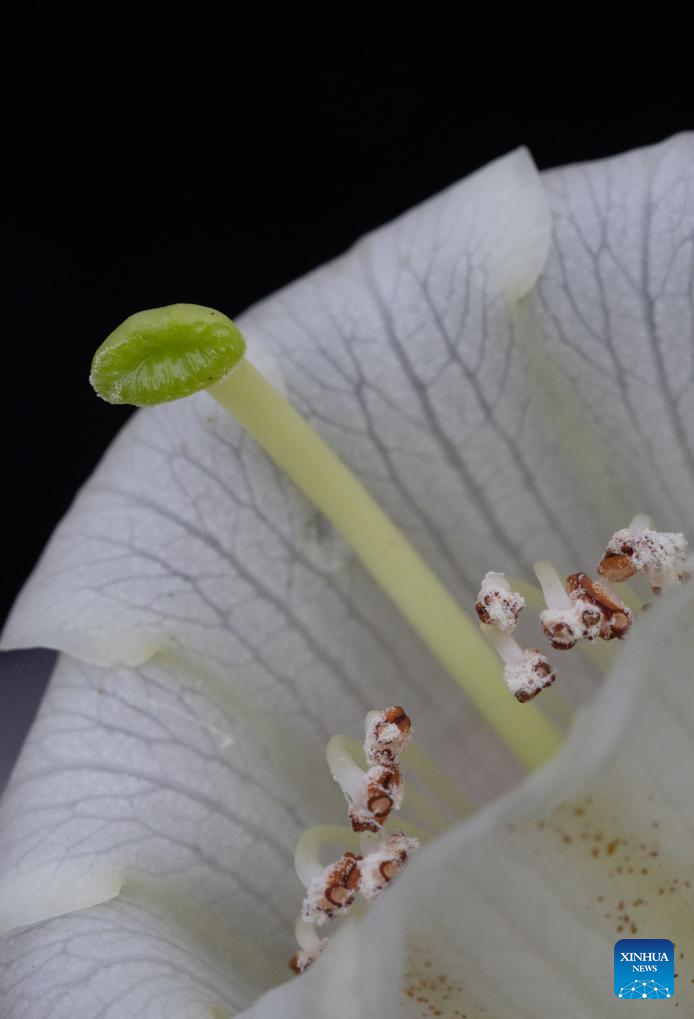
This photo taken with a macro lens on April 8, 2026 shows the stamen and pistil of a blooming Rhododendron sinogrande at the West China Subalpine Botanical Garden in Chengdu, southwest China's Sichuan Province. A batch of Rhododendron sinogrande, an alpine rhododendron species, recently bloomed for the first time here after 29 years of artificial cultivation.
According to researchers at the West China Subalpine Botanical Garden, Rhododendron sinogrande is naturally distributed in high-altitude primeval forests in southwest China's Yunnan and Xizang, while its artificial propagation is characterized by a long cycle and high difficulty.
This achievement fills the gap in the flowering records of this species under ex-situ conservation in China, providing key living specimens and practical experience for the conservation of alpine rhododendrons and biodiversity research in China.
The seeds of this batch of Rhododendron sinogrande were collected in October 1997 from their native habitat at an altitude of 3,000 meters in Lijiang of Yunnan Province. Researchers completed sowing and seedling cultivation at the West China Subalpine Botanical Garden in the spring of 1998. (Xinhua/Jiang Hongjing)
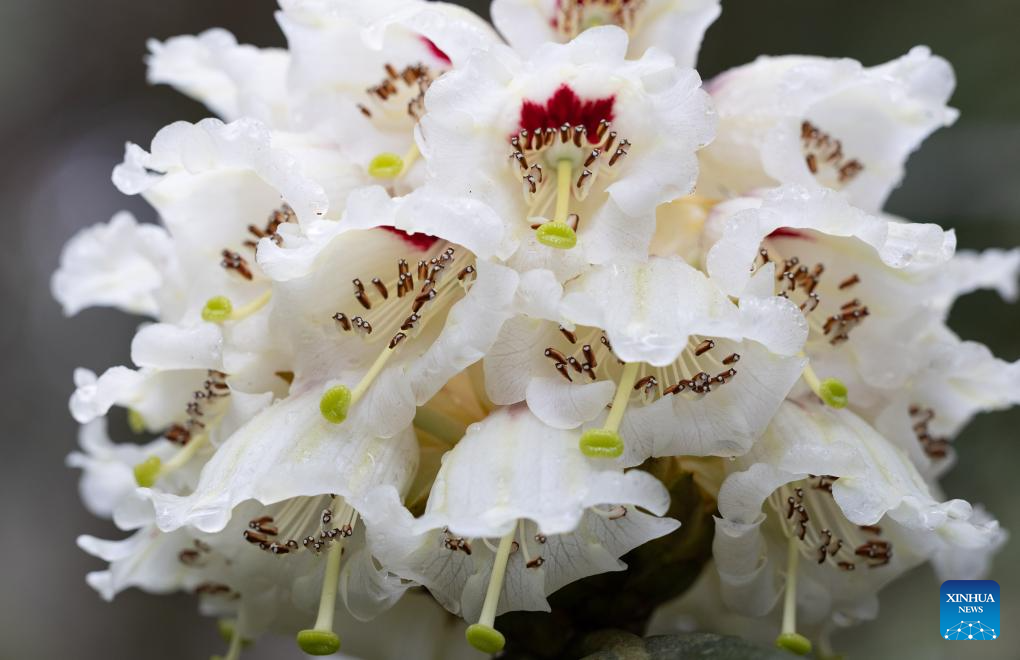
This photo taken on April 8, 2026 shows blooming Rhododendron sinogrande at the West China Subalpine Botanical Garden in Chengdu, southwest China's Sichuan Province. A batch of Rhododendron sinogrande, an alpine rhododendron species, recently bloomed for the first time here after 29 years of artificial cultivation.
According to researchers at the West China Subalpine Botanical Garden, Rhododendron sinogrande is naturally distributed in high-altitude primeval forests in southwest China's Yunnan and Xizang, while its artificial propagation is characterized by a long cycle and high difficulty.
This achievement fills the gap in the flowering records of this species under ex-situ conservation in China, providing key living specimens and practical experience for the conservation of alpine rhododendrons and biodiversity research in China.
The seeds of this batch of Rhododendron sinogrande were collected in October 1997 from their native habitat at an altitude of 3,000 meters in Lijiang of Yunnan Province. Researchers completed sowing and seedling cultivation at the West China Subalpine Botanical Garden in the spring of 1998. (Xinhua/Jiang Hongjing)
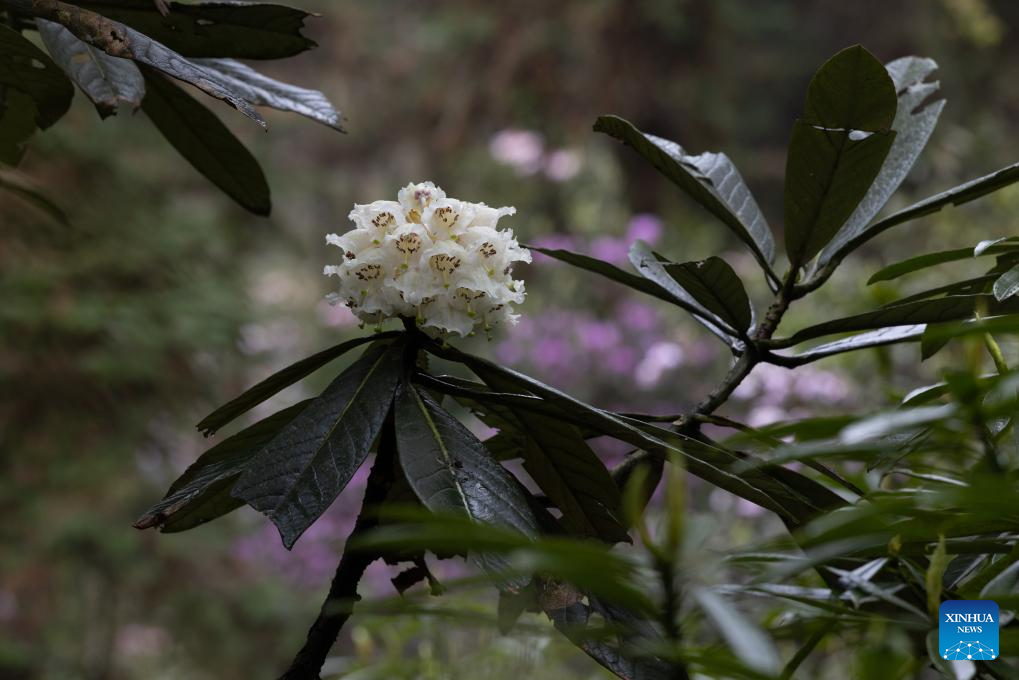
This photo taken on April 8, 2026 shows blooming Rhododendron sinogrande at the West China Subalpine Botanical Garden in Chengdu, southwest China's Sichuan Province. A batch of Rhododendron sinogrande, an alpine rhododendron species, recently bloomed for the first time here after 29 years of artificial cultivation.
According to researchers at the West China Subalpine Botanical Garden, Rhododendron sinogrande is naturally distributed in high-altitude primeval forests in southwest China's Yunnan and Xizang, while its artificial propagation is characterized by a long cycle and high difficulty.
This achievement fills the gap in the flowering records of this species under ex-situ conservation in China, providing key living specimens and practical experience for the conservation of alpine rhododendrons and biodiversity research in China.
The seeds of this batch of Rhododendron sinogrande were collected in October 1997 from their native habitat at an altitude of 3,000 meters in Lijiang of Yunnan Province. Researchers completed sowing and seedling cultivation at the West China Subalpine Botanical Garden in the spring of 1998. (Xinhua/Jiang Hongjing)
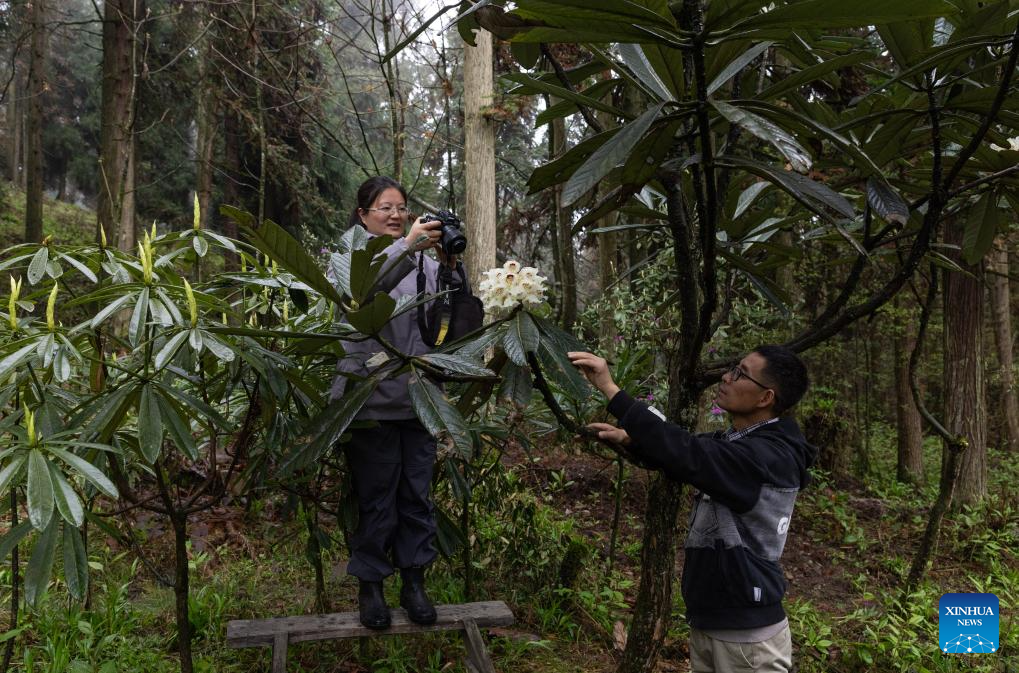
Researchers Wang Fei and Shao Huimin (L) record the condition of blooming Rhododendron sinogrande at the West China Subalpine Botanical Garden in Chengdu, southwest China's Sichuan Province, April 8, 2026. A batch of Rhododendron sinogrande, an alpine rhododendron species, recently bloomed for the first time here after 29 years of artificial cultivation.
According to researchers at the West China Subalpine Botanical Garden, Rhododendron sinogrande is naturally distributed in high-altitude primeval forests in southwest China's Yunnan and Xizang, while its artificial propagation is characterized by a long cycle and high difficulty.
This achievement fills the gap in the flowering records of this species under ex-situ conservation in China, providing key living specimens and practical experience for the conservation of alpine rhododendrons and biodiversity research in China.
The seeds of this batch of Rhododendron sinogrande were collected in October 1997 from their native habitat at an altitude of 3,000 meters in Lijiang of Yunnan Province. Researchers completed sowing and seedling cultivation at the West China Subalpine Botanical Garden in the spring of 1998. (Xinhua/Jiang Hongjing)


