
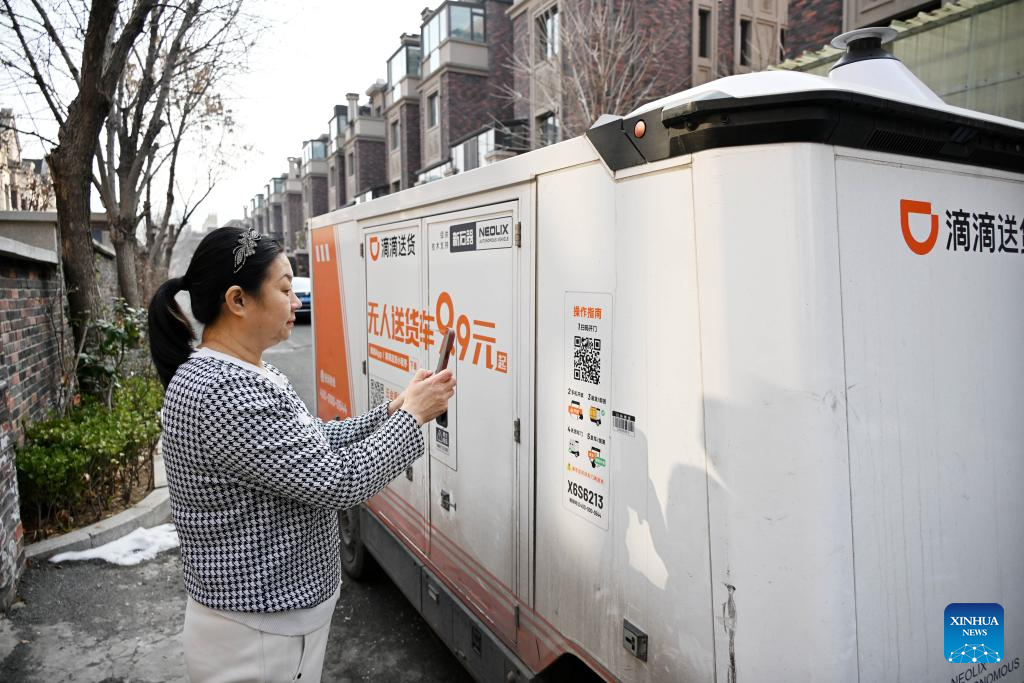
Zhou Li scans a QR code with her mobile phone to collect her order delivered by an unmanned delivery vehicle at her residential compound in Chengyang District, Qingdao, east China's Shandong Province, Jan. 28, 2026. (Xinhua/Li Ziheng)
JINAN, April 7 (Xinhua) -- An unmanned delivery vehicle pulled up in front of Zhou Li, a resident in Qingdao, east China's Shandong Province. After scanning the QR code on its side, she collected her order -- beer, sausage and roasted nuts -- before the vehicle quietly drove away on its own.
"I never imagined groceries could be delivered this way," Zhou said, still amazed by her first experience with the self-driving delivery vehicle. Costing 9.9 yuan (about 1.44 U.S. dollars) per time for deliveries within 30 km, the service was, in her view, reasonably priced.
In the coastal city of Qingdao, autonomous delivery vehicles are now a familiar sight on the streets. With no driver's section or steering wheel, the boxy vehicles resemble compact metal containers, measuring roughly half the size of a standard passenger car. Powered by artificial intelligence (AI), the vehicle can plan routes, recognize road conditions, detect traffic lights and nearby obstacles, and brake or maneuver to avoid collisions.
So far, unmanned delivery vehicles in China handle major tasks such as transporting packages from distribution hubs to local nodes and providing on-time delivery of perishable goods and cold-chain medicines. Some are also used in logistics within industrial parks.
Qingdao is now home to roughly 1,150 unmanned delivery vehicles, making it one of China's largest application sites. Neolix, a leading domestic player in this sector, holds a significant share of the fleet.
Last June, the company began piloting the unmanned delivery service in the eastern port city. Currently, vehicles running there have a load-bearing capacity of one tonne, a cargo space of six cubic meters, a top speed of 45 km per hour, and a battery range of 200 km.
Since 2021, Neolix has been developing AI-based vision algorithms that enable its vehicles to interpret complex traffic conditions with the judgment of an experienced driver, thus significantly cutting the cost of map collection and updates, according to Miao Qiankun, the company's chief technology officer.
As of last September, the firm had deployed more than 10,000 vehicles in total. In addition to working closely with domestic courier firms, the company has expanded its presence to over 15 countries and regions worldwide, including Japan, the Republic of Korea, Germany, and the United Arab Emirates.
In addition to Qingdao, the self-driving delivery vehicles have now entered daily delivery service across China.
In Shenzhen, a tech hub in south China's Guangdong Province, 432 unmanned vehicles completed 1.02 million autonomous deliveries last September, generating 8.7 million yuan in revenue. In Beijing, the on-demand delivery platform Meituan uses a hybrid model where self-driving vehicles move orders to relay points for couriers to complete final delivery. Even in rural areas of the Xinjiang Uygur Autonomous Region, unmanned vehicles deliver packages to remote villages 60 km away, where each trip often carries only two or three parcels -- too few to make traditional deliveries profitable.
"Using unmanned delivery vehicles can reduce operating costs by nearly half compared with the traditional delivery mode," said Yao Lei, a manager at Yunda Express, a major express provider in China.
As of June 2025, more than 100 cities in China have launched pilot programs that place autonomous delivery vehicles on public roads.
Last September, the Ministry of Commerce and other departments issued guidelines encouraging areas with suitable conditions to accelerate the development of operational and regulatory standards for unmanned delivery vehicles.
Low cost, convenience of dispatch, and high efficiency of the self-driving delivery vehicles can address pressing challenges in last-mile logistics, such as high expenses and labor shortages, said Li Tiegang, a professor at the School of Economics, Shandong University.
He added that the technology's rapid large-scale adoption in China is supported by a combination of mature technology, robust market demand, as well as strong policy backing.
The development of intelligent connected vehicles was highlighted in China's 15th Five-Year Plan (2026-2030), which identified the sector as a strategic emerging industry. The integration of AI into various industries is encouraged to drive the development and better meet people's daily needs, according to the plan.
"The promotion of unmanned delivery vehicles is not simply about replacing human labor," said Li. "It focuses on human-machine collaboration. While optimizing delivery services, it will also create new jobs in operations, maintenance and dispatch." ■
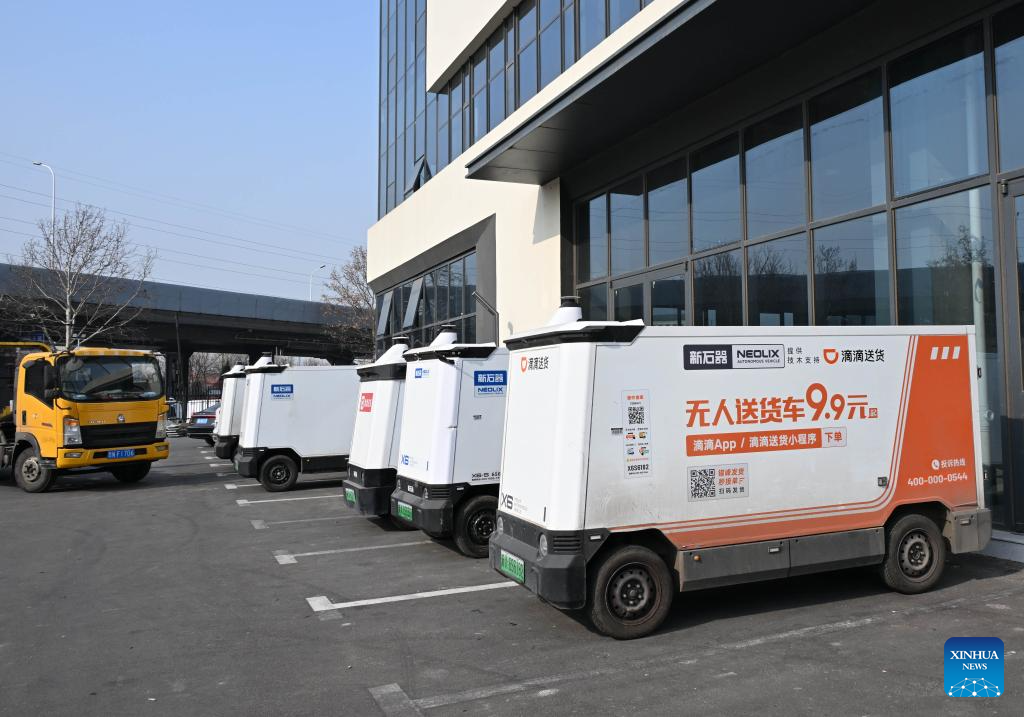
Unmanned delivery vehicles undergo maintenance at a parking lot of Neolix located in Chengyang District, Qingdao, east China's Shandong Province, Jan. 28, 2026. (Xinhua/Li Ziheng)


