
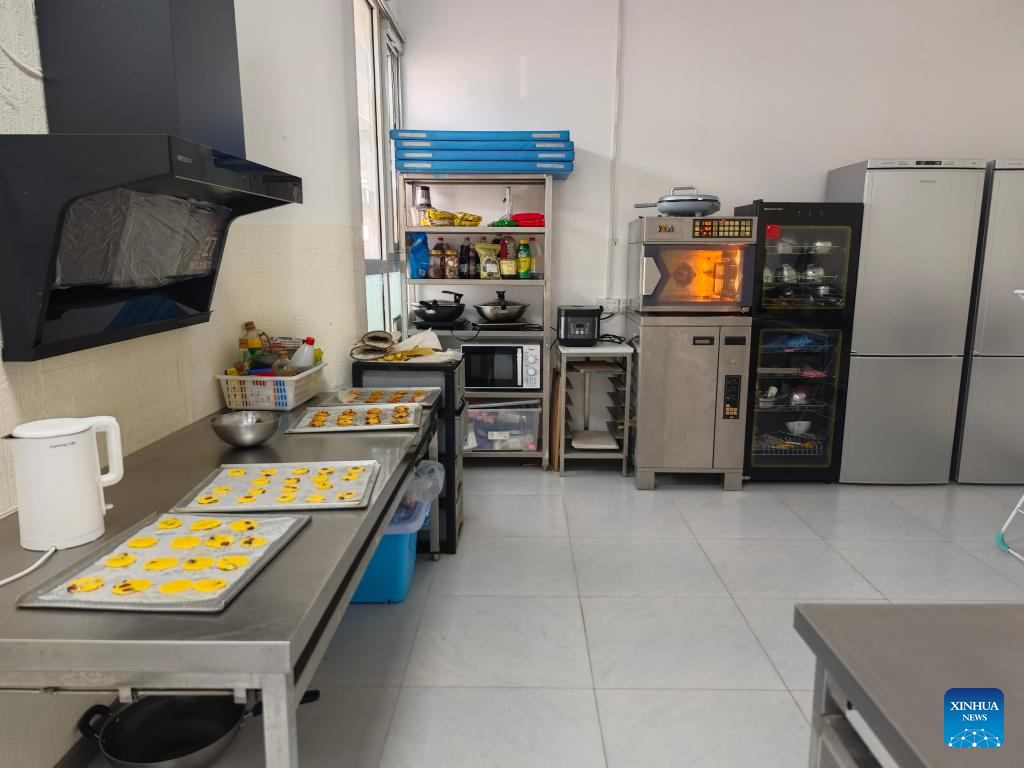
This photo taken on March 31, 2026 shows a view of a baking classroom at Kangnazhou Autism Family Support Center in Haidian District, Beijing, capital of China. (Xinhua)
BEIJING, April 1 (Xinhua) -- Though it was winter vacation, 17-year-old Yangyang started his day early, walked to the supermarket on his own and returned home to whip up a bowl of seafood noodles for his younger sister.
To outsiders, he seemed like a caring and responsible older brother with a passion for cooking, yet only his parents truly understood the immense effort involved in helping Yangyang, who lives with autism, reach this level of independence.
"He is outgoing, generally capable and communicates reasonably well," said Yangyang's mom, 47-year-old Yang Xiaoxia, a resident of Haidian District in Beijing.
As a young child, Yangyang was hyperactive and reveled in rough-and-tumble play, while struggling with social interactions and following instructions, Yang recalled. The mother initially thought it was ADHD (attention deficit hyperactivity disorder) and was taken aback by the autism diagnosis.
She searched online and ultimately chose a nearby facility, where over the past 10 years Yangyang not only underwent rehabilitation but also took part in a bakery course. "He acquired basic life skills and grew significantly more confident," Yang said.
Yangyang is now enrolled in a special education middle school, and his mother hopes that he will one day secure a job in the food and beverage industry after graduation.
Since the first case of autism was reported in China in 1982, awareness of this neurological and developmental disorder has grown steadily over the decades. According to data, the prevalence rate of autism among children in China ranges from seven to ten in a thousand.
China's autism narrative has long focused on minors, fondly nicknamed as "children of the stars." But as that generation comes of age, addressing the employment and social integration of adults with autism is emerging as a new priority.
Zhang Jianli of the Kangnazhou Autism Family Support Center, where Yangyang attended, told Xinhua that the institution, founded in 2012, is dedicated to supporting autistic adults. It offers training to develop vocational skills such as baking and coffee-making, assigns employment counselors, and helps connect students with potential employers.
Xiaoming, who has been passionate about music and singing since childhood, was diagnosed with autism at the age of three. After graduating from college, an employment counselor assisted him in securing a position at a kindergarten.
"Although he lacks experience in handling conflicts among children, he is constantly learning and adapting," Zhang said. "Pursuing one's talents in a beloved field is not only a personal achievement but also a testament to the effectiveness of inclusive education and support systems."
The One Foundation has been aiding Kangnazhou since 2023. By the end of 2025, the foundation had collaborated with more than 600 social organizations across China, providing support to over 912,200 individuals.
Ren Shaopeng, program director of the One Foundation, noted that autistic adults are among the most challenging groups to serve in terms of care services, yet they are also the most in need of social support. They urgently require community-based living arrangements, tiered care services and personalized health improvement strategies.
According to Wen Hong, founder of Kangnazhou and former chairperson of the China Association of Persons with Psychiatric Disabilities and their Relatives, autistic adults typically have three options: institutional care, day services and employment. "Given the large population, centralized care is difficult, while day service providers face sustainability challenges," she said.
Wen, 76, is also the parent of an adult with autism. She believes that employment enables individuals with autism to engage with society and achieve self-fulfillment.
As outlined in the 15th Five-Year Plan (2026-2030), China aims to develop community-based rehabilitation for mental disorders, strengthen employment assistance for people with disabilities, and improve mechanisms for quota-based hiring, centralized employment and self-employment.
For instance, the China Disabled Persons' Federation has actively promoted the "Xihaner car wash" initiative nationwide, setting up over 60 car wash centers across the country to hire nearly 700 individuals with intellectual and developmental disabilities.
Ren said that in response to growing demand, the One Foundation's Ocean Paradise Project will support autistic adults in areas such as daily life and social adaptation skills, vocational training, social engagement, personal care and emotional well-being.
However, Wen found that employment conditions for this group have generally been unsatisfactory. Kangnazhou once organized autistic individuals to make mooncakes for sale, but most of the buyers came "from within the circle" of their families and friends, she said.
"I hope that organizations working with individuals with autism and their families can build a platform to connect job seekers with more potential employers, thereby expanding their employment opportunities," Wen added.
Chen Zhuoying is a musician. He is also the father of a young man with autism named Xiaoye. Through Kangnazhou, many parents expressed their children's desire to learn music. In 2024, Chen formed a band for them, which performed over 20 times in 2025.
Currently, Chen's company has five bands for autistic individuals, comprising 28 members. From teaching them musical instruments to arranging commercial performances, the company provides this community with opportunities to showcase talents. Xiaoye, a graduate of Beijing Information Science and Technology University, now works as a teaching assistant for one of the bands and is also responsible for video editing and sound system setup.
"Forming bands isn't just about giving them a job opportunity. It's about helping them grow together," Chen said. "They've been performing together since childhood, and I hope they'll still be together when they're 50, rather than becoming isolated individuals." Enditem
(Please note that pseudonyms have been used in this story for those with autism to protect their privacy.)
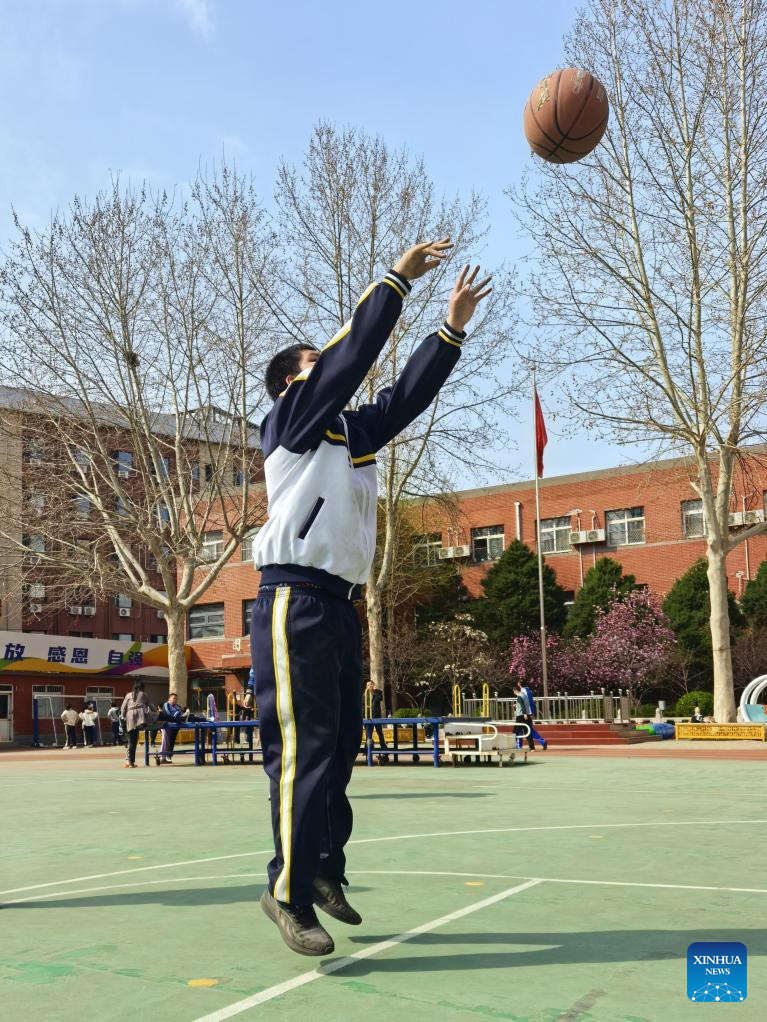
This photo taken in March 2026 shows Yangyang playing basketball at a playground in Beijing, capital of China. (Xinhua)


