
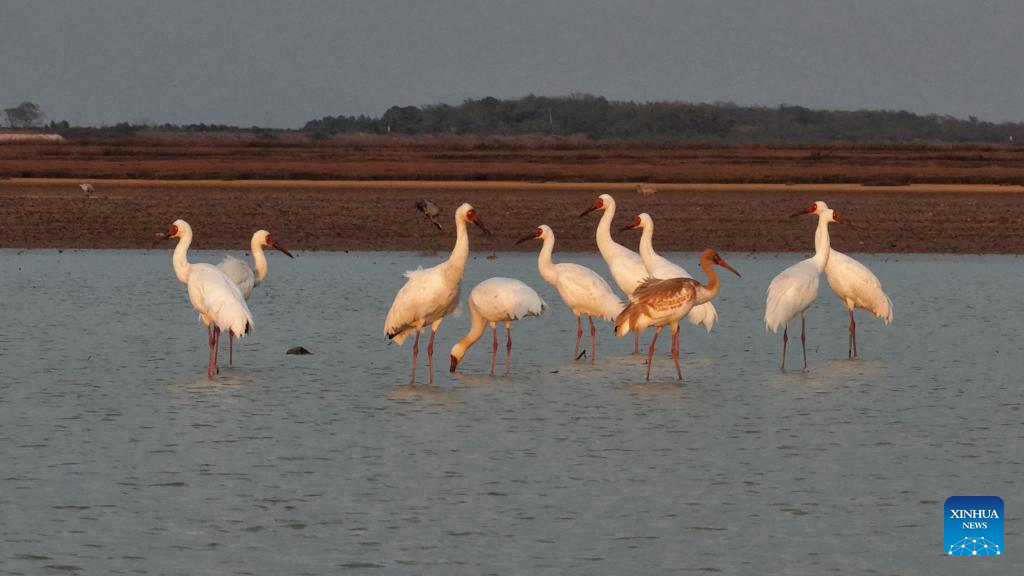
Siberian cranes are pictured at Poyang Lake wetland in east China's Jiangxi Province, Nov. 18, 2025. (Photo by Yu Qiwen/Xinhua)
NANCHANG, Feb. 9 (Xinhua) -- It was not yet sunrise, but Yu Qiwen was already on the move.
Inside his home near the shore of Poyang Lake, he steadied himself with both hands and then shifted into an electric wheelchair. One hand nudged the control lever back and forth, while the other checked his equipment. "Binoculars. Camera. Drone. All set," he noted to himself.
When the door opened, cold air rushed in, reddening Yu's face within seconds.
Yu, 48, is a patrol ranger in Duchang County, east China's Jiangxi Province. From a wheelchair, he helps watch over China's largest freshwater lake, a vast wetland where Siberian cranes cross winter skies, Yangtze finless porpoises surface without warning, and milu deer, also known as Pere David's deer, walk quietly across exposed flats.
"I do not do this alone," Yu said. Two fellow villagers patrol with him, watching the lake's edge through binoculars.
At high water, Poyang Lake spreads across more than 4,000 square kilometers, sustaining over ten million people who live around its rim. Duchang alone accounts for roughly a third of the lake's waters, with most of its townships facing the shoreline directly. Each winter, migratory birds arrive there in waves. For species such as Pere David's deer, Poyang Lake is part of its historical range.
Winter patrols are demanding. At this time of year, biting winds can make it hard to keep one's eyes open. "We're usually up before six," Yu revealed, his tone relaxed. "A normal patrol is about 17 kilometers. On longer days, nearly 40 kilometers round trip."
During the dry season, the lake retreats and mudflats emerge, with faint twin tracks visible, curving across the sand. These tracks are the marks left by Yu's wheelchair.
"Just over a month ago, I spotted Pere David's deer here," he said, gesturing toward wetlands near the waters of Zhenzhu Lake, which form part of Poyang Lake.
Once widespread across eastern China, this species nearly vanished more than a century ago, with some surviving in a European estate. In 2018, 47 deer were released into the surrounding wetlands at Poyang Lake. According to wildlife authorities in Jiangxi, the population has since grown to about 80.
"I first noticed their traces in 2021," Yu said, scrolling through photos on his phone. "They shed antlers around the winter solstice. Calves are born in May. Last year I photographed seven. Two were fawns."
The deer are cautious and hard to approach. "If I spot them through binoculars, I use the drone," he said. "But never close. I keep at least 1.5 kilometers away." Birds require even more restraint. "No drones at all, only long lenses."
His phone gallery offers quiet evidence of time spent observing: deer running freely across open flats, white-naped cranes stepping with measured calm, and oriental white stork standing tall in winter light.
Asked why he became a patrol ranger, Yu answered without hesitation: "The lake is my home." A photography enthusiast, he often spends entire days outdoors, watching and recording.
A traffic accident in 2016 left Yu with limited mobility, but it could not reduce the size of his world. Via a wheelchair, a three-wheeled vehicle and a drone, Yu continues to patrol and document wildlife. Outside his home hangs a sign identifying it as a wildlife observation base affiliated with Jiangxi's bird loving association. Birdwatchers stop by regularly. Villagers and photographers, he said, now alert authorities when injured or sick animals are found.
Across Jiangxi, wildlife protection has evolved into a coordinated effort combining legislation, monitoring and public participation. Infrared cameras and thermal remote sensing support night patrols, while experienced rangers like Yu extend conservation work to the lake's edge.
This change has not gone unnoticed by outsiders. Victor Wright, a French anthropologist at Peking University and a longtime friend of Yu's, has been conducting fieldwork around Poyang Lake for more than a year. In a social media post in January, he wrote that what he was seeing was "a richer, more diverse and more vivid environment."
On Yu's way home, winter sunlight settled over the shallows, where cormorants and oriental white storks were gathered. Yu lifted his camera and pressed the shutter. He kept watch, while also capturing the magic that is Poyang Lake. ■
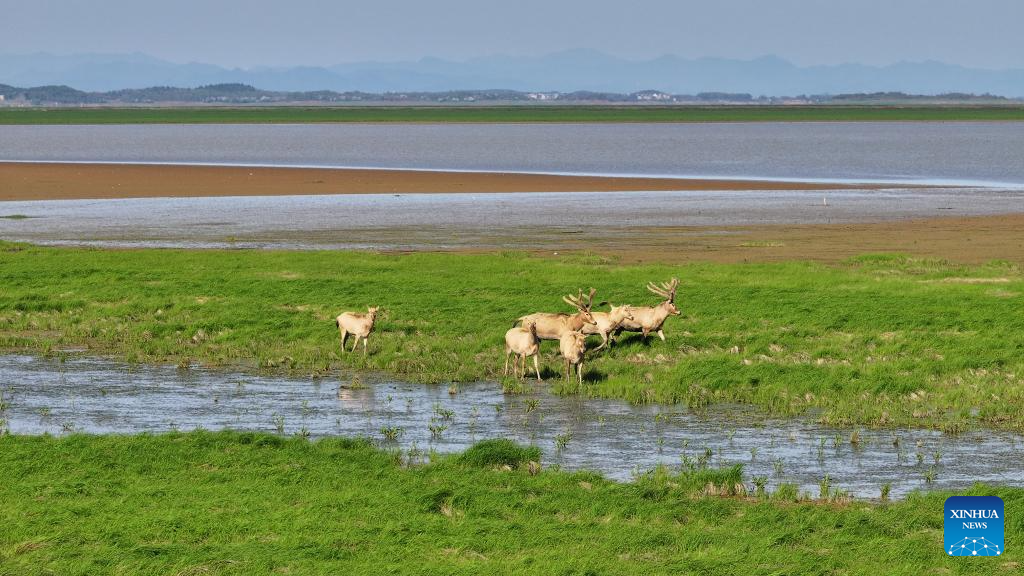
This photo taken on March 26, 2024 shows the Milu deer running at Poyang Lake wetland in east China's Jiangxi Province. (Photo by Yu Qiwen/Xinhua)


