
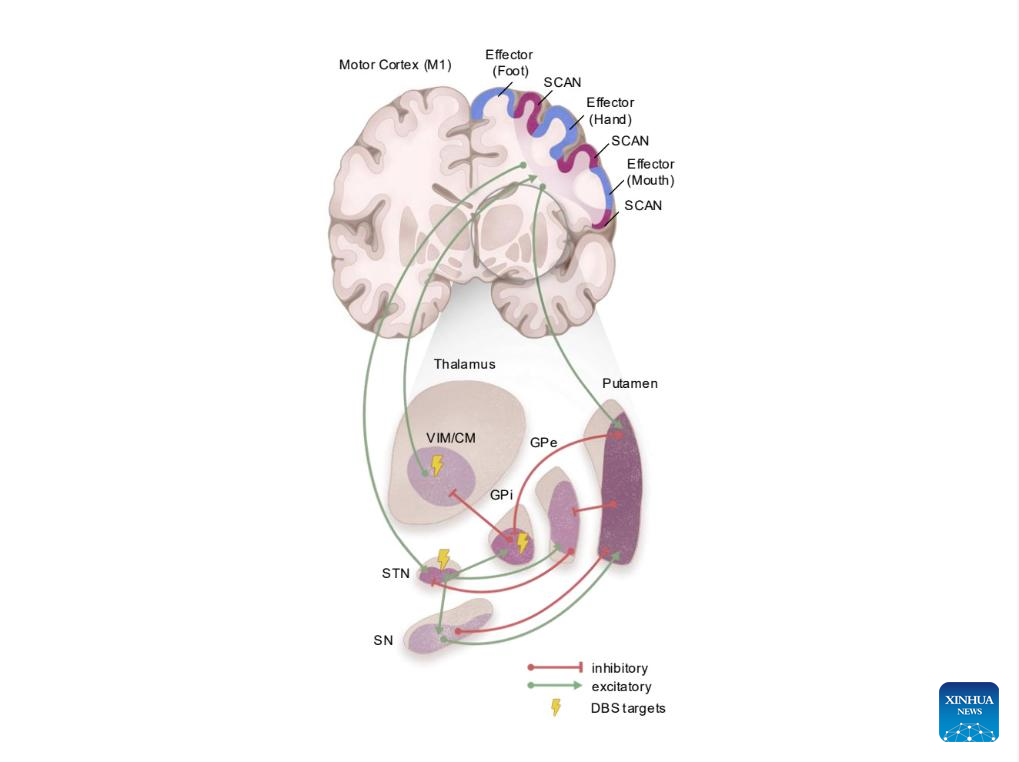
This illustration delineates the cortico-subcortical circuit important in Parkinson's disease, comprising the somato-cognitive action network (SCAN) and six subcortical nodes.(Xinhua)
BEIJING, Feb. 6 (Xinhua) -- Chinese scientists have discovered the core pathological brain network for Parkinson's disease, and direct medical intervention targeting this network in clinical studies has achieved positive outcomes.
The findings, made by a research team led by Professor Liu Hesheng from Changping Laboratory in Beijing, were published in the journal Nature on Thursday.
According to the China Parkinson's Disease Report 2025, more than 5 million people are living with Parkinson's disease in China, accounting for about two-fifths of the global patient population.
As the second most common neurodegenerative disorder after Alzheimer's, Parkinson's disease has been a major global challenge for years and has long been conceptualized as a movement disorder due to its movement-related symptoms, such as tremors, slowed movement, and walking difficulties.
In fact, it also causes more complex issues, including low blood pressure, sleep disturbances, and digestive problems -- non-motor symptoms that have been difficult to explain and complicate treatment.
This recent study of more than 800 Parkinson's patients has revealed that the disease affects a brain network known as the somato-cognitive action network (SCAN).
Located in the brain's cortex, this network links key brain regions involved in movement control, including the basal ganglia and thalamus, which are commonly targeted in Parkinson's treatments for motor dysfunction.
What distinguishes this study is the discovery that the connections between SCAN and these regions are abnormally strengthened in patients with Parkinson's disease.
The researchers emphasized that understanding this abnormal connectivity is crucial, as it offers new treatment possibilities that target the root cause of both motor and non-motor symptoms.
Based on Liu's latest and prior research, a new precision brain circuit stimulator developed by Galaxy Brain Scientific Inc. achieves millimeter-level accuracy in targeting treatment areas for Parkinson's disease.
In earlier years, Liu's team developed Personalized Brain Functional Sectors (pBFS), a technology that provides a more detailed and accurate map of the brain's functional regions. This innovation is paired with a real-time navigation system that uses personalized functional maps for highly targeted magnetic stimulation.
Because each person's functional regions can vary substantially, these advancements made it possible to precisely locate the areas affected by Parkinson's disease, Liu told Xinhua.
"Under traditional navigation methods, it took about 15 to 30 minutes to localize the target, depending on the patient's condition; now it can be done in less than a second," said Deng Wei, CEO of Galaxy Brain Scientific Inc.
Once the target is located, the new brain circuit stimulator will produce an external magnetic field to induce currents on the brain's surface and to stimulate neural cells, thereby improving brain function through a process known professionally as transcranial magnetic stimulation (TMS).
Clinical trial results show that after two weeks of treatment using the stimulator, the SCAN target group achieved a treatment efficacy rate of 55.5 percent, compared to only 22.2 percent in the control group that targeted nearby brain areas.
The results offer clinical evidence supporting individualized, non-invasive, and highly targeted treatment options for patients in China and beyond.
Since 2025, five hospitals across China -- spanning Beijing and Henan in the north, Guangdong in the south, Zhejiang in the east, and Sichuan in the southwest -- have been using this new equipment to treat patients.
In addition, compared with brain surgeries costing around 200,000 yuan (about 30,000 U.S. dollars), each TMS session costs less than 200 yuan.
A course consists of treatments over two to three weeks, repeated every six months. Long-term, repeated treatment may delay disease progression.
Hu Ying, now 64, was one of the first patients to volunteer for Liu's team's intervention therapy starting in 2022.
Diagnosed in 2018, Hu's health quickly deteriorated, leading to a loss of facial expression, frequent falls, and difficulty in swallowing. Since invasive surgery was not an ideal option for her and medications grew less effective, Hu decided to try Liu's treatment.
After just one 18-day course, Hu regained the ability to walk independently, and her swallowing and speech improved significantly. Nearly four years of ongoing treatment have allowed her to even sing karaoke with friends.
The therapy has not only given Hu back her mobility and speech, but also reignited the retirement dreams of Hu and her husband, Jiang Ke.
Jiang shared that the treatment has enabled them to travel across China and even take a long-distance trip to Europe, fulfilling plans they once thought were beyond reach forever.
"We never imagined we could still do this," Jiang said, with a smile. ■


