
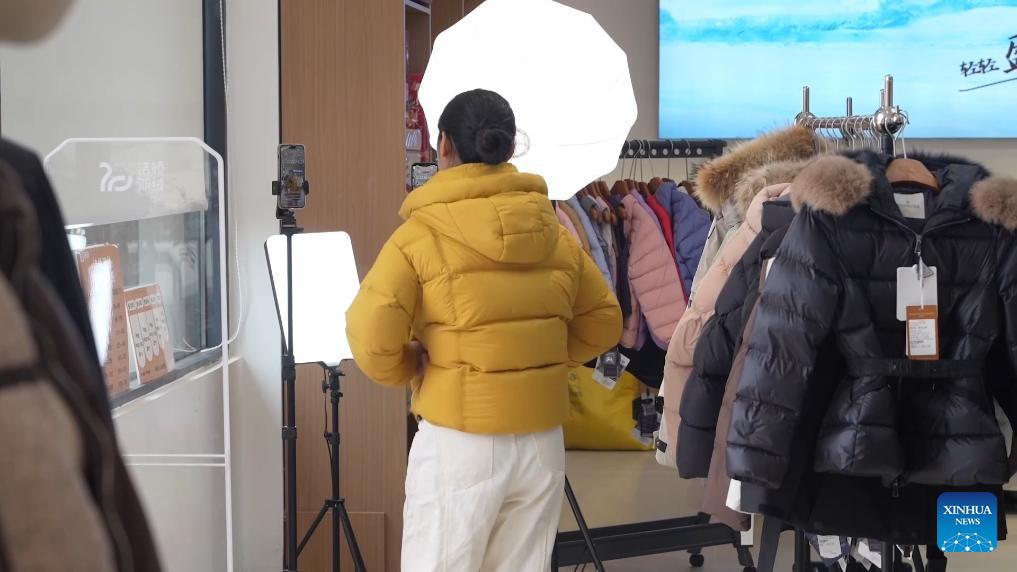
A staff member promotes down jackets via livestreaming at a store in Guigang City, south China's Guangxi Zhuang Autonomous Region, Jan. 4, 2026.(Xinhua/Qin Guanghua)
NANNING, Feb. 6 (Xinhua) -- Inside a large, well-equipped factory, the environment contrasts with the subtropical warmth of the mild winter in south China's Guangxi Zhuang Autonomous Region. Inside the facility, large glass chambers are filled with white duck and goose down, which is sorted and processed for various products.
This is Qiaoxu, a township in Gangnan District, Guigang City, that has quietly become the key engine behind the world's winter wardrobes.
Despite its modest profile, the town's industrial footprint is nothing short of spectacular. Qiaoxu now processes around 100,000 tonnes of feathers and down annually, accounting for 28 percent of China's total output and an estimated 18 percent of the global supply.
In the early 1980s, Qiaoxu's industry began not with high-tech invention or massive infrastructure investment, but with the clatter of tin cans on dirt roads. Young villagers would trek through the countryside, bartering candy for the one thing local poultry farmers would otherwise casually throw away: feathers.
At the time, the plumes were dismissed as "worthless refuse," bundled crudely and shipped to garment hubs in coastal provinces such as Zhejiang and Guangdong.
The turning point came in 1987, when enterprising locals decided to move up the value chain. By copying and improving a basic wooden separator box, locals began sorting valuable down from feathers right in the township.
It was a low-tech starting block that helped launch what would later become a multi-billion-yuan industry.
Inside the facilities of veteran producer Chen Shaoping, executive vice president of the local down association, the focus has shifted to intensive research and development (R&D). Chen's team has spent years developing "Guifei down," a premium variety harvested from long-cycle poultry in the region.
"The secret is the size of the floret," Chen said, adding that larger florets trap air the way double-paned glass traps heat, while the down is denser and loftier, creating a thermal barrier that outperforms standard varieties.
In an era of conscious consumerism, traceability has become the new industrial currency. Local firms, such as the one run by Yang Mei, embed digital birth certificates in their products. A quick scan of a QR code reveals lab-tested metrics.
"We can show every customer the exact test data for their jacket: down content over 86 percent, residual rate 0.9 percent, which exceeds national benchmarks," said Yang.
By turning a simple purchase into a transparent data set, Qiaoxu is winning the trust of Western markets that demand high-end products.
On the factory floor, these top-of-the-line statistics are propped up by ingenuity. Instead of traditional channel quilting, which is prone to heat leakage, local artisans use direct-fill techniques, injecting down through tiny apertures. The meticulous process can take more than an hour per premium jacket, producing a fashionably slim but thermally efficient silhouette.
"Our grandparents started it, our parents sustained it, and now our generation is building a full value chain, including R&D, design, production, and global marketing," said Yu Ke, head of a local down-and-feather company. "Our products now reach over 30 countries worldwide."
The township's rapid growth is in part due to forward-thinking local policy. In the past, about 40 percent of the Gangnan District's raw materials were imported from Southeast Asia but routed through distant ports in Hong Kong or Shanghai, resulting in over a month of transit.
A recent customs reform, piloted by the authorities in Nanning and Guigang, bypassed these bottlenecks by rerouting shipments through the nearby port of Qinzhou. Logistics time was cut by one-third, shipping distance slashed by 1,500 kilometers, and costs reduced by about 5,000 yuan (about 718.7 U.S. dollars) per twenty-foot equivalent unit (TEU).
The streamlined "green channel" has turbocharged growth. In the first ten months of 2025 alone, about 200 Qiaoxu-based enterprises, including 61 large-scale firms, posted a combined output of 3.16 billion yuan, according to an official account.
Qiaoxu is also diversifying to adjust to market shifts. The town has entered the high-performance sports sector, using wing feathers to produce professional-grade badminton shuttlecocks.
China's booming ice and snow economy has driven surging demand for premium thermal products, with official data showing that the 2023-2024 season recorded 430 million winter tourism trips.
Against this backdrop, Gangnan District has set a target to achieve an annual output value of 10 billion yuan in the coming years.
"Down has long been the backbone of the local economy," said Tao Jianquan, an official of Gangnan district. "Our focus is to help our local businesses move up the chain with stronger tech and brands, raising our industry's profile." ■


