* China has undertaken over 3,800 wetland restoration projects, reviving more than 1 million hectares of critical wetland habitat.
* To protect the Gahai-Zecha National Nature Reserve, local authorities have implemented an integrated conservation strategy, with key measures including water resource management, grassland restoration and rodent control.
* At Dianchi Lake, researchers have introduced an intelligent monitoring system powered by AI "bird facial recognition" technology to better observe and protect the migratory birds.
XINING, Feb. 3 (Xinhua) -- As early spring thaws the Gahai-Zecha wetlands in northwest China, a high-tech vigil begins. Conservation staff are using drone patrols and underwater cameras to monitor the environment, awaiting the first flocks of returning migratory birds, set to arrive in March.
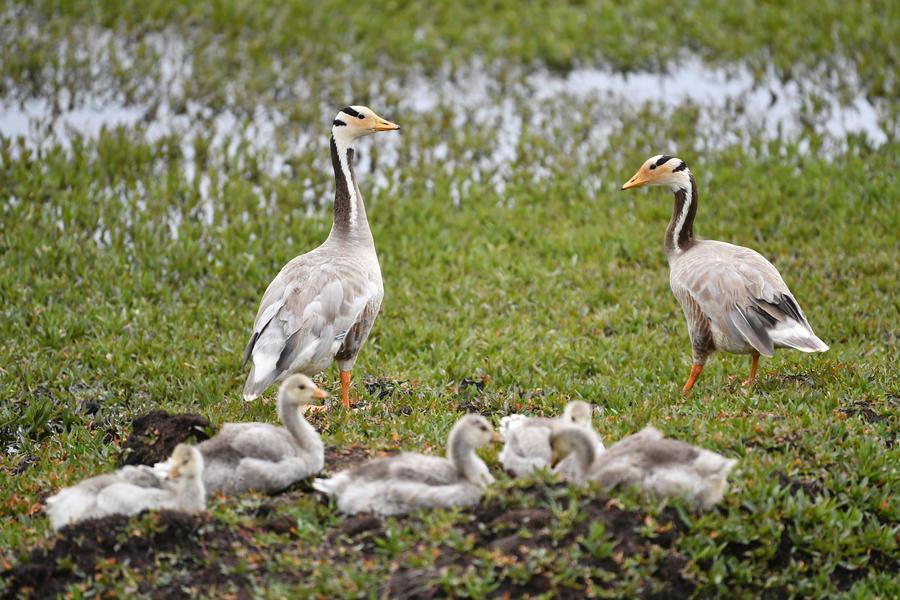
As a crucial stopover on the Central Asian migratory route, the Gahai-Zecha National Nature Reserve in Gansu Province provides vital rest and nourishment. By May, the reserve enters its peak breeding season, hosting numerous birds in its reed marshes, including rare white spoonbills and black-necked cranes. Bird populations are projected to exceed 30,000 by midsummer.
This vitality is recent and hard-won. In fact, from the mid-1990s to the early 2000s, Gahai Lake suffered three catastrophic droughts that almost turned it into a barren sandpit.
This local success mirrors a national campaign. Since 2012, China has undertaken over 3,800 wetland restoration projects, reviving more than 1 million hectares of critical wetland habitat, according to the National Forestry and Grassland Administration.
COMPREHENSIVE ECOLOGICAL RESTORATION
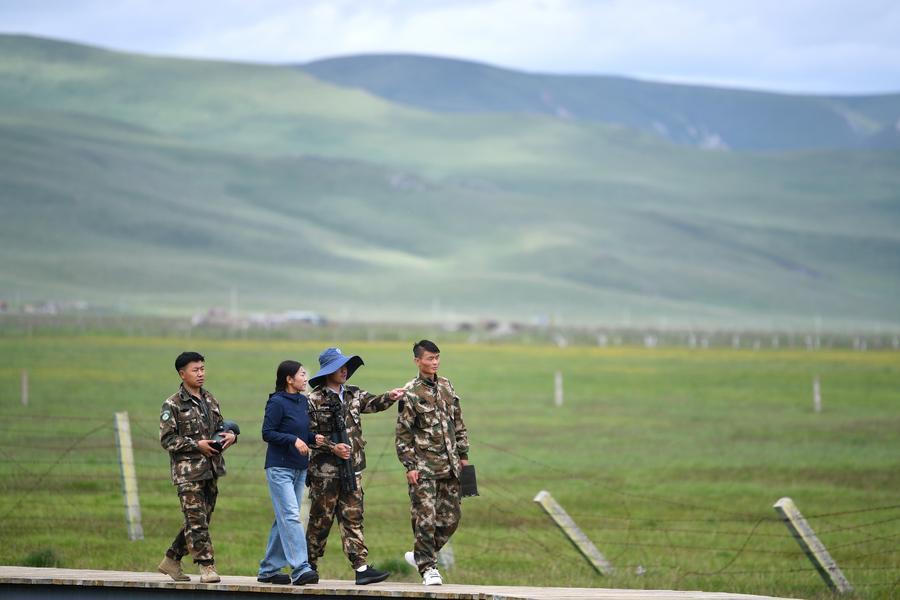
To protect the nearly 250,000-hectare Gahai-Zecha reserve, local authorities have implemented an integrated conservation strategy for its wetlands and grasslands. Key measures include water resource management, grassland restoration and rodent control.
A dam and diversion channels were constructed to connect the wetlands with nearby rivers. This system enables the precise regulation of water levels, replenishing reserves during dry spells and mitigating flood risks in the wet season.
To restore ecological balance, degraded grasslands have been reseeded, and grazing has been banned from May to October, a critical period for plant growth and migratory bird breeding. Rodent control programs have further supported ecosystem recovery, significantly improving vegetation coverage on the plateau grasslands and stabilizing the wetland foundation.
These enduring efforts have yielded remarkable results. The surface area of Gahai Lake has expanded fivefold, stabilizing at between 2,600 and 2,800 hectares. Biodiversity has increased, with a notable rise in wetland plant and animal species. The peak population of migratory waterbirds in the reserve surpasses 30,000 in the summer, featuring a stable number of black-necked cranes, a species under first-class state protection in China.
Beyond Gahai-Zecha, 94 wetland restoration projects have been carried out across the Qinghai-Tibet Plateau, a critical region known as "China's water tower." Qinghai Lake, one of the world's highest plateau lakes, has received a total investment of 330 million yuan (about 47.35 million U.S. dollars) dedicated to wetland conservation, restoration and water ecosystem rehabilitation. This investment has driven a continuous expansion of wetland area and the recovery of multiple protected animal populations.
Through systematic and targeted measures, such once-degraded ecosystems are being revitalized, boosting biodiversity and ensuring the long-term health of these vital wetlands.
HIGH TECH PLAYS ROLE
Daily monitoring is essential for ensuring the long-term recovery of wetland ecosystems. At the Gahai-Zecha reserve, Fan Long, head of the wetland management department, and his team have modernized their conservation approach via a suite of technological tools.
The reserve now employs 26 remote monitoring stations, as well as drones and infrared cameras, to track wetland health around the clock. This system is gradually replacing resource-intensive, hands-on methods such as high-altitude vehicle patrols for wildlife observation and manual water sampling.
"New floating hydrological sensors provide near-instant water quality readings," said Fan, as data on oxygen levels, pH and flow rates streamed across his computer screen in real time.
Beyond efficiency, a key priority is minimizing human disturbance. Drones can now observe bird behavior from a safe distance, eliminating engine noise and vibrations that once startled wildlife. Similarly, submerged cameras document fish populations without intruding into their habitat.
"These technological upgrades allow us to track wetland conditions in real time. Healthier water means a safer environment for the wildlife food web," Fan added. "For me, observing the animals here is the most rewarding part of the work. It's a living example of how humans and nature can thrive together."

AI GUARDIANS OF WILDLIFE
Every autumn and winter, Dianchi Lake in southwest China's Yunnan Province welcomes tens of thousands of black-headed gulls migrating from Siberia. To better observe and protect these seasonal visitors, researchers have introduced an intelligent monitoring system powered by AI "bird facial recognition" technology.
Around this lake, the largest in southwest China, an AI system equipped with high-definition cameras, drones and deep neural network algorithm analyzes features such as plumage, size and beak shape to identify bird species. The system can count and identify birds that would take two professionals a whole day to do within hours, with an accuracy of over 90 percent, said Pan Min, deputy director of the Kunming Dianchi Plateau Lake Research Institute. It also records behaviors like feeding and roosting, building a dynamic digital archive with hundreds of thousands of images, videos and audio clips.
At several demonstration sites along Dianchi, the AI system has identified 17 bird species across five orders and six families, creating a vast multimedia database. Researchers also installed an acoustic recognition system around the lake that identifies species through their calls, and has already cataloged the likes of night herons and magpies.
Zhang Zhizhong, an engineer of the institute, added that the AI intelligent monitoring system greatly facilitates studies on migration routes, breeding habits and wetland health, while enabling long-term tracking of bird populations and behaviors -- crucial data for assessing biodiversity.
Similar AI bird monitoring systems have been used in Shandong and many other Chinese places. Shuangguihu National Wetland Park in southwest China's Chongqing Municipality has launched a bird-monitoring big data platform capable of tracking and automatically identifying multiple bird species in real time. By analyzing collected data, this platform reveals activity patterns and migration trends to directly support research and conservation efforts.
From systematic wetland policies to technological innovations, analysts say these integrated efforts underscore China's unwavering commitment to restoring and safeguarding vital wetland ecosystems for future generations.
(Video reporters: Li Linhai, Li Ning, Du Xiaowei, Yu Gang and Chen Yushan; video editors: Wang Houyuan, Luo Hui and Hong Yan) ■