
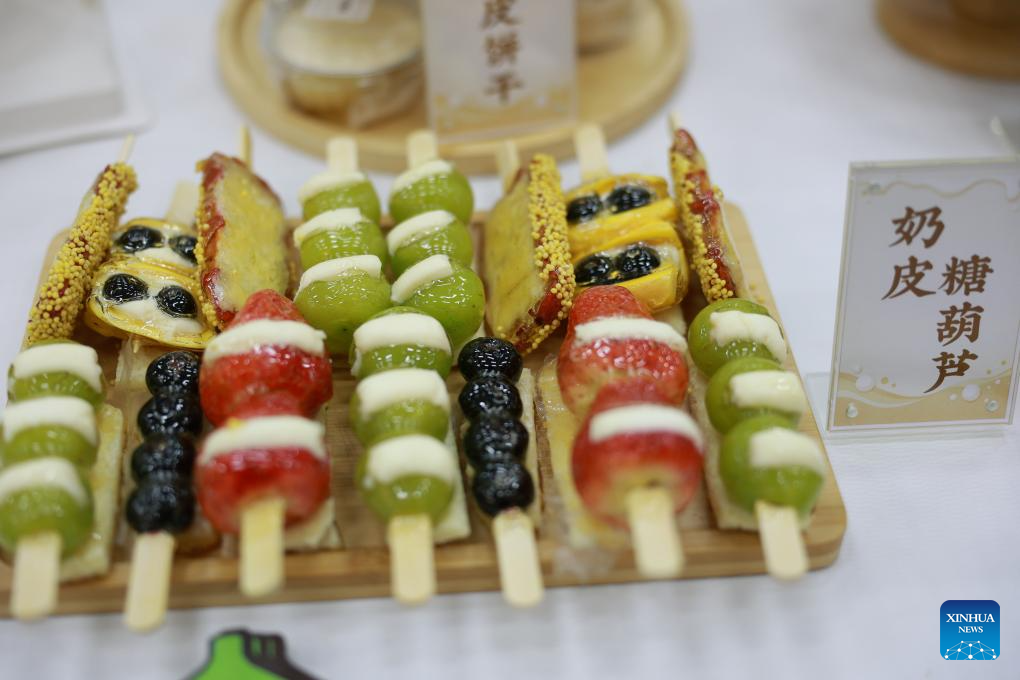
This photo taken on Jan. 19, 2026 shows sugar-coated hawthorn sticks made with "naipi," a traditional Mongolian milk skin, in Galutu Town of Wushen Banner, Ordos City of north China's Inner Mongolia Autonomous Region. (Photo by Wang Dongxu/Xinhua)
HOHHOT, Feb. 3 (Xinhua) -- While sugar-coated haws wrapped in "naipi," a traditional Mongolian milk skin, are going viral on Chinese social media, few realize that the heart of this culinary craze lies deep within the grasslands of north China's Inner Mongolia Autonomous Region.
No longer merely a staple of traditional morning tea, the ancient delicacy in Wushen Banner's Galutu Town is finding its way into hotpots, coffee, pizzas and mooncakes, activating a vibrant industrial chain that blends heritage with modern consumption.
At 7 a.m., herdsman Batu was already in his kitchen, where brick tea simmered in a copper pot. He gently lifted a pale yellow, wrinkled sheet of milk skin from the surface of fresh milk that had sat undisturbed overnight.
This rich layer of milk fat, the concentrated essence of nearly two kilograms of fresh milk, is the soul of a Mongolian breakfast. When broken into salty milk tea, it releases a rich aroma that cuts through the morning chill.
Only a few kilometers away, the Minxin Dairy Processing Workshop hummed with the sound of modern machinery. On standardized production lines, thousands of milk skin sheets were being simultaneously dried and shaped. They will be vacuum-packed and shipped to metropolitan hubs such as Shanghai and Hangzhou, both located in east China.
"The orders simply don't stop," said Bayinnamuri, head of the workshop. "Our 2025 output nearly doubled compared to the previous year. We now process about two tonnes of fresh milk daily to produce over 2,000 sheets of milk skin."
The "breakout" of milk skin from a local staple to a national commodity is no accident. As health-conscious consumers seek natural, high-protein foods, Galutu, a town that once earned fame for making the world's largest milk skin, has seized this trend in revitalizing its dairy industry.
Since 2022, the town has implemented a systematic industrial chain project. Upstream, it established 4,000 mu (266.67 hectares) of "central kitchen" for high-quality forage like oats and silage corn, while introducing Jersey cows to boost milk yields.
Consequently, the town's annual milk production has surged from 817,000 kg in 2022 to nearly 5 million kg, providing a stable supply of premium raw materials.
Innovation has turned the town into a "flavor laboratory." To meet the demands of younger, fashion-forward consumers, Galutu has launched creative dairy competitions, sparking a wave of fusion dishes.
Xing Heli, an entrepreneur who reinvented the traditional tanghulu, which are sugar-coated haws, by stuffing them with fruit-filled milk skin and cold-brew yogurt, sells hundreds of skewers daily.
"Initially, the market was hesitant," Xing said. "But by sticking to the trend last year, it exploded. The fruit-filled versions are especially popular."
"These innovative products do more than just open up sales. They connect traditional dairy food with modern life," said Wang Minjing, deputy head of Galutu.
The town's strategy focuses on integrating planting, breeding, processing and sales with tourism. Visitors can now tour modern ranches, try their hand at making traditional milk skin, and taste an array of innovative snacks at local street shops before leaving with exquisite souvenir sets.
By challenging Guinness World Records and hosting cultural festivals, the town is cementing milk skin as a core cultural intellectual property (IP).
"Our next step is to continue strengthening the chain through research and development," Wang added. "The goal is to let the grassland aroma float to even broader markets, ensuring more herdsmen share the dividends of industrial growth." ■
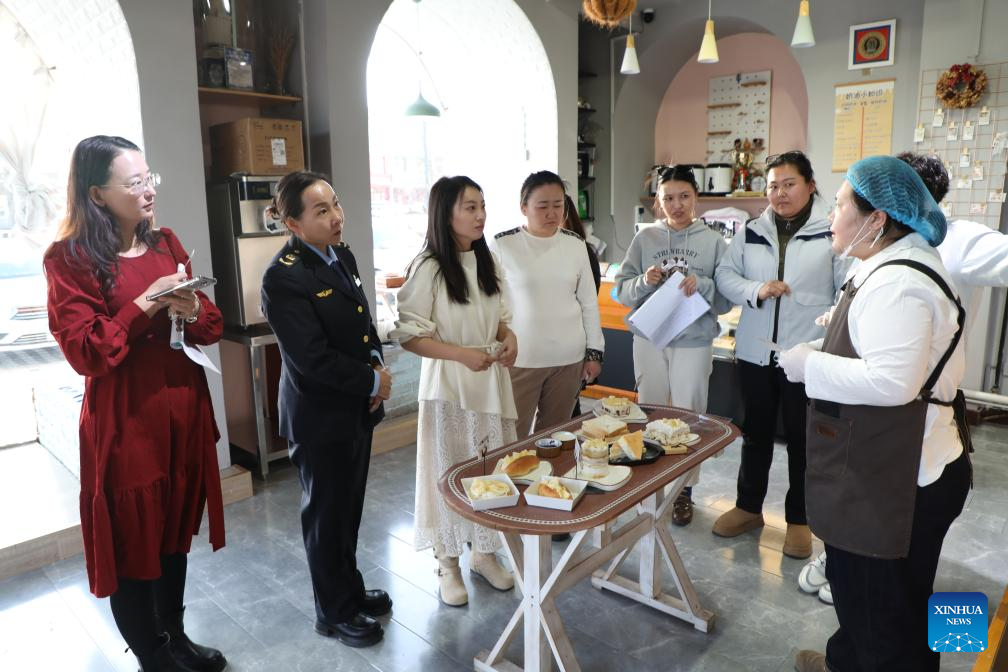
People take part in a contest for artisan of "naipi," a traditional Mongolian milk skin, in Wushen Banner of Ordos City, north China's Inner Mongolia Autonomous Region on Nov. 28, 2025. (Photo by Wang Dongxu/Xinhua)


