
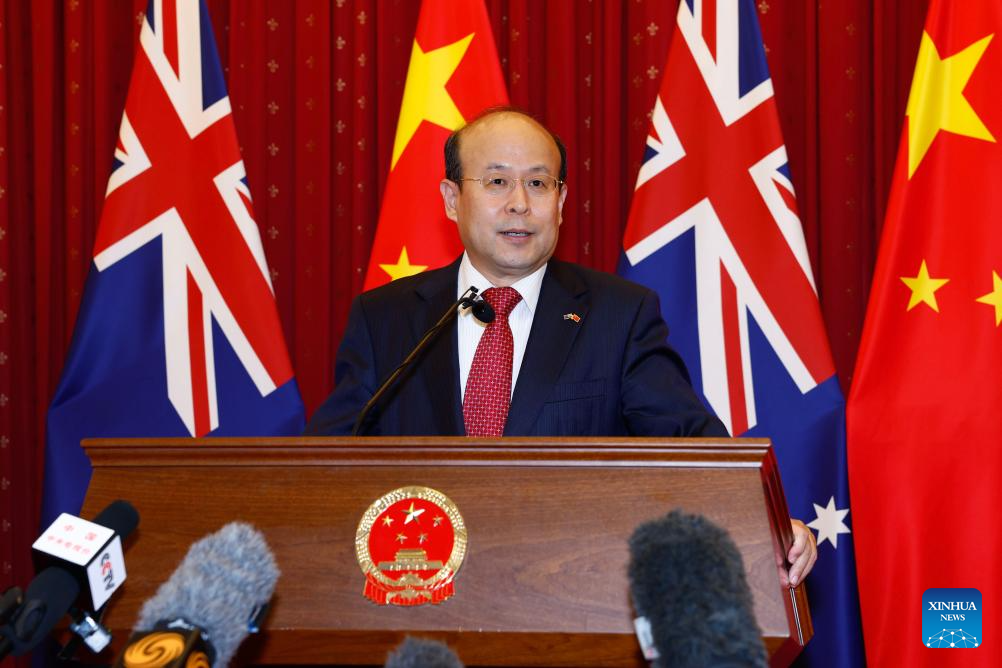
Chinese Ambassador to Australia Xiao Qian delivers a speech at a New Year media briefing in Canberra, Australia, on Jan. 28, 2026. The significance of China-Australia relations extends far beyond the bilateral scope, and China has always regarded Australia as an important partner both regionally and globally, Chinese Ambassador to Australia Xiao Qian said Wednesday. (Photo by Chu Chen/Xinhua)
CANBERRA, Jan. 28 (Xinhua) -- The significance of China-Australia relations extends far beyond the bilateral scope, and China has always regarded Australia as an important partner both regionally and globally, Chinese Ambassador to Australia Xiao Qian said Wednesday.
Bilateral relations made progress toward stability, with political mutual trust deepening, economic and trade cooperation improving, vibrant cultural exchanges enhanced, and strategic interests increasingly entwined, Xiao said in his address at a New Year media briefing.
Last year, bilateral trade between the two sides once again exceeded 300 billion Australian dollars (210 billion U.S. dollars), Xiao noted, adding that for 16 consecutive years, China has remained Australia's largest trading partner, largest export destination and largest source of imports.
The year 2025 marked the 80th anniversary of the victory of the World Anti-Fascist War and of the founding of the United Nations, the ambassador said, noting that as major countries in the Asia-Pacific region, both China and Australia are builders and defenders of the post-war international order.
Amid a complex and ever-changing international landscape, the strategic interests of our two nations are more tightly entwined, he said, adding that the two countries have also enhanced cooperation within multilateral frameworks, and increasingly supported and coordinated with each other in multilateral affairs.
China wishes to work with the Australian side to enhance mutual trust, handle differences properly, and promote China-Australia relations to achieve more developments, Xiao said.
Answering questions from journalists, the ambassador refuted the recent remarks by a Japanese senior official that Japan should have nuclear weapons and elaborated on China's principles and position.
The recent remarks are consistent with Japan's struggle to revive militarism, he noted. "Once Japan revives militarism, peoples in the Asia-Pacific region will bear the brunt of the consequences. China and Australia fought side by side in World War II and made tremendous sacrifices in resisting Japanese aggression," he said.
The two countries must remain highly vigilant against the resurgence of Japanese militarism and firmly oppose the attempts by Japan's right-wing forces to revive militarism, he stressed. ■


