
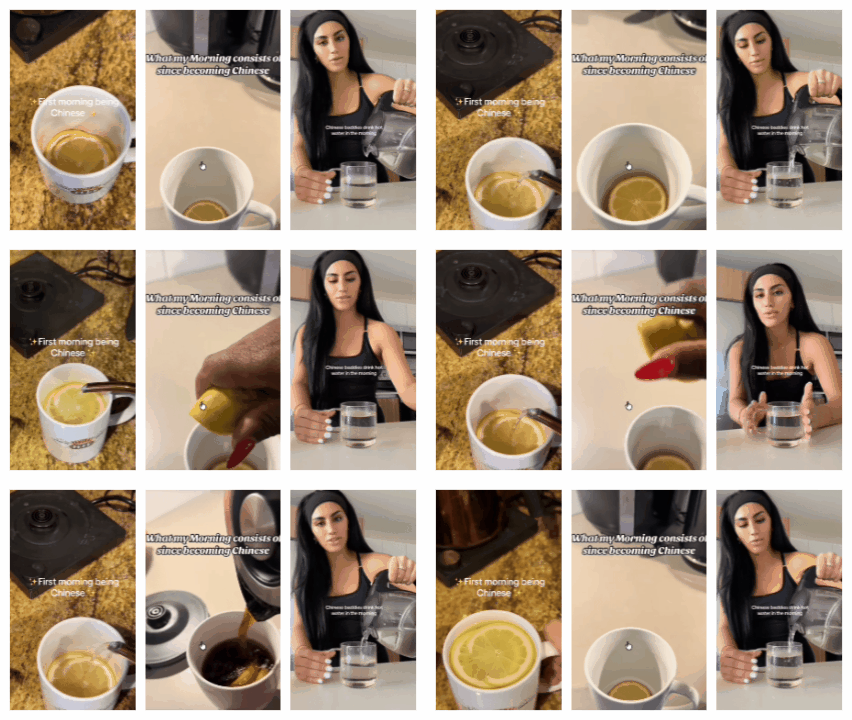
This compilation GIF shows global netizens practicing Chinese wellness habits, such as drinking hot tea and ginger tea. (Composite from TikTok users)
By Liu He, Chen Zhuo
BEIJING, Jan. 27 (Xinhuanet) -- "Tomorrow, you are turning Chinese," a creator says in a viral TikTok video, listing a series of distinct Chinese lifestyle habits. The playful "prophecy" by @sherryxiiruii has sparked a global fever, gaining nearly 750,000 likes and sparking a top-trending hashtag #BecomingChinese.
Building on the initial post, international TikTok users have increasingly posted their own videos under the same theme, showcasing their "Chinese-style" lives. These videos often highlight subtle but significant lifestyle changes, such as drinking warm water instead of iced beverages, practicing Baduanjin (an ancient Chinese wellness exercise), exploring traditional Chinese medicine, preparing basic Chinese dishes, as well as reshaping diet, sleep, and work routines to achieve a more balanced daily rhythm.
Reactions to the content have been largely positive, with many viewers describing the practices as "healthy" and "effective." Some express appreciation for the openness of Chinese creators, "I'm very thankful that Chinese people are sharing these things with us. I'm taking advice to become healthier and more disciplined." Others focus on personal experience, commenting that they "tried it last night and it was seriously so good," while newcomers also say they are actively seeking out the "Becoming Chinese" trend for guidance. Such responses indicate a sustained enthusiasm in Chinese everyday practices that extends beyond fleeting online attention.
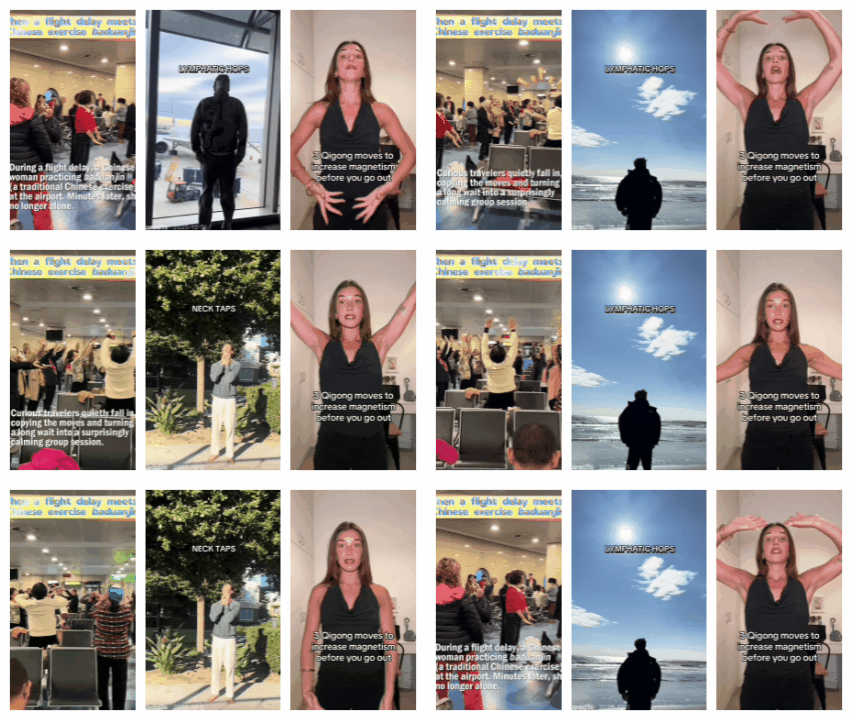
This compilation GIF shows global netizens practicing Baduanjin and Qigong. (Composite from TikTok users)
The trend goes beyond mere cultural exchanges; it represents a growing interest in Chinese lifestyle values. The "Becoming Chinese" fever has proven that China has gone beyond the conventional labels in foreigners' eyes, such as Kung Fu and cheongsam, and has gradually emerged as a global trend, attracting international followers to live a Chinese life.
According to the Global Soft Power Index 2025 published by Brand Finance, China has climbed to second place in the Index, achieving its highest position to date.
In an accompanying commentary, Brand Finance said that China's soft power advancement can be attributed to its strategic efforts to enhance its global image, including a series of opening-up policies, a renewed focus on sustainable development and stronger product brands.
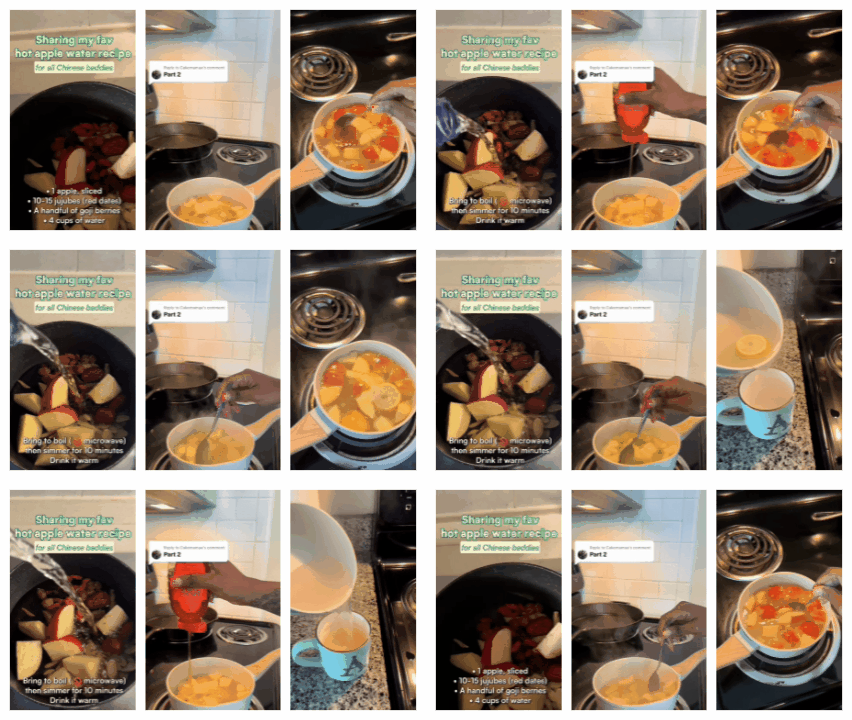
This compilation GIF shows global netizens preparing specialty soups guided by TCM. (Composite from TikTok users)
This ascent in global standing is anchored by favorable policies, digital empowerment, and industrial upgrades that highlight the underlying logic of the "Becoming Chinese" trend.
EASIER ENTRY
China's high-standard opening-up policy has significantly lowered the threshold for international tourists to explore the country firsthand. Policies such as a visa-free transit make short visits easier. At the end of 2024, China announced a significant relaxation of its visa-free transit policy, extending the permitted stay for eligible foreign travelers from the original 72 or 144 hours to 240 hours. The program now applies to 55 eligible countries.
Since rolling out its 240-hour visa-free transit program, China has seen 40.6 million inbound arrivals, up 27.2 percent year-on-year.
All of the measures have pushed a wave of foreign travelers and internet influencers to document their experiences in China, producing large amounts of spontaneous, first-person content. The videos and posts present China through ordinary scenes of daily life rather than as official narratives, which have transcended information barriers and long-standing cultural stereotypes.
INFORMATION FLOWS DECENTRALIZED
Moreover, social media has reshaped how global users encounter information about China, offering alternatives to some biased Western media portrayals. Algorithm-based platforms prioritize everyday experiences over political framing, allowing foreign users to engage with Chinese society through lifestyle content.
A notable example is the emergence of "TikTok refugees," as some overseas users migrated to Xiaohongshu, a Chinese platform often described as China's equivalent to Instagram and Pinterest, amid concerns over potential TikTok bans in the U.S. On Xiaohongshu, they found fragments of ordinary Chinese life: grocery hauls, medical bills, and memes ricocheting in real-time communication.
Their voluntary moves reflect a desire for more authentic social interaction and signal the growing attractiveness of China's digital ecosystem. When users actively cross platform boundaries to seek real experiences, information flow becomes more decentralized, experiential and people-driven, contributing to a more nuanced global understanding of China.
BRANDS GO GLOBAL
Soft power becomes persuasive only when it is grounded in tangible products. Over the past decade, "Made in China" has undergone a quiet transformation -- from a manufacturing label associated with cost efficiency to one defined by design sensibility, technological sophistication, and cultural storytelling.
The rise of globally recognizable Chinese brands illustrates this shift. Labubu, a toy collectible from POP MART, has evolved into a cultural phenomenon, blending fashion, humor, and character IP.

Toys themed on Labubu, a popular furry doll from Chinese toy company Pop Mart, are pictured during the opening ceremony of a new offline store of Pop Mart in Bangkok, Thailand, July 5, 2024. (Xinhua/Sun Weitong)
In gaming, titles such as Black Myth: Wukong have drawn unprecedented global attention, demonstrating China's capacity to produce high-end cultural content. Meanwhile, smart electric vehicles (EVs) equipped with intelligent cockpits are competing in international markets, gaining an increasing market share among customers.
These products do more than entering households -- they introduce a lifestyle grammar rooted in Chinese creativity. When consumers abroad adopt Chinese appliances, play Chinese video games, or drive Chinese EVs, cultural affinity is embedded in consumption choices.
RESONANCE IN SHARED VALUES
The "Becoming Chinese" trend reflects a deeper shift from lifestyle imitation to value alignment. Chinese concepts of balance, moderation, and holistic well-being, which were expressed through practices such as herbal wellness, food therapy, and slow living, have resonated with global audiences facing burnout, anxiety, and the limits of hyper-efficiency culture.
These values enter through problem-solving: how to sleep better, eat smarter, reduce stress, or age healthily. Traditional wisdom becomes legible when it is translated into modern routines and everyday habits, enabling Eastern and Western values to meet at a shared horizon.
This is not accidental, but the outcome of the unswerving opening-up, technological innovation, and cultural adaptation. The vitality of contemporary Chinese culture lies in its ability to cross borders without assertion, but through resonance.
(Han Lin and Zhou Ziyan contribute to this story.)


