
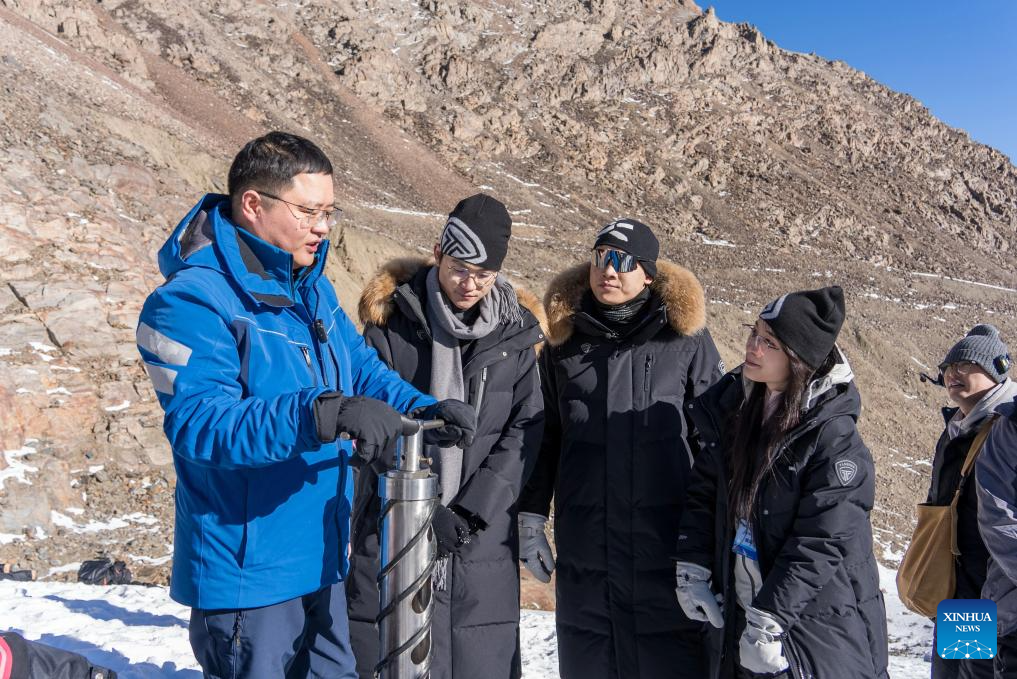
Wang Feiteng (1st L), a glacier scientist at the Chinese Academy of Sciences, explains ice core drilling operation to a group of young Chinese explorers on the Urumqi Glacier No. 1 in northwest China's Xinjiang Uygur Autonomous Region, Dec. 23, 2025. (Polar Hub/Handout via Xinhua)
by Xinhua writer Yuan Quan
URUMQI, Jan. 21 (Xinhua) -- For me, the most unforgettable experience of 2025, a year that ranked among the hottest on record, was climbing on a nearly 4,000-meter-high glacier in northwest China, alongside a group of young explorers in late December. Standing on that vast expanse of ice, with a drone hovering above for video, we shouted a pledge into the thin, frigid air: "Protect glaciers, and keep Earth cool."
Called Urumqi Glacier No. 1, the valley glacier was located in the Tianshan Mountains, about 120 km away from Urumqi, the capital of Xinjiang Uygur Autonomous Region. It is the world's closest glacier to a major city. However, due to the effects of global warming, the glacier -- spanning an area larger than 210 football fields -- is retreating at a rate of five meters annually.
"By the summer of 2026, the icy area beneath our feet will have disappeared," said our guide Wang Feiteng, a glacier scientist at the Chinese Academy of Sciences.
For most of the 13 explorers, this was their first time reaching a glacier. They came from diverse backgrounds, including researchers from scientific institutes, publishing house employees, university students majoring in AI and even professional e-sports players. They had been brought together by Polar Hub, a Tianjin-based NGO focused on exploring digital technologies to observe and protect the remote melting glaciers.
Wang is a frequenter here. He first came to the Tianshan Mountains in 2004, when he was a PhD student, and was stunned by the massive glacier, a sight he had never seen in his hometown in the eastern province of Shandong.
Wang told me he had initially intended to come to the northwest region for desert research, as his hometown often suffered from sandstorms originating from the arid inland deserts there. But he also discovered that the region contains over 42 percent of China's total glacier mass.
Although surrounded by the country's two largest deserts, the snow-capped Tianshan Mountains and their glaciers are the source of many rivers. These waterways, flowing down from the ice, nurture an array of oases. In ancient times, these oases linked to form a corridor through the barren landscape -- the Silk Road. Today, their modern remnants, cities like Urumqi, Kuqa and Kashgar, have become integral parts of the Belt and Road Initiative.
"Glaciers and humans were intimately connected," said Fang Hui, a marine researcher in his 20s and a member of the group, after learning that the glacier helps sustain a population of over four million.
However, data shows that from 1959 to 2024, the area of the Urumqi No. 1 Glacier has shrunk by approximately 20 percent.
Wang said the changes in the glacier, which has existed for millions of years, can reflect climate changes in Central Asia. Over the past two decades, he has analysed the data, tracked the signs and watched the glacier shrink year after year.
This trend is playing out across the globe. From the 1960s to 2020, China's glacier area has declined by 26 percent, with nearly 7,000 small glaciers disappearing entirely. A UN report confirms that global warming is driving the rapid loss of ice sheets, glaciers and Arctic sea ice worldwide.
"The more breathtaking the glacier appears, the more heartbreaking its disappearance feels," said Hu Yang, a member of the team who studied glacial microorganisms in Chengdu.
In response, Wang and his team have tested protective measures, including covering parts of the glaciers with a reflective "blanket." The idea came from snow-preservation trials he conducted for the 2022 Beijing Winter Olympics.
But scientists cannot save the glaciers alone, said Shang Xiaotong, a wildlife conservation PhD student at Sun Yat-sen University in Guangzhou.
"Only by raising awareness among more people can real change take place," she added, quoting primate scientist Jane Goodall, "Only if we understand can we care. Only if we care will we help. Only if we help shall all be saved."
In fact, glaciology remains a niche field with very few researchers, and glacier retreat is compounded by another problem, a shortage of data.
"Many glaciers lack systematic monitoring, yet explorers and tourists visit them regularly," said Hu Jiaojiao, founder of Polar Hub. "Could these visitors help collect data?"
To mark 2025 as the International Year of Glaciers' Preservation, Hu's team launched "Glacier Watch," a citizen-science project funded by public donations. They established six citizen science monitoring stations in key glacier-covered regions across China, including the Urumqi No. 1 Glacier, where young explorers extract ice cores and install automated equipment for 24/7 real-time data transmission.
Using drones, AI glasses and AR/VR technology, the team has also developed two video games that allow players to explore glaciers virtually and understand the ecological impacts of their melting.
"Through the microphone, I will share the magnificent beauty and highlight the importance of the glaciers," said e-sports commentator Hou Chen, who was part of the expedition. "I hope to inspire more young players behind their screens to take action. On the real arena of glacier preservation, we stand together to safeguard our homeland." ■
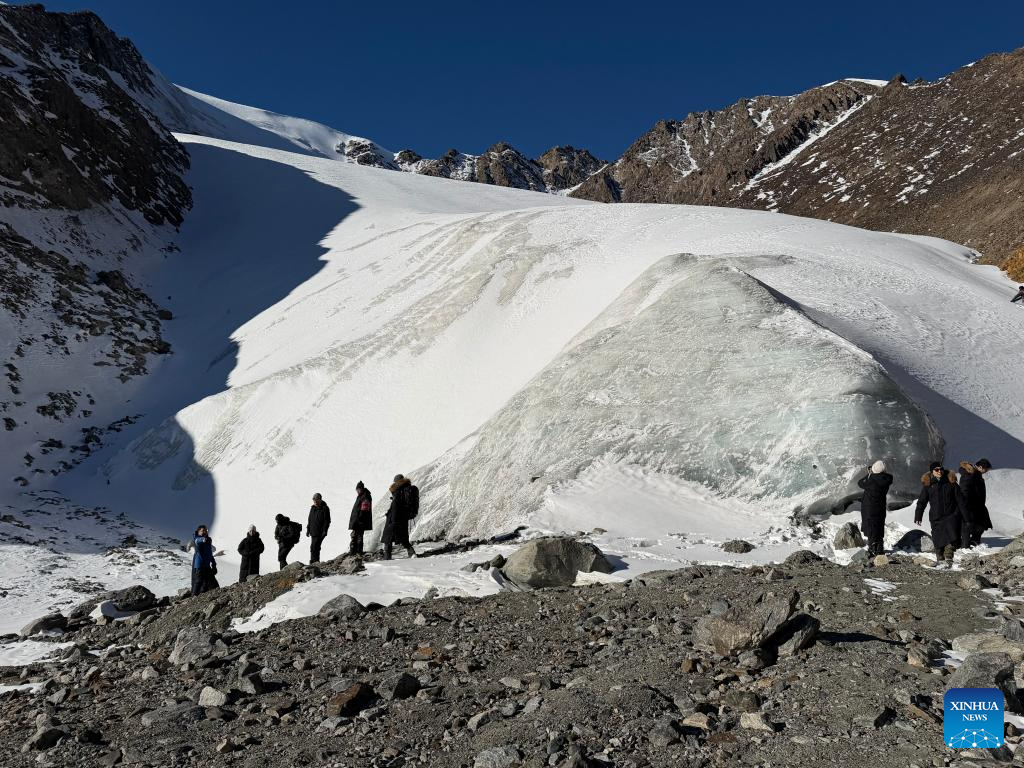
A group of young Chinese explorers are pictured during a field trip to the Urumqi Glacier No. 1 in northwest China's Xinjiang Uygur Autonomous Region, Dec. 23, 2025. (Xinhua/Yuan Quan)


