
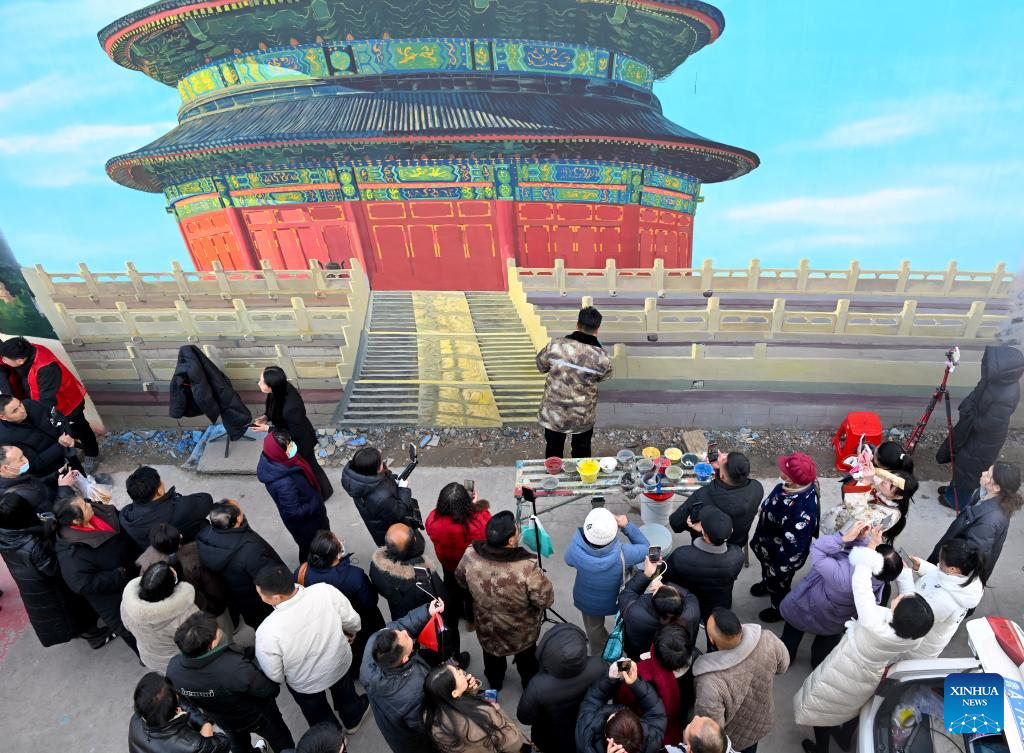
Wu Chengyan paints a mural in Wuying Village of Shangqiu City, central China's Henan Province, Jan. 6, 2026. (Xinhua/Hao Yuan)
ZHENGZHOU, Jan. 15 (Xinhua) -- A photo recently went viral showing a group of elderly villagers beaming with joy in front of the "Tian'anmen Rostrum," their faces radiating with a warm sense of excitement.
But a closer look reveals a heartwarming secret: the "Tian'anmen Rostrum" is actually a meticulously painted mural in the Wuying Village of Shangqiu City, central China's Henan Province. The artwork was created to fulfill the lifelong dreams of local seniors who had never visited the iconic site in China's capital.
The completion of the mural marked a festive day for the village. Elderly residents dressed in their finest attire, as if celebrating a major holiday, with some overcome by emotion and shedding tears of joy.
"With this paintbrush I would like to take my fellow villagers to places where they haven't been to," said 39-year-old Wu Chengyan.
Wu inherited his love of painting from his father, but it was in 2023 that inspiration really struck, when he painted a landscape for his wife's grandfather in Zhaolou Village. That moment gave Wu an idea: why not create art for the seniors in his hometown?
At the beginning of 2025, capitalizing on the popularity of animated blockbuster "Ne Zha 2," he created over 10 murals based on the movie, which earned Wuying its nickname "Ne Zha Village."
These murals quickly became tourist attractions, attracting visitors from far and wide. Villagers soon set up a market, giving a real boost to the village's economy.
On December 18 last year, Wu began his masterpiece on a white wall 18 meters long and eight meters tall where villagers often hang out. He spent five days working hard, putting in eight hours each day to bring the majestic "Tian'anmen Rostrum" to life.
"My hand trembled while painting the national emblem," Wu recalled. "It is the symbol of our country." He did thorough research to confirm every detail. When the last stroke was finished, elderly onlookers erupted in applause.
The murals served as a powerful magnet for tourists, drawing crowds from across the province and even farther afield. Online videos depicted long queues of visitors eagerly waiting to take photographs with the artwork. In a notable example, a man set out from home before dawn, driving an electric tricycle for 20 kilometers to bring his 97-year-old mother to see the "Tian'anmen Rostrum."
During the three-day New Year holiday, the village witnessed an impressive influx of 50,000 to 60,000 visitors per day. To help accommodate everyone, over 400 new stalls were set up at peak times, offering snacks, toys, and local specialties.
Feng Junhong who traveled from east China's Shandong Province set up a stall selling steamed buns. "We came here because the village has become a hotspot for tourism," she said, adding that her daily earnings could reach up to 600 yuan.
Zhang Xiling, 46, previously sold cold rice noodles outside the village but decided to move her business back to her doorstep, now earning between 200 and 500 yuan daily.
Boosted by the tourism boom, Wuying village has upgraded its roads. According to Wu Chengxin, the Party chief of the village, future plans include connecting with several other scenic spots and developing strawberry and vegetable bases to sustain economic growth.
In the first half of 2025, China's countryside received 24.88 million tourists and generated 9.244 billion yuan (1.32 billion U.S. dollars) in tourism revenue, marking increases of 7.9 and 8.6 percent, respectively, year on year.
Last October, the 20th Communist Party of China (CPC) Central Committee concluded its fourth plenary session, where participants deliberated and adopted the Recommendations of the Central Committee of the CPC for Formulating the 15th Five-Year Plan for National Economic and Social Development.
This document emphasizes the need to accelerate agricultural and rural modernization and take solid steps to advance all-around rural revitalization.
So far Wu Chengyan has completed more than 40 murals, featuring iconic landmarks such as the Temple of Heaven and the Great Wall, as well as portrait of Chinese scientist Yuan Longping who is known as the "father of hybrid rice" and characters in the video game "Black Myth: Wukong," transforming Wuying an outdoor art gallery.
In the village, several young residents have expressed their wishes to learn painting skills from him. "I plan to establish a studio, collaborating with more people to cover every blank wall with murals," he said. ■
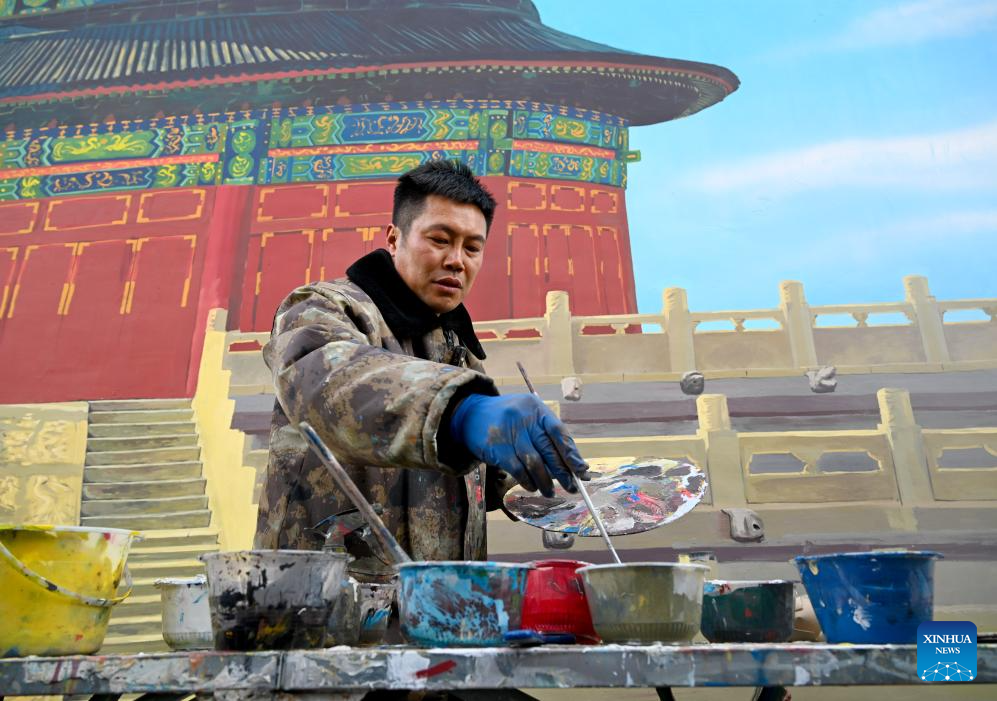
Wu Chengyan mixes colors in Wuying Village of Shangqiu City, central China's Henan Province, Jan. 6, 2026. (Xinhua/Hao Yuan)
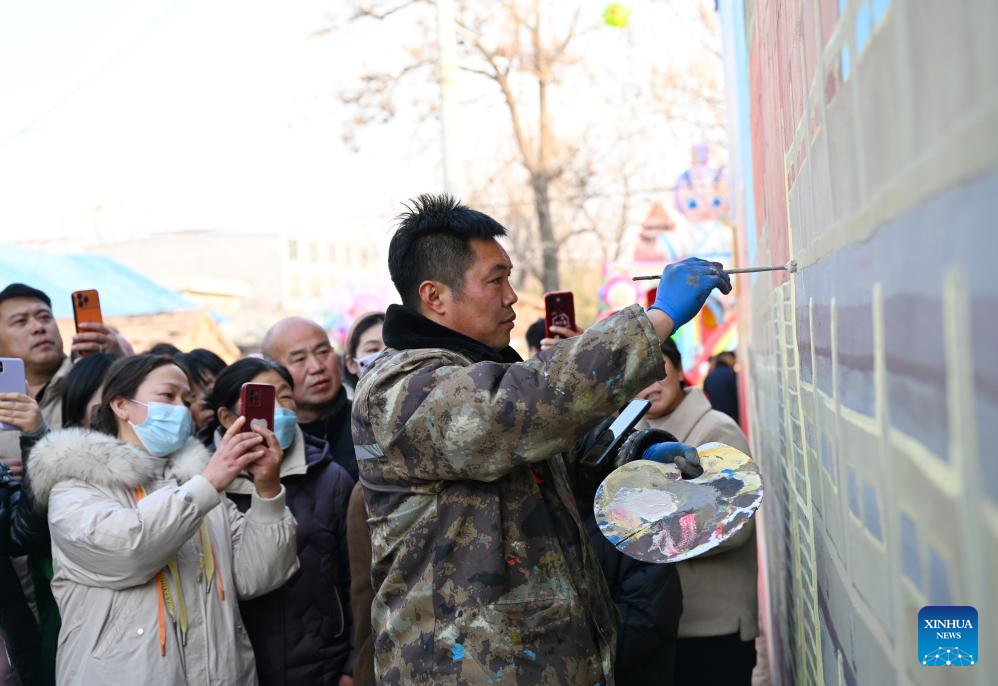
People watch Wu Chengyan painting a mural in Wuying Village of Shangqiu City, central China's Henan Province, Jan. 6, 2026. (Xinhua/Hao Yuan)
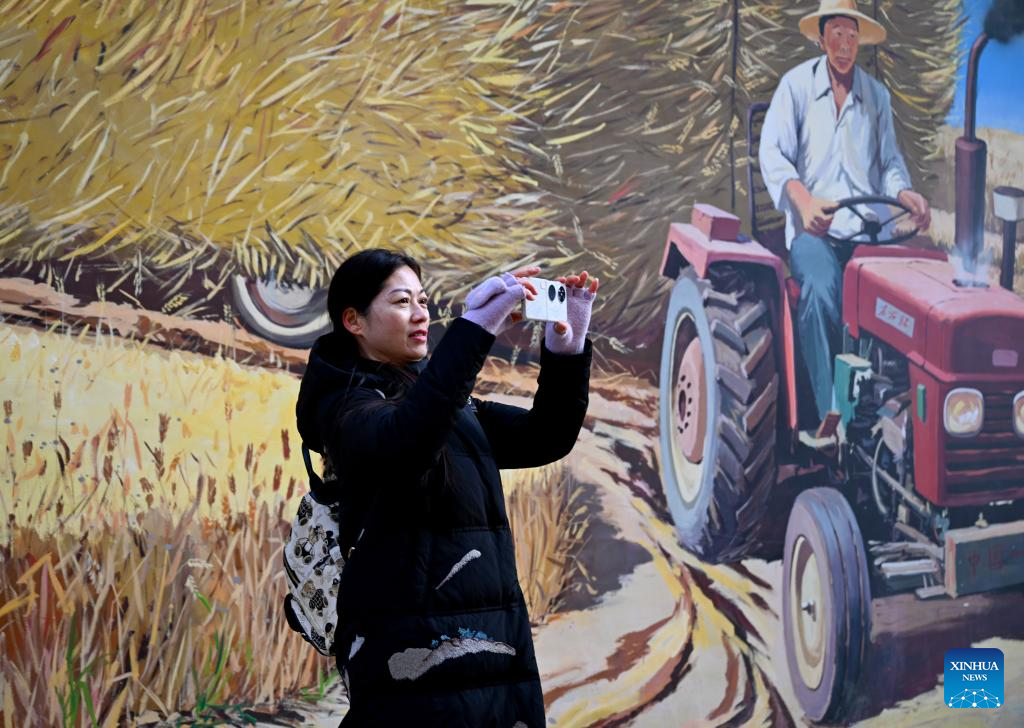
A woman takes photos in front of Wu Chengyan's painted mural in Wuying Village of Shangqiu City, central China's Henan Province, Jan. 6, 2026. (Xinhua/Hao Yuan)


