
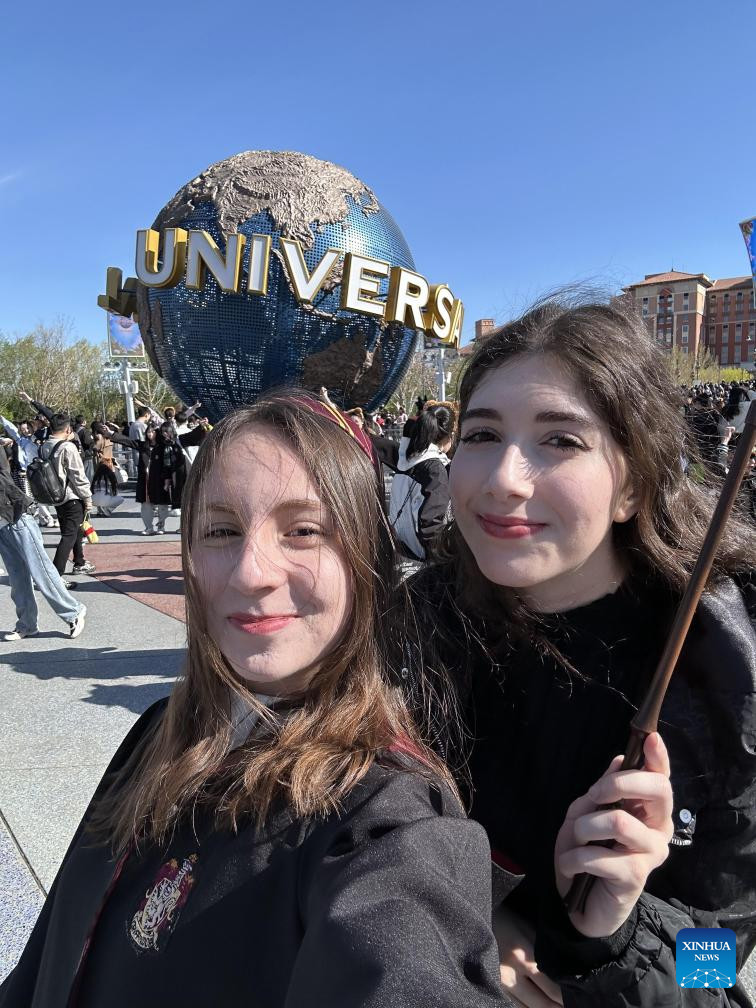
Türkan Hamza (R), a Turkish student majoring in Chinese-English translation, poses for photos with her friend at the Universal Beijing Resort in Beijing, capital of China, April 5, 2025. (Xinhua)
TIANJIN, Jan. 13 (Xinhua) -- Inside a classroom at Nankai University in north China's Tianjin Municipality, Türkan Hamza, a Turkish student majoring in Chinese-English translation, practices Chinese calligraphy with quiet concentration.
"It was the Chinese language that brought me from thousands of miles away," Hamza said. "Here, I've found my direction for study, life and the future."
Born in 2003, Hamza has long been interested in foreign languages, having previously learned English, Japanese and Korean. However, the Chinese language particularly captivated her due to its unique structure, long history and rich culture.
Her interest began after she watched a Chinese historical drama. "I was immediately drawn to the tonal variations and unique rhythm of the language," she recalled.
At first, Chinese sounded like a song she'd never heard before. But bit by bit, with the help of subtitles, she started picking up simple phrases like "hello" and "thank you" and even started repeating lines from the shows.
The sense of achievement motivated her to actively learn Chinese through films and TV series. The more she watched, the more curious she became, and that pushed her to keep exploring the language.
Driven by the interest, she enrolled in the Chinese language and literature program at Istanbul University. But after two years of study, she felt limited by her learning environment.
"The entire department had only one Chinese teacher, and most of the learning was confined to textbooks and grammar," she said. "I wanted to hear the vivid language used in daily life, to immerse myself in the local society and culture, and to understand the warmth and logic behind the words."
She then decided to go to China for her undergraduate studies, even though her parents were hesitant at first.
"To them, China was still a distant and unfamiliar country. I spent a lot of time explaining China's safety, development and educational opportunities," Hamza recalled.
Her persistence paid off when she received an admission letter from Nankai University.
In September 2023, she arrived in Tianjin for the first time. But the city, located near China's capital Beijing, did not match her earlier expectations.
"The city wasn't as dazzlingly modern as I had imagined. Instead, it had an everyday, down-to-earth vibe," she said.
After visiting cities like Beijing and Shanghai, she came to see China as a country of striking regional diversity rather than a place with a single identity.
At Nankai University, she's studying much more than just the language. Her classes cover Chinese culture and history, and even subjects like math and programming. For her, this wide-ranging curriculum shows how Chinese universities value well-rounded development. It's also helped her connect more deeply with the language.
While enjoying the challenge and joy of building connections between Turkish, Chinese and English, Hamza said she is often impressed by the depth and richness of the Chinese language.
"The tones, idioms and classical Chinese often make me ponder. Many expressions cannot be translated literally," she explained.
For Hamza, the language is more than a communication tool. Learning Chinese has given her insight into the emotional logic and social concepts prevalent among the Chinese people.
She cited the term "chunyun," or the Spring Festival travel rush, which embodies the profound Chinese sentiment towards family and reunion.
Outside of class, she gets involved in all kinds of cultural activities, like making zongzi (sticky rice dumplings) and mooncakes, which give her a real taste of traditional Chinese customs. She has also taken part in a Turkish "Silk Road Letters" contest, documenting her observations and feelings about China through writing.
As her studies continue, Hamza has also been following the growing economic and trade ties between China and Türkiye.
From Chinese companies participating in the construction of local projects to new energy vehicle manufacturer BYD announcing plans to build a factory in Türkiye, she said that cooperation between the two countries is becoming increasingly tangible for ordinary Turkish people.
Whether returning to Türkiye or pursuing a career in China after graduation, Hamza hopes to use her language skills to serve as a bridge between the two nations, promoting mutual understanding in areas like culture, education and trade.
"For me, China is no longer just images on a screen or words in a textbook," Hamza said. "It has become part of my everyday life. With the Chinese language serving as a key, I am unlocking door after door to new worlds." ■


