
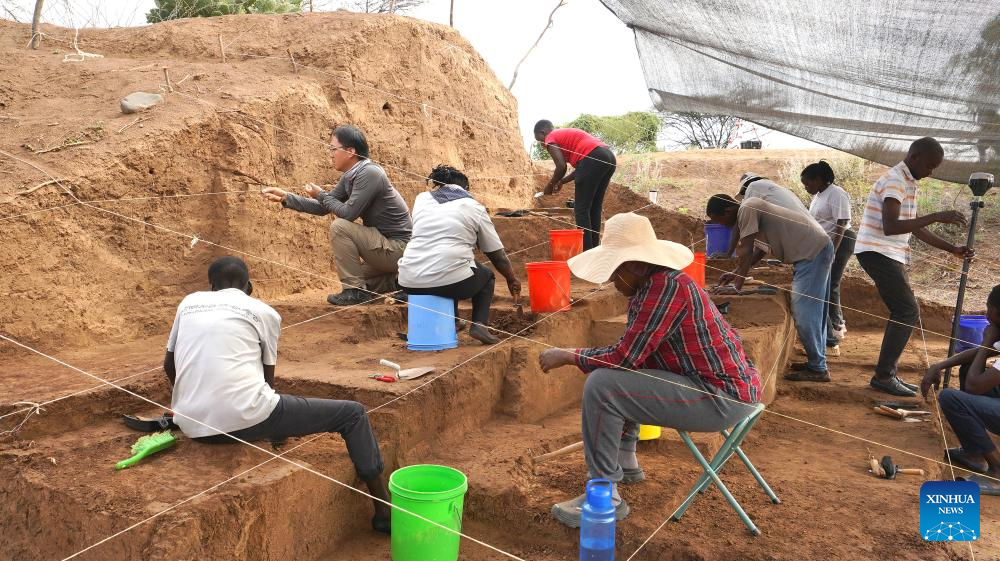
This undated file photo shows China-Kenya joint archaeological team working at Kenya's Lake Bogoria site. A China-Kenya joint archaeological team has for the first time unearthed stone tool products featuring blade technology from the middle to late Paleolithic period at Kenya's Lake Bogoria site. The discovery, announced at a conference on the 2025 archaeological results of central China's Henan Province held from Wednesday to Saturday, provides crucial material for studying the origins and spread of blade technology and its connection to early modern humans. (Xinhua)
ZHENGZHOU, Jan. 9 (Xinhua) -- A China-Kenya joint archaeological team has for the first time unearthed stone tool products featuring blade technology from the middle to late Paleolithic period at Kenya's Lake Bogoria site.
The discovery, announced at a conference on the 2025 archaeological results of central China's Henan Province held from Wednesday to Saturday, provides crucial material for studying the origins and spread of blade technology and its connection to early modern humans.
Peng Shenglan, a team member from the Henan Provincial Institute of Cultural Heritage and Archaeology (HPICHA), explained that blade technology is considered a major "upgrade" in human toolmaking. Compared to earlier, bulkier tools, these blades were more portable and easier to rework, significantly improving production efficiency and standardization.
Kenya is recognized as "one of the cradles of humankind" and a key region supporting the "Out of Africa" theory of modern human origins. The Lake Bogoria site is located in Baringo County within Kenya's Rift Valley.
In September 2025, a Chinese team from the HPICHA and Luoyang Institute of Archaeology, also in Henan, arrived in Kenya. They surveyed areas around the lakes of Baringo and Bogoria for middle Paleolithic sites dating between 300,000 and 100,000 years ago and excavated a location of the Lake Bogoria site.
According to Peng, the excavation covered 64 square meters and reached a depth of about 3.6 meters. Over 5,000 stone artifacts and animal fossils were unearthed, including the first stone blade products from that period.
"The discovery of these blade artifacts, with clear stratigraphic information, offers vital evidence for exploring the origins and dissemination of bladelet technology and its ties to early modern humans," said Zhao Qingpo, field director from the Chinese side of the joint team, adding that the abundance of animal fossils in the deposits suggests favorable preservation conditions, raising the possibility of future hominin fossil discoveries.
Zhao said that the team will continue excavations, expand the archaeological survey in the Baringo region, and conduct comprehensive research on the unearthed Paleolithic remains to search for new clues and evidence for the study of modern human origins. ■
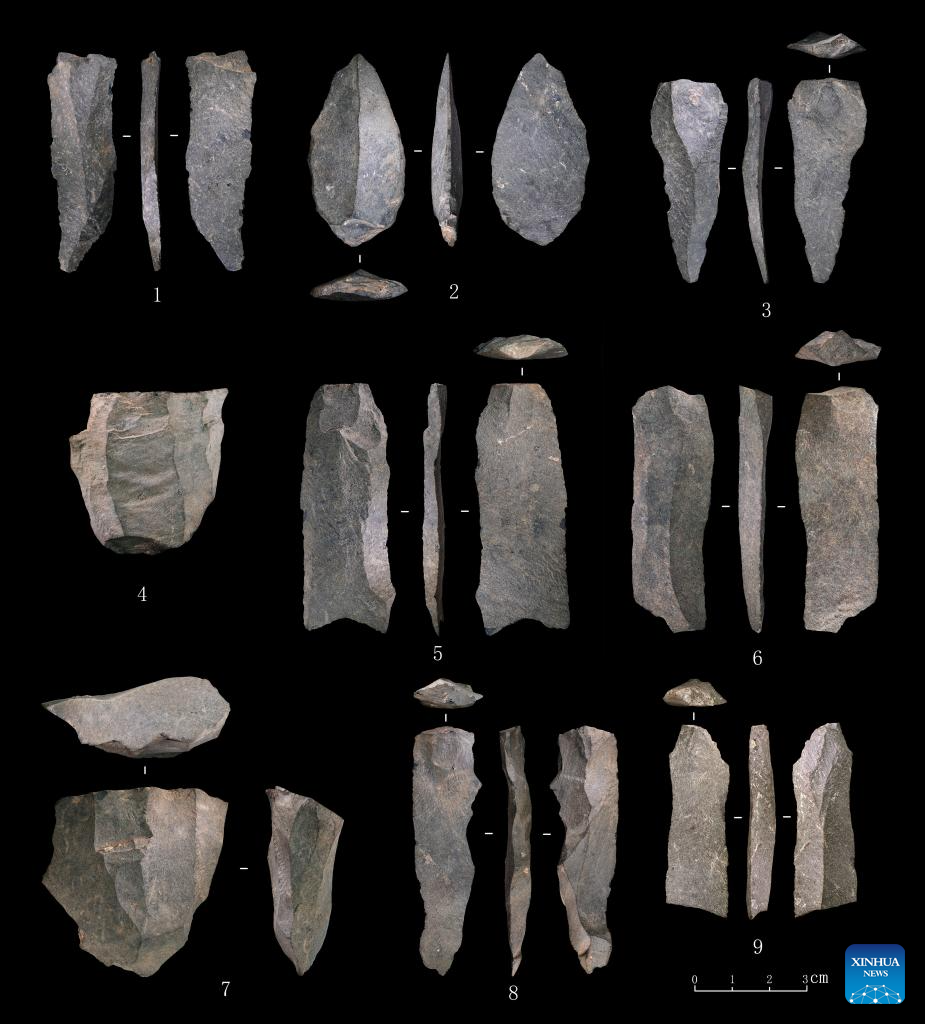
This undated file photo shows stone tool products featuring blade technology unearthed by the China-Kenya joint archaeological team at Kenya's Lake Bogoria site. A China-Kenya joint archaeological team has for the first time unearthed stone tool products featuring blade technology from the middle to late Paleolithic period at Kenya's Lake Bogoria site.
The discovery, announced at a conference on the 2025 archaeological results of central China's Henan Province held from Wednesday to Saturday, provides crucial material for studying the origins and spread of blade technology and its connection to early modern humans. (Xinhua)


