
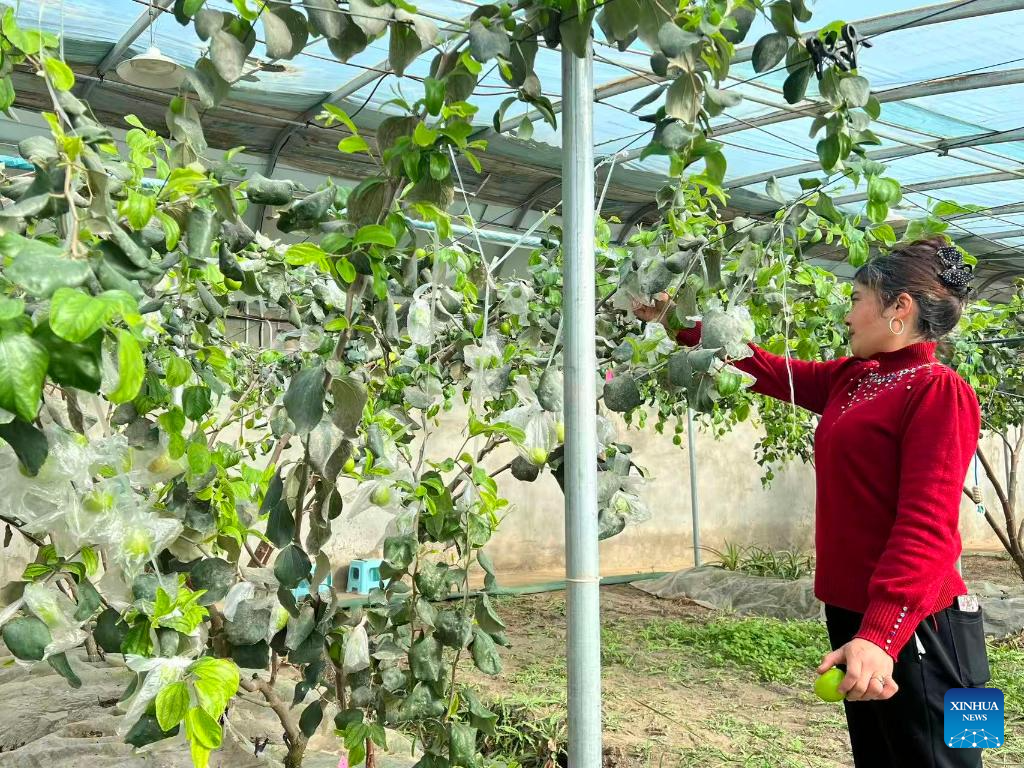
A villager works at a greenhouse in Ayimak village of Moyu County, Hotan Prefecture, northwest China's Xinjiang Uygur Autonomous Region, Dec. 13, 2025. (Xinhua)
URUMQI, Jan. 7 (Xinhua) -- In the depths of winter, rows of vibrant green watermelon vines climb trellises, heavy with fruit, while bunches of plump, dark grapes and red dragon fruits hang from branches inside greenhouses built on the southern fringe of the Taklimakan, China's largest desert.
Ayimak, a village in Moyu County, Hotan Prefecture of northwest China's Xinjiang Uygur Autonomous Region, is defying the season, creating a summer scene of abundance against the backdrop of frozen sand.
Referred to as "scientific fields" by local villagers, this cluster of greenhouses managed by a project team from the Chinese Academy of Sciences (CAS), has become a local winter spectacle, drawing visitors keen to see the thriving of off-season fruits amid the desert chill.
The CAS-led transformation traces back to 2015, and forms part of a rural revitalization project which has helped introduce high-value fruits and vegetables to southern Xinjiang.
Wang Shi, the first secretary of the village's Party committee, said that thanks to years of assistance, over 40 of the village's 122 greenhouses are currently contracted and managed by the CAS project team. More than 100 villagers have secured stable employment in these facilities, enjoying an average monthly income exceeding 3,000 yuan (about 429.8 U.S. dollars).
Wang Xin, from the CAS Xinjiang Institute of Ecology and Geography, said that compared to traditional open-field planting, the trellised watermelon planting method allows for higher density, greater yield and more sunlight exposure, thereby resulting in superior quality.
"Southern Xinjiang has abundant sunshine and heat resources, which are suitable for developing protected agriculture," Wang explained. These advantages are amplified through advanced agricultural technology, significantly boosting both the yield and sweetness of these fruits. The watermelons, hitting the market off-season, have already proven to be a commercial success.
Wang's team has contracted eight greenhouses, with seven dedicated to piloting different trellised watermelon varieties. Through these trials, they aim to identify the breeds best suited to the local climate and market preferences, with plans to expand to over 20 greenhouses.
Wang Ping, another member of the team, has led the pilot efforts of introducing more than 50 fruit varieties to Ayimak, including cherries, dragon fruit, winter jujube and pineapple.
"By continuously introducing superior fruit tree varieties, we select and cultivate those most suitable for local development," he said.
Pointing at ripening off-season grapes, Wang Ping revealed that these grapes haven't been promoted on a large scale yet. Notably, they can sell for up to over 30 yuan per kilogram on the market.
Over years of research, the team has tackled challenges like soil salinization, soil compaction and sand dust affecting the survival of fruit trees in this area, laying the groundwork for high-quality fruit production in southern Xinjiang.
Meanwhile, the project's effectiveness has become obvious. Villager Bayimai Abudouaini, employed in the greenhouses, said he has learned valuable cultivation skills through working with CAS experts, and hopes to contract his own greenhouse in the future.
He now earns a monthly salary of 4,000 yuan. "The job is right at my doorstep. I can take care of my family and increase my income," he said.
Such success is breeding new ambition. College-graduate Turantohti Abudouaini, for example, decided to return to the village instead of seeking city jobs. He has since participated in establishing an agricultural technology service cooperative in the county, which has contracted 14 greenhouses to date. He plans to nearly double the scale in the near future, eyeing farmers' growing demand for agricultural technology services.
Xinjiang has attached great importance to the development of protected agriculture, including smart farming. As of 2023, the region had more than 1.2 million protected agriculture units, involving a vegetable plantation area exceeding 44,600 hectares in total, according to the regional department of agriculture and rural affairs.
Yu Jingquan, an academician of the Chinese Academy of Engineering, said northwest China is suitable for the development of protected agriculture, as this region has abundant uncultivated land that can be used to increase scale and reduce costs.
In line with a work plan to promote modern protected agriculture in southern Xinjiang, jointly issued by the Ministry of Agriculture and Rural Affairs and Xinjiang's regional government in November 2025, the annual output value of protected agriculture in southern Xinjiang is projected to reach over 9 billion yuan by the end of 2028, creating jobs for more than 200,000 rural residents.
The young entrepreneur Turantohti and his partners have recently been busy installing warm-air blowers in their greenhouses, preparing for the blossoming of cherry trees.
"We will continue to expand in the future, helping more fellow villagers to work in the greenhouses," he said. "With national policy support and experts providing hands-on technical guidance, our protected agriculture will surely get better and better." ■

Tourists pick grapes at a greenhouse in Ayimak village of Moyu County, Hotan Prefecture, northwest China's Xinjiang Uygur Autonomous Region, Dec. 13, 2025. (Xinhua)


