

People visit the Mirabell Palace & Garden in Salzburg, Austria, Jan. 7, 2026. An Arctic blast has brought heavy snow and widespread ice across Europe, disrupting travel and public services across large parts of the continent. (Xinhua/He Canling)
BERLIN, Jan. 6 (Xinhua) -- An Arctic blast has brought heavy snow and widespread ice across Europe, disrupting travel and public services across large parts of the continent.
Airports and rail operators in several countries have reported cancellations and delays, while weather agencies warn that sub-zero temperatures and hazardous roads may persist in the days ahead.
SNOW, ICE, DEEP FREEZE
In the Nordic region, temperatures in northern Sweden and Finland fell well below minus 30 degrees Celsius over the weekend, with Sweden recording around minus 40 degrees in its far north. Heavy snowfall compounded wintry conditions across northern Europe.
The Baltics also faced freezing weather. Lithuania reported its coldest night in nearly two years on Jan. 1, with Salcininkai at minus 20.4 degrees. Latvia warned of renewed nationwide frost and accumulating snow, with temperatures ranging from minus 3 to minus 15 degrees.
Further west in Britain, amber cold weather alerts remain in force for England through Friday, with snow, ice, strong winds and heavy rain expected to bring further hazards later in the week. The coldest night of the winter so far was recorded in eastern England.
Across western and central Europe, the Netherlands issued a yellow alert for slippery roads, France placed 26 departments in the northwestern region under orange snow and ice warnings, and Germany reported widespread frost and icy conditions. Poland also issued multiple snowfall and frost warnings, expecting up to 25 cm of snow in southern regions and low nighttime temperatures to minus 18 degrees in parts of the country.
Further east and south, Romania, Hungary, Croatia and Bulgaria issued weather warnings for snow, freezing rain, strong winds and hazardous roads, with heavy snowfall forecast in several areas.
On Tuesday, Romania forecast precipitation totals of 10-40 liters per square meter in many areas, while Hungary is expecting total snow depth of 20-30 cm in southern areas by Wednesday morning.
In southern Europe, Italy issued orange and yellow weather alerts for more than 10 regions after reporting the coldest weather in about 15 years in the north. Spain said Storm Francis from the Atlantic brought heavy rain, strong winds and localized flooding, particularly in southern regions.
TRAVEL CHAOS, POWER OUTAGES
Heavy snowfall and plunging temperatures caused widespread disruption across Europe.
Transport was hit hard, with large parts of Sweden's rail network suspended and flight disruptions in Finland's Lapland prompting authorities to intervene after unrest among stranded passengers. In Britain, Eurostar advised travellers to delay journeys between London and the Netherlands, while airports reported cancellations and delays.
France saw severe congestion in the Paris region, where traffic jams exceeded 1,000 km, and airlines were ordered to cut flights by 15 percent at the capital's two main airports. In the Netherlands, KLM cancelled nearly 300 flights scheduled for Tuesday, while rail services were reduced. Strong winds disrupted flights in Italy, and heavy rain and flooding affected transport in parts of southern Spain.
Power outages were reported in several countries, with thousands of households left without electricity in Sweden, more than 9,000 subscribers affected in Romania and over 40,000 families in Bosnia and Herzegovina.
Schools were closed in parts of Lithuania and across Scotland, while Latvia said it was expanding emergency accommodation for homeless people as temperatures plunged.
One death was reported in Bulgaria after a tree fell onto a moving car, killing a 31-year-old woman on Saturday in the Vitosha Mountains.
POLAR AIR, ATLANTIC LOWS
Meteorologists have attributed the plunging temperatures to a southward surge of polar air, driven by large-scale circulation shifts, setting the stage for repeated wintry outbreaks across Europe.
The German Weather Service said a low-pressure system over northern Europe and a broad high-pressure area to the northwest and west have combined to funnel very cold air steadily into the country.
The World Meteorological Centre in Beijing noted in an international bulletin that the early-January snowfall from Northern Europe to Central and Eastern Europe is linked to an upper-level cold vortex system, with Lithuania in the most-affected area.
The key driver of snowfall and ice is where that cold air interacts with moisture-bearing systems, according to experts. A high-pressure system (anticyclone) is drawing cold air south from northern Europe, while a Mediterranean low-pressure system (cyclone) is circulating moist air over the region -- creating ideal conditions for snowfall, Croatian meteorologist Damjana Curkov Majaros said.
As a result of the combined effects, Hungary will expect continued snowfall in several waves, with freezing rain possible in eastern and southeastern regions before transitioning back to snow. In Spain, meteorologists and climate experts said a strengthened Atlantic low interacting with southward-moving cold air helped drive intense rainfall, bringing continued risks of flash flooding and secondary hazards. ■

People walk at the Mirabell Palace & Garden in Salzburg, Austria, Jan. 7, 2026. An Arctic blast has brought heavy snow and widespread ice across Europe, disrupting travel and public services across large parts of the continent. (Xinhua/He Canling)

A man poses for a photo at the Mirabell Palace & Garden in Salzburg, Austria, Jan. 7, 2026. An Arctic blast has brought heavy snow and widespread ice across Europe, disrupting travel and public services across large parts of the continent. (Xinhua/He Canling)
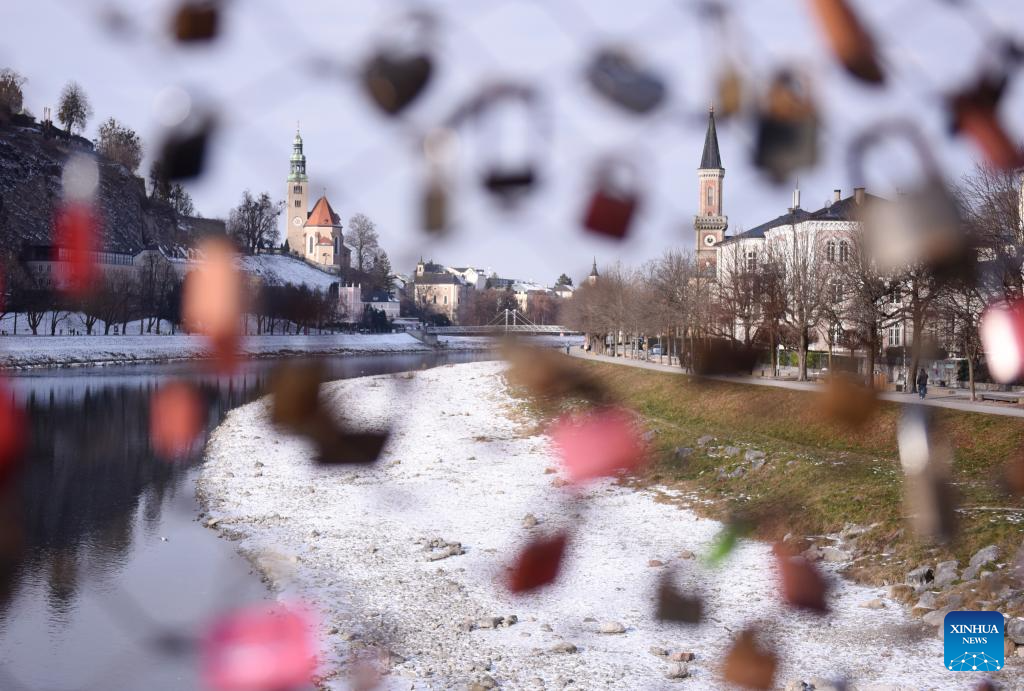
This photo taken on Jan. 7, 2026 shows a snow view in Salzburg, Austria. An Arctic blast has brought heavy snow and widespread ice across Europe, disrupting travel and public services across large parts of the continent. (Xinhua/He Canling)


