
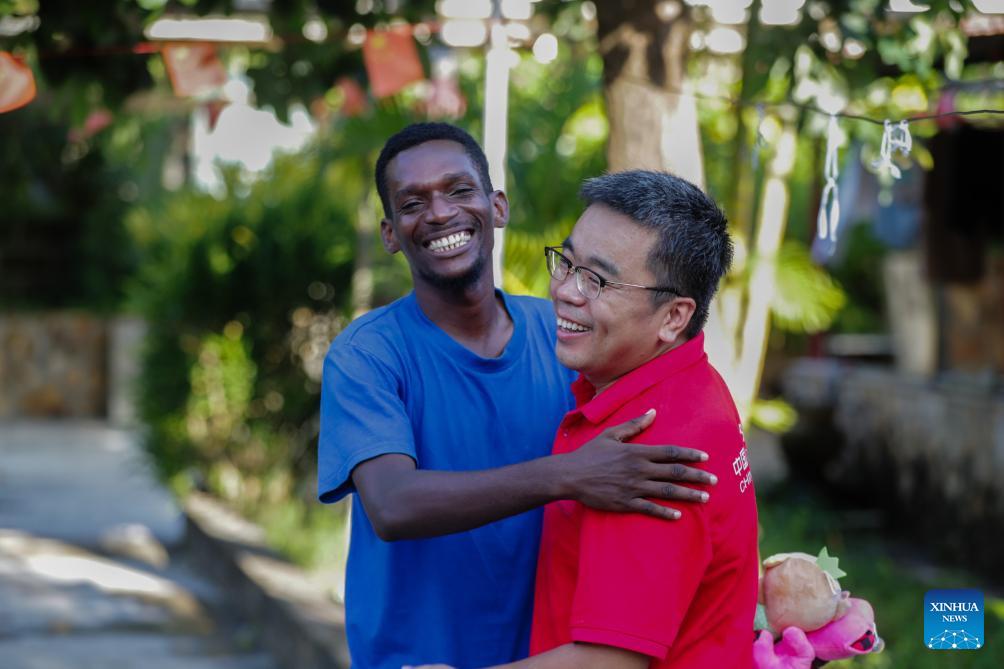
Tanzanian doctor Harun Maisara Mahkum (L) hugs He Zhilong, an otolaryngologist with the 35th Chinese medical team in Zanzibar, in Abdulla Mzee Hospital on Pemba Island, Zanzibar, Tanzania, on Jan. 1, 2026. (Xinhua/Emmanuel Herman)
by Xinhua writers Hua Hongli, Lin Guangyao, and Lucas Liganga
ZANZIBAR, Tanzania, Jan. 6 (Xinhua) -- Harun Maisara Mahkum is now happier and more confident than ever, after he independently extracted a coin from the esophagus of a two-year-old boy in Abdulla Mzee Hospital on Pemba Island, in Tanzania's Zanzibar.
The procedure, the first for 30-year-old Mahkum, was conducted under the guidance of He Zhilong, an otolaryngologist with the 35th Chinese medical team in Zanzibar.
Behind it is a story of courage, mentorship, and international collaboration.
When the toddler was whisked to the state-run hospital on the evening of Nov. 4, 2025, more than 48 hours had elapsed since he ingested a 50-shilling coin, slightly smaller than a standard soda plastic bottle cap yet thick enough to block a child's narrow esophagus.
In pain and unable to swallow, the boy was in grave danger.
For Mahkum, the case was not only a test of medical skill but also a defining moment in his career.
Foreign body ingestion in children is a common yet dangerous emergency. Coins, batteries, and small toys often become lodged in the esophagus, where they can cause severe complications, Mahkum said.
On Pemba Island, such cases traditionally required transferring patients to larger hospitals or waiting for visiting specialists, delaying urgent care and heightening risks. But on that November evening, the presence of the Chinese medical team changed everything, he added.
"I was nervous," Mahkum admitted in an interview with Xinhua.
"This was my first time performing this type of surgery. But Doctor He trusted me to lead. He guided me step by step," he said. "I learned so much in that moment. I am deeply grateful for his mentorship."
Minutes after Mahkum called him about the emergency, He rushed to the hospital, with his esophagoscope and surgical kit.
Together, they prepared the child for anesthesia and positioned the instruments.
The procedure was delicate, and the toddler's small anatomy and the coin's rough edges made every movement critical.
Under Doctor He's guidance, Mahkum finally extracted the coin, to the relief of all in the operating room. Nurses and anesthetists exchanged quiet smiles, knowing a life had been saved.
For Mahkum, the coin became more than a surgical artifact. It reflects the transformative power of mentorship.
"This surgery was not just about removing a coin, and it was about gaining confidence, mastering a skill, and proving that we can care for our patients independently," he said. "Doctor He taught me patience, precision, and trust in my own abilities."
"Before the Chinese doctors came, we could not perform surgeries like this on our own. We depended on outside specialists. Now, I can act immediately in emergencies," Mahkum said.
"It is empowering, and it changes the way we serve our community," he added.
China sent its first medical team to Zanzibar in 1964 and to the Tanzanian mainland in 1968. To date, 27 medical teams have served the mainland and 35 in Zanzibar, treating nearly 20 million patients and helping local hospitals fill technical gaps.
The 35th Chinese medical team to Zanzibar arrived last September, with a total of 24 members. In addition to otolaryngology, the team includes specialists from general surgery, orthopedics, respiratory medicine, cardiology, traditional Chinese medicine, medical imaging and other disciplines.
Since joining Abdulla Mzee Hospital eight years ago, Mahkum has worked closely with successive Chinese medical teams. He has learned procedures ranging from tonsillectomies to advanced endoscopic surgeries.
Each lesson built his confidence, preparing him for the moment when he would save a child's life with his own hands.
For 45-year-old He, the success was equally meaningful: "Our goal is not just to treat patients but to train local doctors to perform complex procedures themselves."
"By providing step-by-step guidance, demonstrations, and supervision, we aim to build a sustainable medical workforce here in Zanzibar," he added. "By empowering local doctors, we ensure patients are treated safely long after we depart."
Mentorship is the cornerstone of the Chinese medical mission. Doctors like He provide practical, hands-on teaching on instrument handling, anesthesia protocols, patient positioning, and post-operative care.
Structured training programs have expanded beyond esophageal procedures. Chinese doctors teach nasal endoscopic surgery, laryngeal operations, and other ENT techniques tailored to local needs.
Over time, these programs aim to establish a robust network of skilled surgeons capable of handling diverse cases independently.
They would rehearse procedures repeatedly until local colleagues are confident enough to proceed. "It is not just about surgery," He said. "It is about building resilience and independence."
Thanks to Chinese medical teams' long-term mentorship, local doctors can now better respond to emergencies without always waiting for outside assistance.
Families across Pemba and Unguja islands can now count on faster, safer care. Anxiety is reduced, outcomes are improved, and trust in local healthcare grows stronger, Zanzibarian health authorities said. ■


