
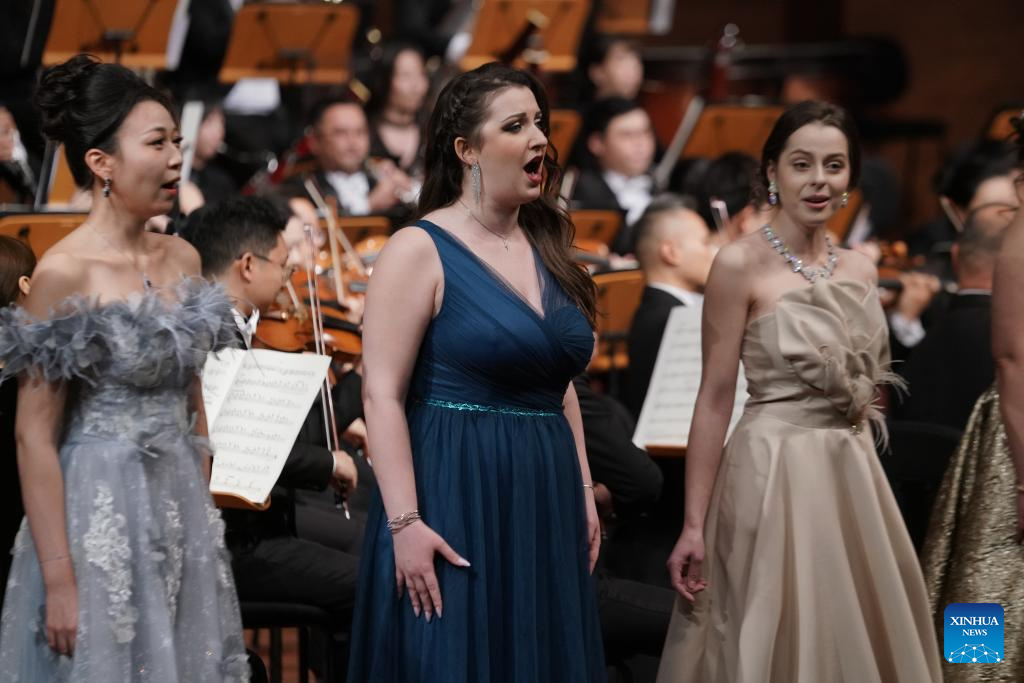
Italian mezzo-soprano Erica Cortese (C) sings during the concert in Guiyang, southwest China's Guizhou Province, Dec. 5, 2025. (Guiyang Symphony Orchestra/Handout via Xinhua)
GUIYANG, Dec. 9 (Xinhua) -- For Italian mezzo-soprano Erica Cortese, 31, the greatest challenge in performing Chinese Tang Dynasty (618-907) poetry in a symphonic song was not only the language but also the intense emotions she experienced.
"The music is so beautiful, so passionate that every time we started the concert, I got overwhelmed. I got emotions so strong that I wanted to cry," she said after last Friday night's concert in Guiyang, capital of southwest China's Guizhou Province.
Titled "Echoes of Ancient Tang Poems," the performance was a collaborative effort between the iSING! Festival, a grassroots singing festival focused on cultural exchanges, and the Guiyang Symphony Orchestra. It featured 15 young vocalists from six countries, including China, the United States, and Italy, who performed over 10 Tang Dynasty poems in Chinese.
Tang Dynasty poems represent the crown jewels of ancient Chinese poems. They often explore themes of natural imagery, historical reflections, friendships and solitude with profound beauty and rhythmic elegance. For Western singers, performing the millennia-old poetry, set to contemporary compositions, proved to be an intense, almost cinematic experience.
"Every time I listened to or sang this, I could almost make a movie in my head because the music is so good. It's really descriptive of the words and of a situation," said Cortese, who has studied Italian opera for over a decade. She joined the program in August 2024, drawn by its fusion of music and cross-cultural exploration.
Fusion, however, presents challenges and requires extra efforts for artistic perfection. "The pronunciation, the procedure and the legato are very different from the Italian Bel Canto," she explained. "I even need to get into a different mindset."
Her solo piece, "Sending off to Du Shaofu," adapted from the Tang poet Wang Bo's poem that captures the sentiment of parting with a friend, became her favorite due to its "blend of Asian and European ideas."
American baritone José Rubio, who first came to China in 2014 and joined the program in 2020, spoke of his opportune encounter with China's Tang poetry. "I was unfamiliar with Tang poetry until this program, and ever since then, I've been fascinated. It's a cultural beauty," he told Xinhua.
The beauty lies primarily in its simplicity. "There is such a simplicity to it. The poems are only a few lines long, yet they are incredibly impactful," Rubio said, highlighting the lasting cultural significance that Tang poetry has held throughout history.
Recalling the thrill of opening with legendary Chinese poet Li Bai's "Bring in the Wine," Rubio said, "There's so much joy and excitement starting the concert this way with the words of Li Bai."
The mastery did not come easily. Preparation involved months of intensive study. In addition to attending video meetings to improve pronunciation and reciting the entire poem, Rubio said it was also of utmost importance to understand the poet's context. "You have to see the mountains and grasp the significance of all the different elements mentioned in the poem," he added.
This Guiyang concert is part of a broader international tour. The same performance was previously staged in cooperation with the Philadelphia Orchestra in New York and Philadelphia, respectively. "The tickets were sold out, and the audience loved it. It's something new and beautiful," Rubio said, reflecting on the warm reception from American audiences.
Tian Haojiang, the concert's artistic director, highlighted the program's dual mission: training Western singers to perform in Chinese and nurturing Chinese singers for international stages. To date, the iSING! program has welcomed over 400 vocalists from nearly 40 countries to China for both performance and learning opportunities.
For the performers, the connection forged with the Guiyang audience was profound. "It gave instant joy to perform for an audience like that. I saw people touched by what we were doing. It created a very deep connection," Cortese said.
The concert hall was packed. "I brought my daughter here because she's familiar with these Tang poems. The singers performed them so beautifully in Chinese. This was truly an extraordinary experience," said an audience member surnamed Chen. ■
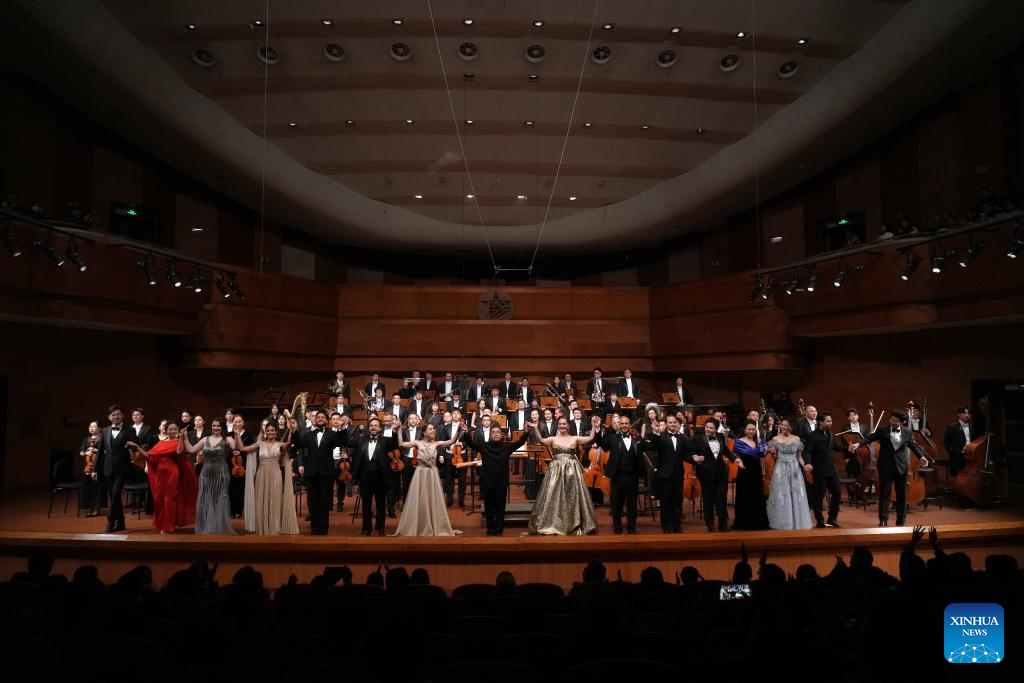
Artists take a curtain call after the performance in Guiyang, southwest China's Guizhou Province, Dec. 5, 2025. (Guiyang Symphony Orchestra/Handout via Xinhua)


