
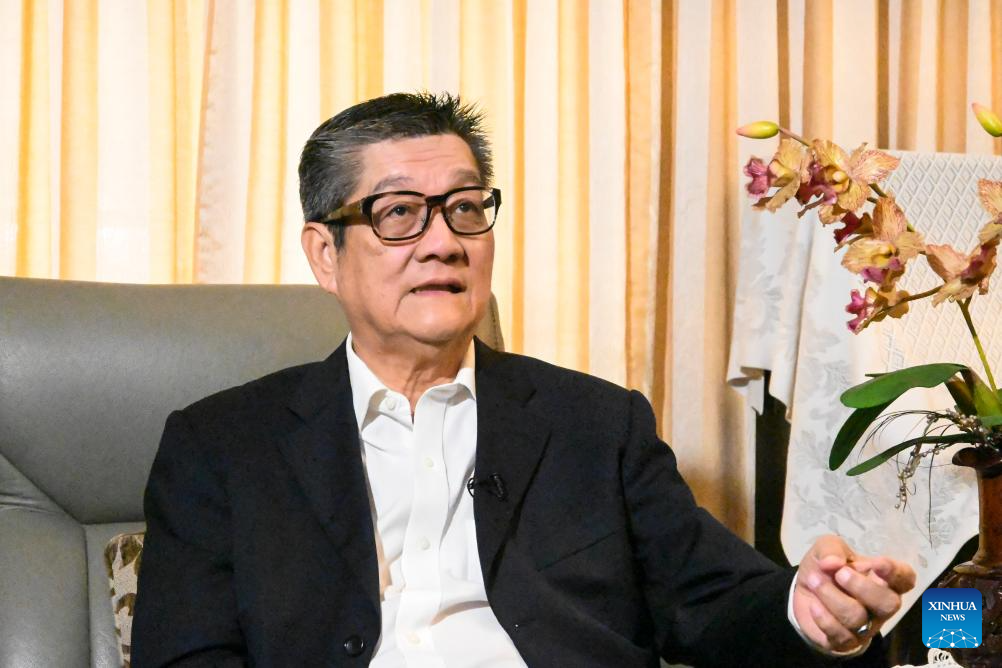
Koh King Kee, president of the Center for New Inclusive Asia, a Malaysian non-governmental think tank, speaks during an interview with Xinhua in Selangor state, Malaysia, Nov. 27, 2025. (Xinhua/Wang Jiawei)
KUALA LUMPUR, Dec. 1 (Xinhua) -- China's experience in rural development and targeted poverty reduction provides important lessons for the developing countries, Koh King Kee said in a recent interview with Xinhua.
Koh, president of the Center for New Inclusive Asia, a Malaysian non-governmental think tank, recently visited several rural revitalization and poverty alleviation sites in China.
"China's poverty alleviation focuses on training and capacity-building to help villagers with long-term livelihood skills. This is extremely important and exactly what many developing countries need," Koh said.
He noted that China integrates industrial development, human capital building and grassroots governance into its poverty reduction efforts, with an emphasis on enhancing communities' long-term development capacity.
"This enables poverty alleviation programs to deliver quick results while remaining sustainable," he added.
Koh, who has visited China since the late 1980s, said the transformation he has witnessed over the decades is truly impressive. He believes China's ongoing efforts to narrow income gaps and advance common prosperity offer valuable insights for developing countries.
He also underscored the significance of China's green development. "Poverty alleviation must not come at the cost of environmental degradation."
Looking ahead, Koh sees significant potential for China-Malaysia cooperation in poverty reduction. Malaysia, a tropical country prone to soil erosion and environmental pressures, could benefit from China's green development concepts and technological solutions, he noted.
"Many countries tend to distribute funds without establishing a full process for follow-up, assessment and sustainability. What China has done is the opposite: It is structured, sequenced and coherent. This is something truly worth learning," Koh said. ■


