
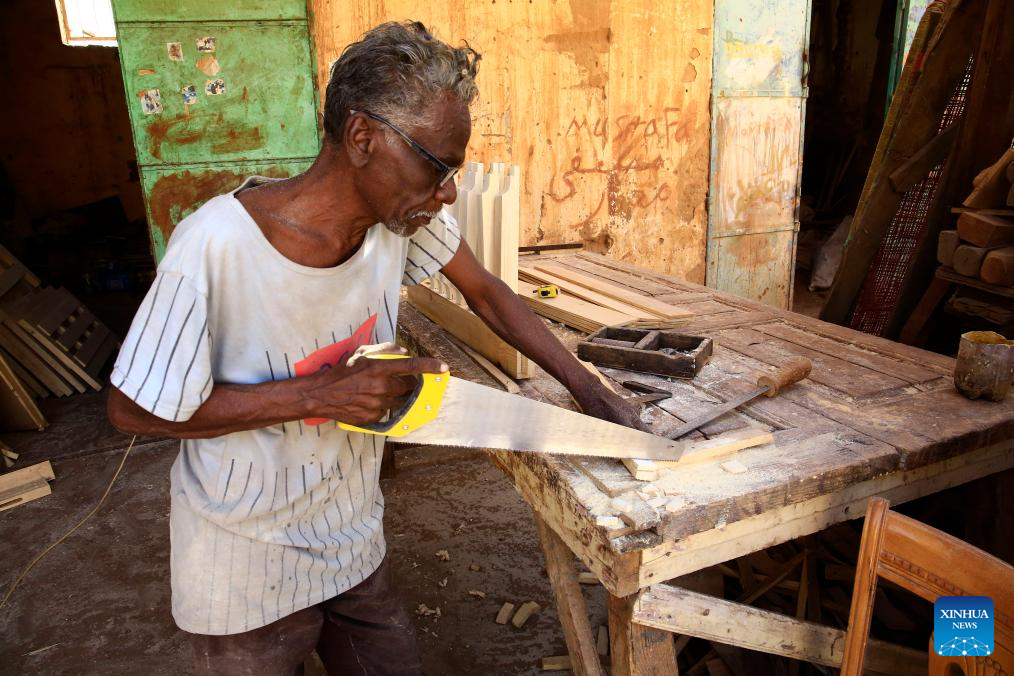
An artisan makes a wardrobe in Al-Thawra Neighborhood, Omdurman, Sudan, Oct. 28, 2025. (Photo by Mohamed Khidir/Xinhua)
KHARTOUM, Nov. 10 (Xinhua) -- In the shattered landscape of Sudan's Khartoum State, where factories stand as hollowed shells and streets bear the scars of conflict, a quiet revival is taking shape. From metal workshops to sewing rooms, artisans are reclaiming their livelihoods, one handmade piece at a time.
Across the central Sudanese state, the sounds of hammers and sewing machines now echo where gunfire once dominated. These modest workshops, often little more than repurposed ruins, have become centers of both survival and resilience.
In the city of Omdurman city, Mohamed Abdul Qader, once a skilled worker in a metal furniture factory, now crafts simple doors in a workshop built from the remnants of his old workplace.
"This little space keeps me alive," he said, bending over a heated piece of iron, with sweat streaking his face. "These are the tools I pulled from under the rubble -- and they still work."
Not far away, Fatima Al-Tahir, once a seamstress in a bustling factory, now sews for her neighbors and displaced families in a small self-made atelier.
"I sew to survive, for my children, and so that I do not forget who I once was," she said softly behind a sewing machine, her little daughter playing with bright fabric scraps in the corner.
The determination extends to the cities of Khartoum and Khartoum North. In Al-Haj Yousif neighborhood, Abdullah Hussein, once a technician in an aluminum plant, now repairs windows in a dim workshop powered by a small generator.
"The factories have vanished, yet we build again, piece by piece -- with bare hands and shared tools, drawing light from humble generators to keep our work alive," he said.
Meanwhile, in Kober neighborhood, 50-year-old carpenter Abdul-Muttalib Abdul-Majid restores wooden furniture salvaged from the ruins. Behind him lie simple tools -- a hand saw, a hammer missing its handle, and nails gathered from here and there.
"The war took everything," he said. "Now it's just me, my son, and the wood we find among the ruins. Carpentry is my life -- every plank holds a story."
To economics professor Al-Tayeb Al-Hassan, these humble efforts have reflected something larger than survival.
"These workshops represent the roots of a productive shadow economy," he said. "They show how Sudanese society adapts, rebuilding the economy from the bottom up -- from individuals and small groups who refuse to surrender."
According to recent data, Sudan's poverty rate has surged from 21 percent to 71 percent since conflict erupted between the Sudanese Armed Forces and the paramilitary Rapid Support Forces in April 2023. The war has killed tens of thousands and displaced millions, with a late October report by the International Organization for Migration (IOM) showing Khartoum State alone accounting for over 3.77 million displaced persons.
Yet signs of return are emerging. The IOM report showed that more than 1 million people have returned to Khartoum State between November 2024 and September 2025, though this represents just 26 percent of those displaced from the state.
"The scale of return to Khartoum is both a sign of resilience and a warning," a news release by IOM on Oct. 27 quoted the organization's Deputy Director General for Operations Ugochi Daniels as saying.
"I met people coming back to a city still scarred by conflict, where homes are damaged and basic services are barely functioning. Their determination to rebuild is remarkable, but life remains incredibly fragile," Daniels said after her Sudan visit.
In the meantime, food security remains critical throughout the country, with 21.2 million people, 45 percent of Sudan's population, facing high levels of acute food insecurity in September, according to a Nov. 3 report by the Integrated Food Security Phase Classification.
Still, in Khartoum's markets and makeshift workshops, the rhythm of recovery continues. As Al-Hassan noted: "When institutions collapse, people return to craftsmanship. These workshops -- this human resilience -- are the true heartbeats of reconstruction." ■
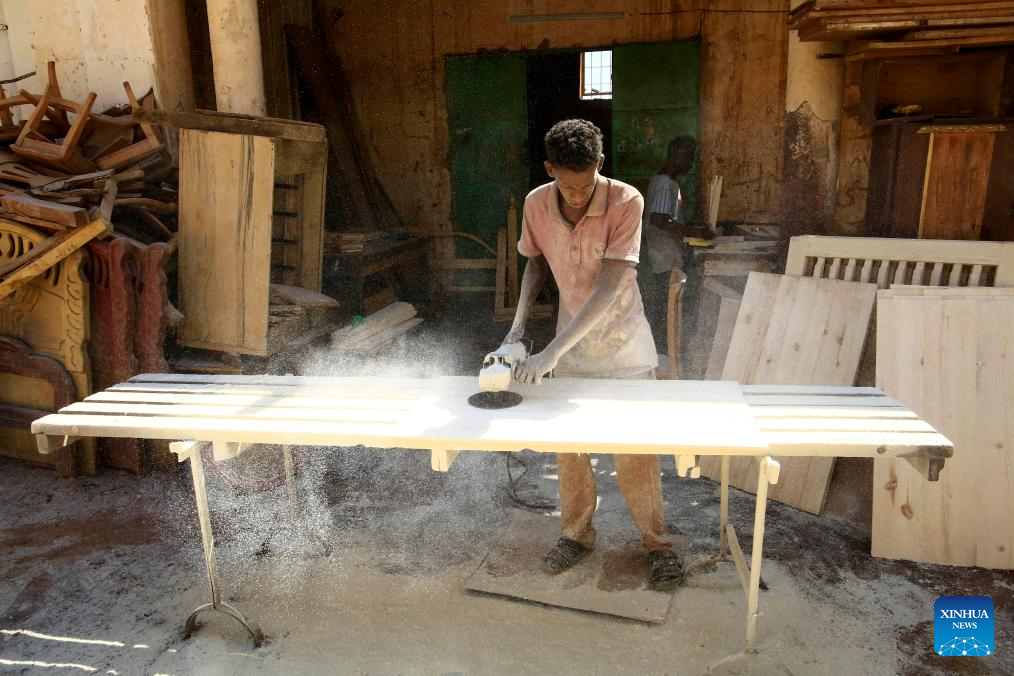
An artisan makes a wardrobe in Al-Thawra Neighborhood, Omdurman, Sudan, Oct. 28, 2025. (Photo by Mohamed Khidir/Xinhua)


