
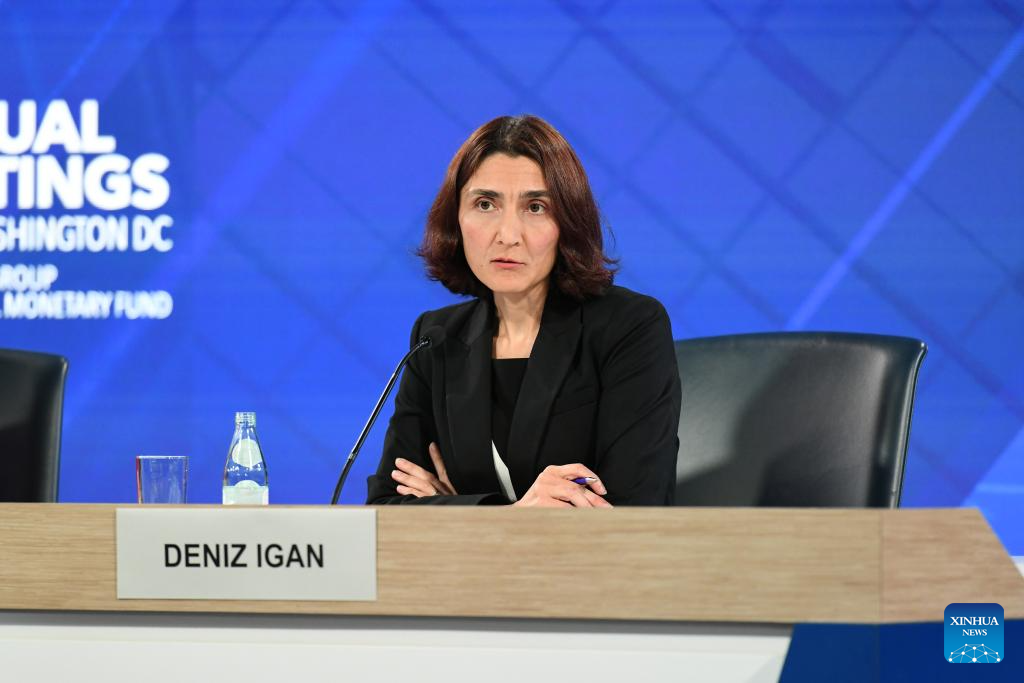
Deniz Igan, chief of the IMF Research Department's World Economic Studies Division, speaks at a press briefing on World Economic Outlook in Washington, D.C., the United States, Oct. 14, 2025.(Xinhua/Li Rui)
by Xiong Maoling, Xu Jing
WASHINGTON, Oct. 15 (Xinhua) -- Artificial intelligence can boost economic efficiency and productivity, but it could also adversely affect the labor market if governments fail to introduce the right policies, an International Monetary Fund official said Tuesday.
"Assuming no policy reaction, if we just let AI run wild, it can have a negative impact on the labor market," Deniz Igan, chief of the IMF Research Department's World Economic Studies Division, told Xinhua in an interview during the ongoing 2025 Annual Meetings of the World Bank Group and the International Monetary Fund.
Currently, companies are adopting AI to reduce headcount, Igan said, while noting that it doesn't necessarily have to be that way.
"Instead of substituting labor, AI can actually be complementary to what people can do. It can make workers faster, more productive, more efficient," she said. "If that happens, then firms will actually adopt AI, and along with it, they will hire more workers."
According to the IMF's newly released World Economic Outlook report, today's surging investment in AI echoes the dot-com boom of the late 1990s, which could pose a potential downside risk to the global economy.
Igan said that with every innovation, new technology, there is some "exuberance."
"Our concern is that we may be approaching that phase where we are in the boom environment, and there's going to be a realization that the expectations on how much productivity gains AI can deliver are going to be disappointed. And if that happens, then there's going to be a correction of the current valuations that we are seeing in the market," she said.
"Perhaps the good news is that if the technology that we're thinking about is really transformative, that can increase productivity in the long run, then this is just going to be a correction," she added.
The latest report raised its 2025 global growth projection to 3.2 percent, 0.2 percentage points higher than the July forecast, while noting that the tariff shock is further dimming growth prospects.
"The underlying force for this strong performance itself is this front-loading by households and businesses in anticipation of higher tariffs. But the upgrade is only part of the story," Igan told Xinhua. "So there is front-loading of trading, and next year might be weaker."
According to the report, global trade volume is expected to grow 3.6 percent this year and will slow to 2.3 percent in 2026.
In the report, the IMF highlighted headwinds from uncertainty, noting that prolonged policy uncertainty could dampen consumption and investment.
"What has happened in the current environment is that uncertainty itself has been moving so much," Igan noted. "The full impact of uncertainty itself has not started biting. So we believe there's still going to be in the pipeline of that impact coming."
The IMF official also noted that how fast an economy can potentially grow depends on the capital, labor and technology it has available. In the current environment, these resources may decline, which could push down potential output.
"Currently, what we are seeing is, in some economies in particular, changes in the labor components. Take the U.S., with more immigration restrictions, the labor force is going to decline. So because there are fewer people, there are going to be fewer products in the economy," she said.
Igan also noted that fragmentation is increasing trade barriers, restricting capital flows, and limiting technology diffusion.
IMF research has estimated that global economic output would be 7 percent lower in the long run. "Fragmentation makes all countries poorer," she said.
However, the situation could be even more challenging for emerging markets and low-income economies.
"Through trade, emerging market economies and lower-income economies have this technology diffusion that helps them increase their productivity and catch up, converge to their richer peers. But if that's not happening, then they would fall behind, so they will suffer much more in that environment," she said. ■


