
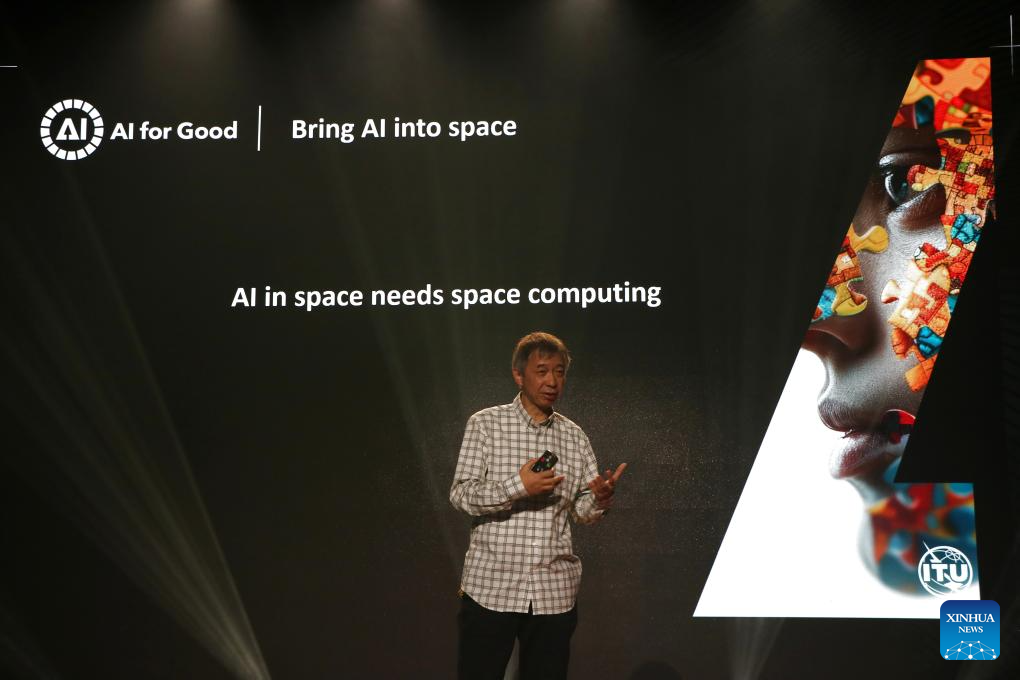
Wang Jian, an academician of the Chinese Academy of Engineering, also director of China's Zhejiang Laboratory, addresses during the AI for Good Global Summit 2025 in Geneva, Switzerland, July 11, 2025. (Xinhua/Wang Qibing)
by Xinhua writer Wang Qibing
GENEVA, July 12 (Xinhua) -- Wang Jian, an academician of the Chinese Academy of Engineering, dressed in a plaid shirt and sneakers, stood confidently under the spotlight, addressing a global audience both in-person and online.
On July 11, 2025, Wang Jian, also director of China's Zhejiang Laboratory, took the center stage of the AI for Good Global Summit 2025 in Geneva.
In a 20-minute English speech titled "Computing and AI: Endless Frontiers and Exploration", Wang showcased two groundbreaking scientific models from his Lab -- GeoGPT and OneAstronomy. These projects exemplified the lab's pioneering efforts in "AI+Science," captivating leading minds in artificial intelligence worldwide.
To illustrate how AI can revolutionize scientific exploration, Wang directed the audience's attention to a screen behind him. "This is a paper published almost 10 years ago by a geologist," he explained. "What they need is very simple: be able to share all the research data about rocks, all the research results, and the infrastructure they could do the work together."
In response to these demands, Chinese scientists, alongside 13 international organizations, launched the Deep-time Digital Earth (DDE) International Big Science Program in 2019 to create a global platform for earth science data sharing.
Inspired by DDE's vision, three years ago, Wang's team initiated GeoGPT -- an AI system tailored for Earth sciences.
"It turned out to be very helpful for the scientists around the world," Wang said. The platform now supports over 40,000 scientists across 135 countries and was honored as a 2025 "AI for Good Innovate for Impact" use case, earning the International Telecommunication Union's Outstanding Innovation Practice Award.
The stage backdrop shifted to an image of the Apollo Guidance Computer from 1971, as Wang transitioned to space computing. "Apollo 11 was the first spacecraft to carry integrated circuits into space, with a guidance computer containing just 16,536 transistors," he said.
This set the stage for his next revelation: the "Three-Body Computing Constellation," a thousand-star-scale space computing infrastructure developed by Zhejiang Lab and global partners. In May 2025, the project's first milestone was achieved with the successful launch of 12 computing satellites, marking a leap toward in-orbit computing and AI model deployment in space.
At the summit, OneAstronomy -- an AI model for astronomy developed with the National Astronomical Observatories of the Chinese Academy of Sciences -- was also recognized as a 2025 "AI for Good Innovate for Impact" use case.
"I've been working on cloud computing for a long time, and finally realized actually all the cloud computing we're talking about is actually on the ground," said Wang, the founder of Alibaba Cloud. "And this is the first time we really put the computing in the inner space. We have three kinds of satellites -- communication, navigation, and observation, and now we could have the fourth type of satellites, which I call the computing satellites."
Wang emphasized that computing and AI are vital for humanity's journey into deep space.
Wang said the new type of satellite system was named the "Three-Body Computing Constellation," inspired not just by a science fiction novel but by Newton's complex three-body problem, symbolizing the challenges of cooperation.
"But we want to make sure, even though it's hard, we want to do that," he said. ■
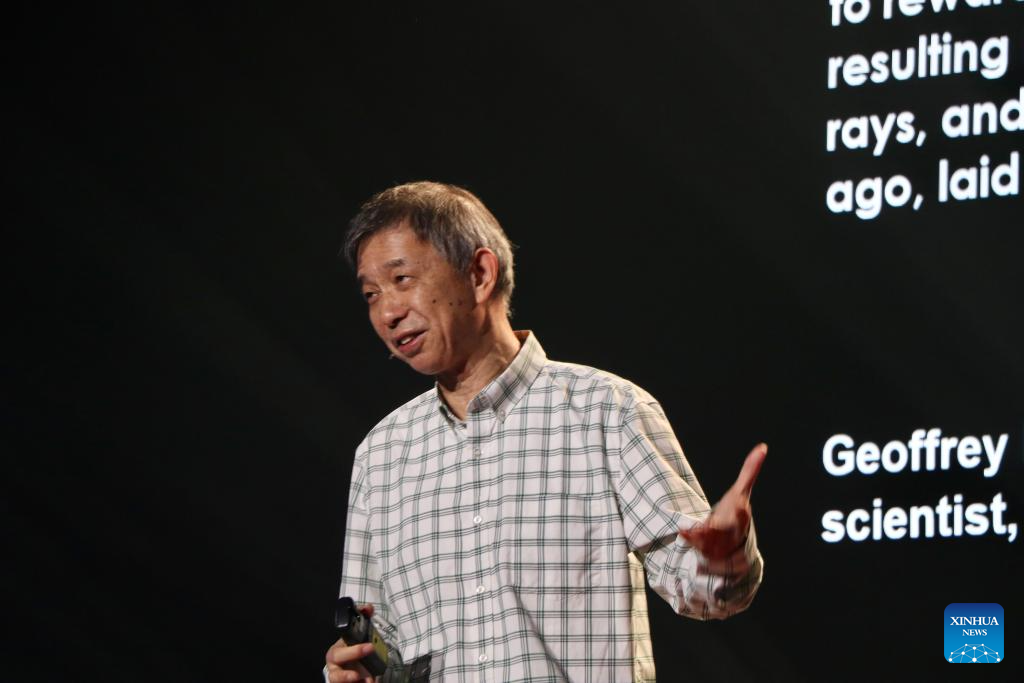
Wang Jian, an academician of the Chinese Academy of Engineering, also director of China's Zhejiang Laboratory, addresses during the AI for Good Global Summit 2025 in Geneva, Switzerland, July 11, 2025. (Xinhua/Wang Qibing)
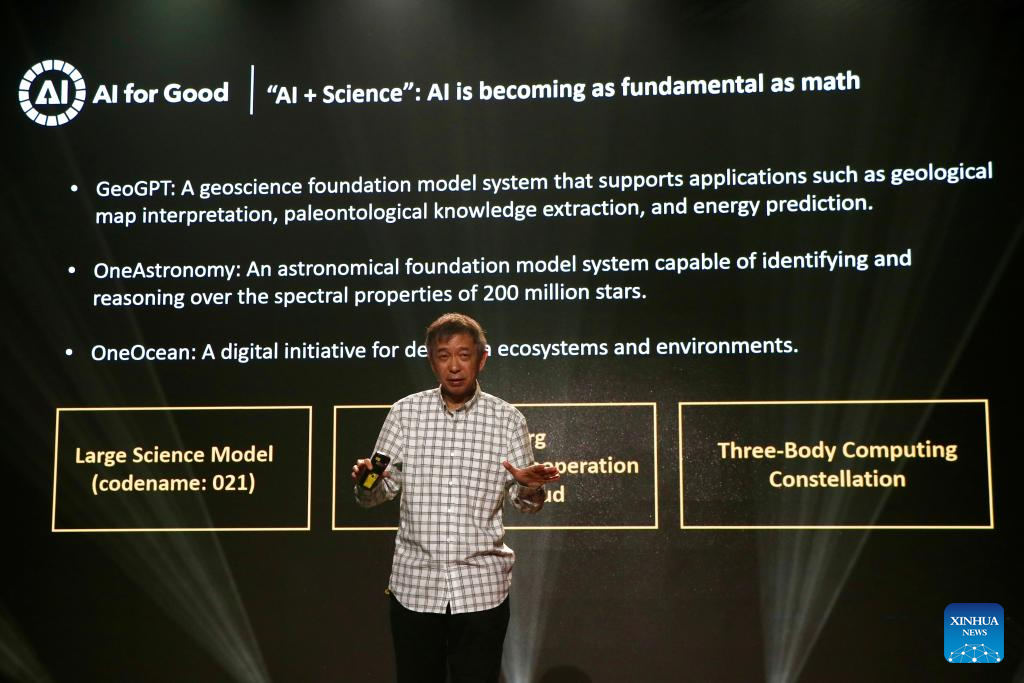
Wang Jian, an academician of the Chinese Academy of Engineering, also director of China's Zhejiang Laboratory, addresses during the AI for Good Global Summit 2025 in Geneva, Switzerland, July 11, 2025. (Xinhua/Wang Qibing)


