
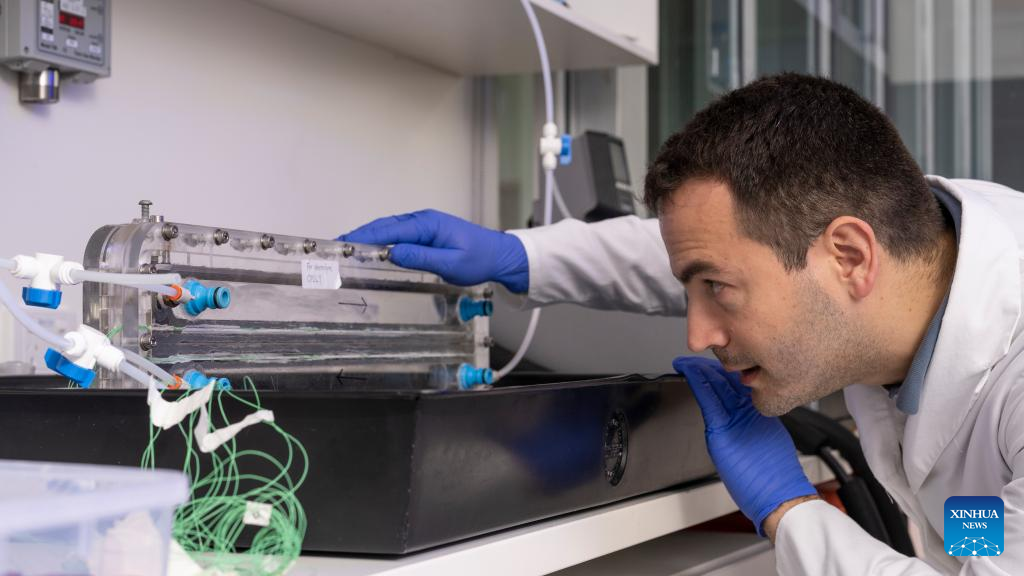
Associate Professor Juan Felipe Torres from the Australian National University (ANU) conducts experiments to extract valuable materials from brine deposits at ANU in Canberra, Australia, May 10, 2024. (Photo by Jamie Kidston/Xinhua)
CANBERRA, July 9 (Xinhua) -- Australian scientists have developed an eco-friendly technique to extract valuable materials, such as lithium for batteries, from brine deposits.
Unlike conventional methods that use electricity and expensive membranes, this process uses moderate heat from sunlight or industrial waste to reduce energy use and environmental impact while conserving water, according to researchers at the Australian National University (ANU).
Brine mining is a major source of lithium, a key material for battery production. The method promises a more sustainable and efficient approach to lithium extraction for battery production, said an ANU statement released Tuesday.
The method concentrates brine without evaporation, conserving water and land by eliminating the need for large evaporation ponds. It efficiently separates water from ions, with potential for much greater speed and energy efficiency, according to the findings published in the London-based journal Nature Water.
"Our goal is to replace traditional evaporation ponds, a technology that is thousands of years old, and instead of using vast amounts of land area and water resources, we can do the job with a much-reduced environmental footprint," said the study's Lead Chief Investigator Juan Felipe Torres from the ANU.
This method could enhance future lithium extraction from brine for battery production, Torres said.
The ANU team, together with U.S.-based Wacomet Water Co, is commercializing the technology worldwide through their spin-off, Soret Technologies, to advance sustainable lithium extraction from brine, he said. ■


